This might be even more incoherent than my usual drivel. I have actually managed
to have some time off and went to Edinburgh to visit some friends as well as
relax and visit the Outlaws. A very nice relaxing time in all and a few very
nice expensive meals as well. I have just arrived back home having driven 250
miles and am trying not to disappoint all you
suckers lovely people who, for some reason, keep reading
my rubbish.
I had bought a few new twisty puzzles some weeks ago to try and catch up with
the backlog of new toys that have come out and are being shown off by the
return of Rline to
YouTube. Amongst them was this Clover Pyraminx, a tetrahedral version of the edge
turning Clover puzzles I have
reviewed before.
I love edge turning twisty puzzles for several reasons...primarily because a
lot of the solve process for them tends to be very intuitive right up to the
very end game and also because they shapeshift and jumble, taking parts out of
their natural orbits and often leaving all sorts of fearsome looking
"sticky-out bits".
After just 4 moves!
Having seen the frightening shapeshifting, I quickly went back to the beginning
and did my usual first approach for these and attempted a non-shapeshifting
scramble using entirely 180º turns. It is a lovely turner but you do need to
watch your thumbnails as the edges get caught and attempt to rip your nails off
(YeeeeOuch!). It doesn't take long to get a nice mixed up puzzle and as expected
the solve is a pleasant logical one of performing 3-cycles on the petals until
they are all in place again. To you non-twisty puzzlers it sounds impossible but
it really is just pure logic. The first 2 times that I did this, I magically
ended up with an easily fully solved puzzle after just doing my logic solve
process. At this point, my luck ran out because the centre triangles were
scrambled when I had finished. For some silly reason I had just thought that
solving the petals was just automatically solving the centres at the same time.
As has been said by almost all puzzlers around the world: "you are not terribly
bright sometimes"!
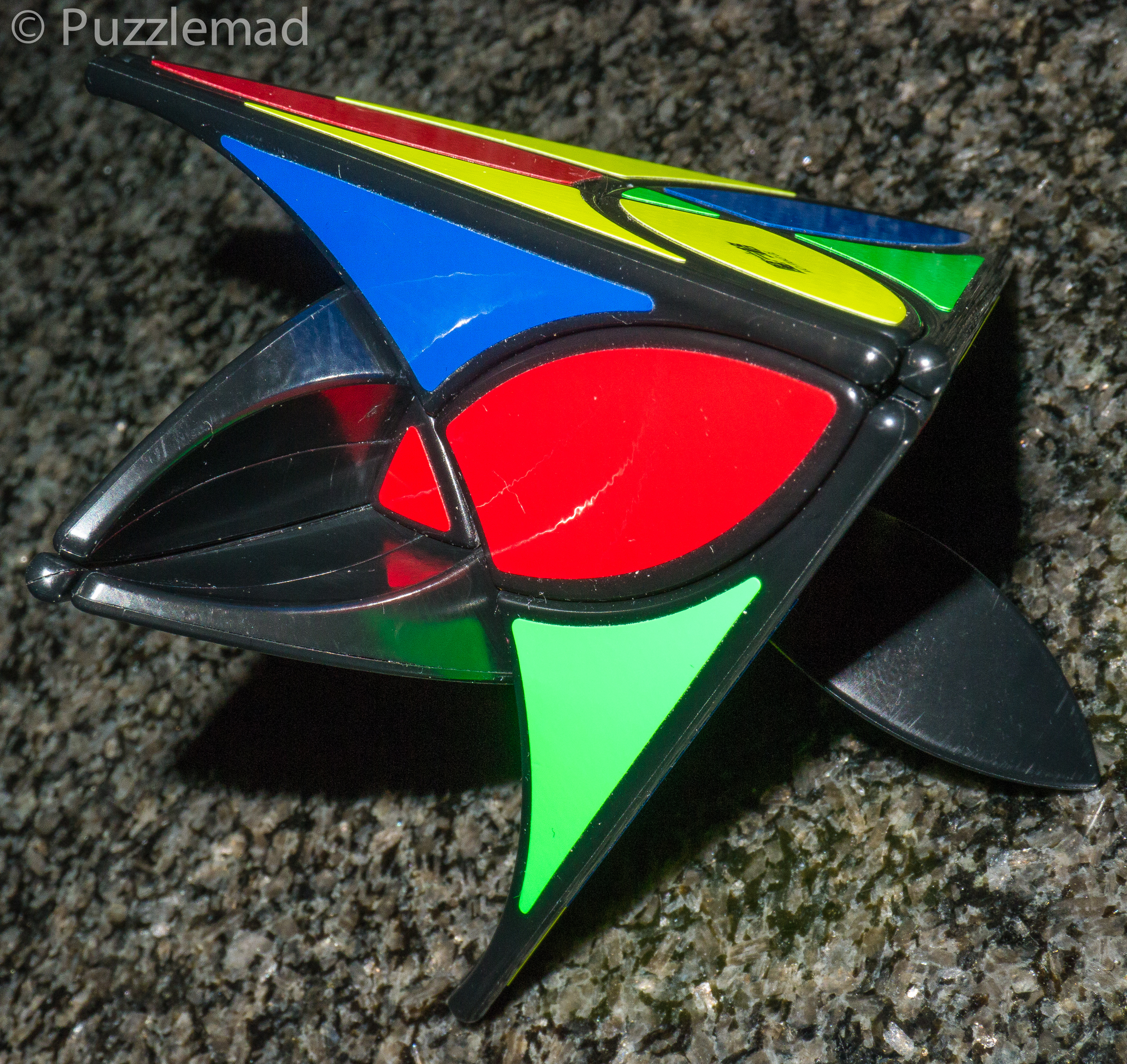
I managed to get it back to tetrahedral shape except there were black pointy bits sticking out and it was not terribly obvious where they had come from. They had no stickers on them and therefore were obviously internal pieces that had been left outside during scrambling and partial solving. Where did they belong? The clue to that came from looking at where they always appeared. They were always found in the place of the centres and I could eventually (after banging my head on the wall for a bit) workout that the centres were now inside the puzzle.
If you twist some of the edges until you find a little clue:
The centre is hidden in a little cavity inside the corner - in the picture to the left the red triangle is inside the puzzle and only revealed by partially turning an edge. So, how to I swap those? On various occasions, I have managed to get anything from one to 3 separate sticky-out bits on various faces. The secret to beat it? Yes, you are good at these! It is the Up-Up-Down-Down moves again. This time you need to do it with 2 edges hard turned out of place and then performing our magic sequence which returns the puzzle to proper shape. Phew! That wasn't too bad was it? Actually, it nearly killed me - all of these discoveries were over a period of 10-14 days and had my colleagues at work laughing at me when I either swore at the bloody thing for having protrusions or swore at it for injuring me. I really suffer for you guys, you know!
Once I had my shape again, I was able to do my intuitive solve using the magic sequence. This, I knew would only get me so far as some pieces will inevitably shifted out of their natural orbits and would not have been returned by the removing of the shapeshifting. Eventually, I ended up with something like this (sometimes on several faces)
Nearly solved but 2 petals are out of orbit (ignore the centres)
With the Curvy copter or related Clover cube (both cubic edge turners), this sort of issue is sorted by carrying out double jumbling moves to swap orbits until they are back in the correct orbit and then can be moved into place by intuition. There aren't enough faces to do that here and I had to adapt the magic technique to allow the fix to happen. Again we have a 3-cycle of pieces using the simple 4 move sequence but starting with a partially turned edge:
Turn one edge and then cycle those petals
Using the front left and right edges and starting with the left one, I can do a Down-Down-Up-Up and those 3 petals cycle around until they are correctly placed. After that is done with all the orbit errors, then the centres may need to be solved and you are done! Fantastic! I worked it out all by myself with only a little (alright, a LOT) of help from Allard. My colleagues were amazed and everyone thought I was brilliant.
And then I tried to do it a few more times and found something awful:
It's a 2-cycle! That's impossible!
My colleagues laughed at the look of horror on my face when I came up with this scenario. I had just 2 centres swapped and as any twisty puzzler knows, a 2-cycle is against the "law of the cube". This is just impossible.
After my initial blank thoughts, I went back to some of my early blog posts and realised that I had an error caused by a "False equivocation". This occurs when you place a piece into position because it looks like it should go there but in reality it is out of place. This can occur either because it looks identical to some other piece or because it has no stickers to tell you where it belongs (this was the case here). I realised that I had put the blank sticky out bits back inside the puzzle but they were placed randomly into whatever vertex I found. I realised that I had inadvertently swapped 2 of this blank internal pieces with each other and had no way of knowing. The manifestation on the outside was a pair of swapped pieces but in reality it was 2 pairs of swapped pieces and this is perfectly possible and relatively easy to fix. I used my earlier fancy move to take a vertex out and swap it with a centre and then replace it with a different vertex before putting the second one back where the first had been. This invariably left me with a 3cycle of centres to do and my puzzle was done. Hooray!
This is actually a wonderful puzzle - it is not too difficult for any experienced twisty puzzler and has some interesting features to make it a must-have in the collection. I would also say that anyone who is just starting out on twisty puzzles should also obtain a copy - solve the Clover cube or Curvy copter first and then move onto this one. It takes you several steps further in your solving and learning process without being too frustrating. Just watch out for those thumbnails! It is available from most good puzzle stores - PuzzleMaster have it here, or you could try the Hong Kong stores. Well worth your money!
Halfway through last year I restarted purchasing twisty puzzles after a
little hiatus (mostly induced by fear of how difficult the newer puzzles
looked). This batch I worked through gradually over a few weeks and
published about them
here
and
here
but the Master Clover cube caused me considerable anxiety...as an edge
turner it is going to jumble and to shape-shift which is normally a fun
challenge but with so many layers, this was potentially going to be painful.
If you are not familiar with the concept then let me quickly explain.
Normally with edge turning puzzles, the individual pieces are restricted in
their positions to certain orbits and cannot leave them. However, a jumbling
move occurs when a partial turn occurs of an edge which lines up the cuts
enough to allow an adjacent edge to be rotated. This can cause
shape-shifting if it isn't lined up with the opposite side or "just" take
pieces out of their usual orbits. Part of the attraction to me with these
edge turning puzzles is that there are two distinct solves to be done - a
non-jumbled scramble can be mostly solved using an entirely intuitive
approach without any fancy algorithms and just a bit/a lot of thought and
planning - this is great fun usually. Then a jumbling scramble makes for a
much tougher solve needing even more thought and often needs a more fancy
algorithm or commutator to solve (and half the fun is working out these
commutators). It also ends up with a hugely shape-shifted nightmare puzzle.
Inner edge turn and outer edge turn
A jumbling turn in process (outer edge)
I had put off the final one in that batch until just this week. It
frightened me to death! I recalled that many years (2013) ago I had bought
and eventually solved the big brother of the Master Clover Cube, Eitan's
Master Curvy Copter
and the process it had nearly killed me. It was a seriously difficult puzzle
with a lot of shapeshifting and a hugely difficult set of commutators to
find.
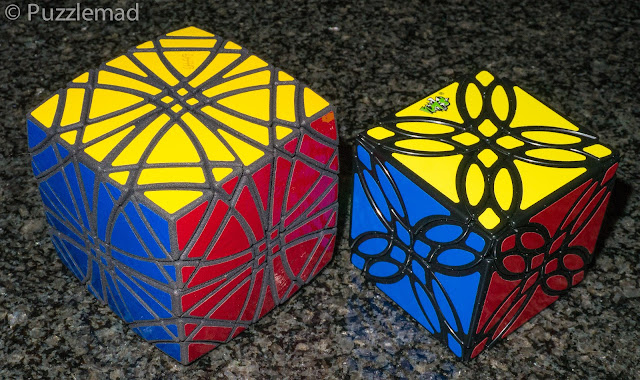
Are they subtly different? Both Master edge turners but a lot more
pieces in the Curvy copter
Eventually after procrastinating a long time, I ended up discussing the
puzzle with
Derek who happened to be working on it at the same time. My fears seemed to
fall on deaf ears and, as usual, he started to badger me to get on with it
and eventually I succumbed when he practically screamed "DO IT" at me via FB
messenger. This shamed me into at least trying a non jumbling scramble in
the hope that it should be solvable by intuition:
"This should be fun", I thought/hoped and my initial approach was similar
to how I solve the ordinary Curvy copter or
Clover cube.
I basically do it layer by layer working my way up from the white face.
The petals in the Master clover cube are split up so it was just a matter
of creating the white face (easy) and then assembling the 2 side faces of
the corner pieces and then adding in the half petals. With delight I
noticed that the centres and the corners are not separable so solving one
solves the other. It can be a little arduous but I managed to get half of
the puzzle solved really quite easily. I was on a roll and then I hit a
problem - the half petals in the remaining half are much harder to pair up
when there is very little room to play in. One of the most important
things I realised was that doing the puzzle layer by layer always ends up
with a scenario where there are single half petals that cannot be placed
in the end game without doing jumbling moves to finish. I was ever so
slightly disappointed in this but I should probably not have been
surprised. It was always going to be unlikely that such a complex puzzle
was going to end up with nice easy intuitive 3 cycles of pieces. Having
solved the lower half, I was able to turn the puzzle back to that
orientation and experiment with the jumbling moves to see what effect they
have. In a normal Curvy copter, the double jumble swaps a the two opposite
petals on adjacent faces as well as either side of the cube. This can
occur here but it is possible to split the inner and outer edge jumbles as
below:
A single jumble swap
Two jumble swaps
Four jumble swaps on both layers
As you can see that matching inner edges with the front outer edge swaps
4 petal pieces. Doing it twice swaps another 4 and then twice more
leaves in a very nice scenario (pictured right). Could I use this? Oh
yes, I was sure I had the puzzle beat...and then this happened:
Reporting my success and struggle back to Derek, he replied that he had
not had anywhere near so much trouble as me with a non-jumbled scramble.
???How is that possible? It transpired that he had reduced it to a
standard Curvy copter first and this could be done without any jumbling
moves at all. I had to have a try and yes this was also a LOT of fun. So
many aspects to just one twisty puzzle. At this point we were both
procrastinating...he said that he had not had time to do a full jumbled
and shape-shifted scramble but practically shouted at me to get on with
it! Gulp! I am, of course, too stupid to say no to an instruction like
that so off I went. I note that Derek has still not fully scrambled his
copy!
First of all, I did a jumbled but not shape shifted scramble and at this
point I was very pleased that I had done my earlier experiments and gained
a lot of experience of what could be moved where - the solve took me a
couple of hours of enjoyable fun. Then it was time to screw my courage to
the sticking place and do it properly:
This might have been a very bad idea!
The shape-shifting does seem to get blocked at various points during the
scramble. It is mostly internal and does feel like it could be pushed
past. But my experience with the original Curvy copter plus warned me off
forcing anything. Everything I had learned about the puzzle up to that
point stood me in good stead. Returning to cube was no more than awkward
and then it was just a fully jumbled solve. I love this puzzle! It is
definitely less difficult than the Master curvy copter but in a way that
is a good thing. The vast majority of this can be solved by intuition
alone and then just a bit of experimentation using the already solved half
will provide what you need to be able to complete it. There are several
challenges (non-jumbled, reduction approach; non-jumbled, layer by layer,
jumbled non-shape shifted and finally fully scrambled) - this is great
value for money. I bought mine from the HKNowstore but for those of you in
America/Canada then
PuzzleMaster
have it in stock as well. Go on, give it a try, you will love it!
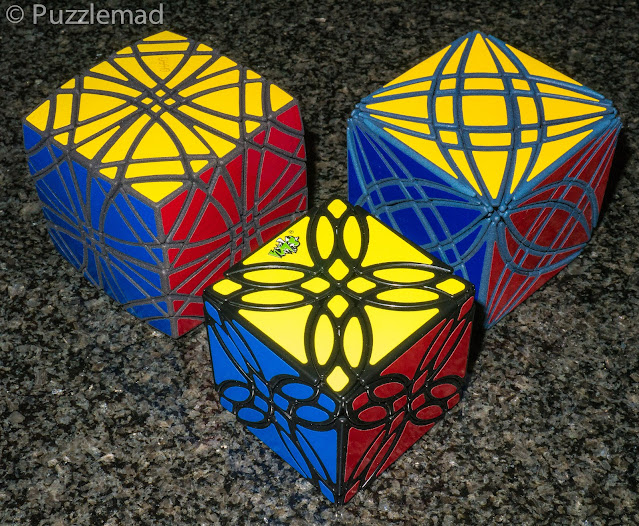
There are a couple of other non-face-turning Master cubes that would be
great if those wonderful cube producers would have a try at manufacturing:
The Master Curvy Copter I have shown and the Master Rex Cube as well would
be incredible:
3 Master cubes - hopefully the back two will be mass-produced
Yes, two twisty blog posts in a row! I have really not had a lot of time for
puzzling since I went back to work after my time off and I figured that it was
time to finally play with something that I had been carrying around with me
since it arrived back in July. I had immediately worked on and solved the
Skewb puzzles which were a fun challenge - just the right difficulty level for someone
who had not been solving twisties for a while. I had not worked on it because it
sort of frightened me as there seemed to be so many parts to scramble and solve
and my twisty prowess was at a low ebb. I showed it to several colleagues who
just shuddered and shook their heads at me.
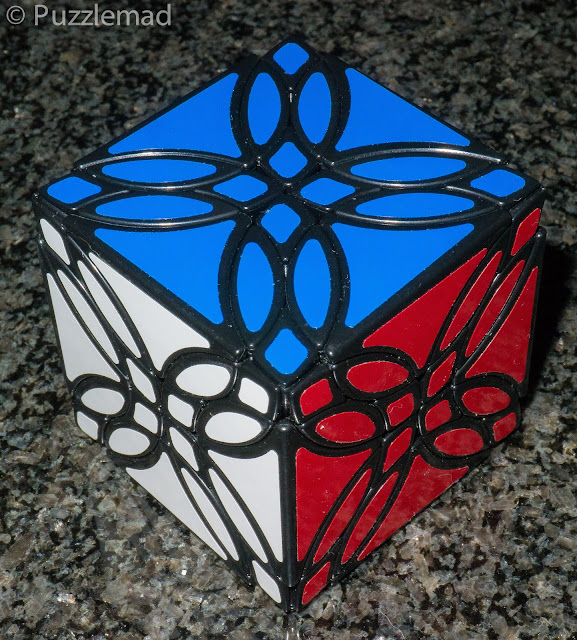
I had thought when I bought it that it was a combination of a Clover cube (a
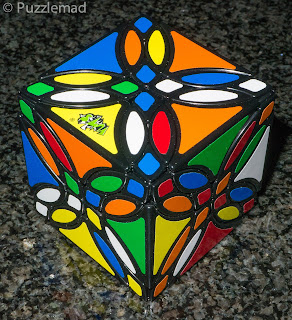
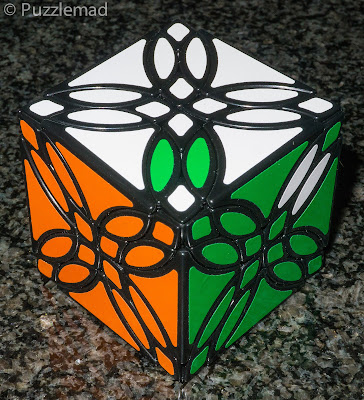
cornerless Curvy copter) and a Dino cube. I have always adored edge turning cube - starting with the Curvy Copter and moving up to the incredibly difficult Skewby Copter Plus. I was sure that this would be a lot of fun and hopefully not too difficult - I was right after a little pain and a little thought (some of which was painful).
Independently edge turning and corner turning
The Butterflower cube turns very nicely and has corner and edge turning properties which includes the usual edge turning jumbling moves. Luckily for me the corner turning and jumbling moves cannot work together otherwise the puzzle would have gotten much too deformed and complex for me to be able to follow.
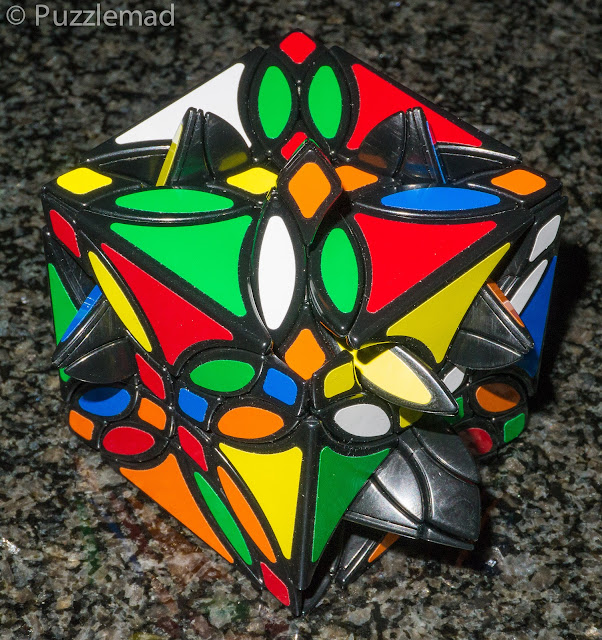
Last week, whilst waiting for an intensive care bed for a patient to be made available, I had a little time. I scrambled the little bugger in front of people at work. They looked on with almost as much horror as I did. Stupidly I went straight for a full jumbling scramble and quickly had a dreadful mess:
Believe me, it is properly scrambled - you cannot separate every coloured piece from all their neighbours.
Having recreated inner edges and outer edges it was time to work on the oval "petals". These are split into a large segment and a small triangle which needed to be combined before being put into their correct position. Again, I worked on this entirely using intuition and the 4 move algorithm. Basically, the petals can be moved around using Curvy copter moves until the ones that you want are arranged around a cube corner. Then the corner is rotated to connect the parts of the petal and the formed part then moved away for use elsewhere before turning the corner back and recreating the edges as they had been. Each completed petal could be moved into place and I worked my way from the white face up the cube. Over the space of a day, I managed to do the whole lot until I was left with 4 or 5 incomplete petals and I was stuck. I could not seem to complete them without breaking other things.
I just had a Curvy copter to solve, complete with jumbled moves that had taken them out of their proper orbits which, as I have stated many times is one of my favourite puzzles to solve. It had taken me 2 days and a fair bit of pain but I had conquered the Butterflower cube.
Why painful? For once, it was not down to a Whack! Ouch! from Mrs S (even if she had accused me of looking like Plug again). Well, my very small brain hurt quite a bit but also this puzzle can be lethal on your thumb nails - I think the sharp corners must have nearly torn them off nearly 50 times in the first solve:
See that pointy corner at the back left and right? Imagine getting that under your thumbnail many many times!
Apart from the pain the Butterflower cube is a wonderful puzzle for anyone who has mastered the basics of the beginners twisty puzzles and wants to go beyond the simple edge turners. This would be another puzzle that would be added to my advice to a beginner twisty puzzler. Once the alternative puzzles have been mastered then this would be an ideal next step up.
Remember to get your vaccines (either first doses or boosters if you are eligible) - they are a LOT better than getting Covid - believe me because I have had Covid and looked after people with it in hospital). They do provide a significant protection from death and significant illness - plus it is everyone's duty to protect the members of society who cannot protect themselves. No, the vaccines are not perfect but they are up to 93% effective for at least 6 months. The only way out of this dreadful pandemic is for people to get vaccinated. Do it! They do NOT affect your DNA! Anyone with knowledge of physiology and genetics knows that is a bloody ridiculous claim. They do NOT affect fertility (also utterly stupid). They are not injecting microchips! Have you seen the size of the needles used to put microchips in pets? They are ENORMOUS! Also most of you carry a phone with you everywhere you go - tracking is pretty easy with that and remember that in your homes Alexa, Siri or Bixby are listening to everything you say anyway!
At the back an edge turn, diagonally a corner turn
Here I am again, fresh from a day of DIY yesterday replacing light switches, sockets and fused connection switches and actually managed to NOT electrocute myself for once! I usually do a batch at a time and test them as I replace them. Sometimes I forget to switch off the mains before moving on to the next and, bloody hell, it hurts when the shock spreads across your chest! Here in the UK, we use 240V which really is quite powerful and, as we say in Yorkshire, it "smarts" a bit! I have set a record of completing a whole day without any pain (apart from the quadricep agony of doing 300-400 squats) - who knows, with this kind of luck, I might even manage to solve a puzzle soon!
Just a month ago, I discussed how I was going to extend my advice to progressing twisty puzzlers to include a special group of new puzzles that consist of two different twisty puzzles combined into one. So far in this group, the amazing Chinese producers have made the Grilles II cube and the 4 Leaf Clover Plus cube. Now the ultimate in this group (at least so far) is the Skewby Copter Plus cube has been released and after an initial period when it was in very short supply, it is now generally available. This puzzle, as the name suggests, is a mixture of the Skewb, a simple deep cut corner turning cube and the favourite of mine, the Curvy Copter. Not just the plain old Curvy copter but the Curvy Copter PLUS which allows a whole lot more movements than the original. The Curvy Copter plus was mentioned in my article on the extreme forms of edge-turning puzzles but has never been properly reviewed by me because of some major flaws in its' design.
Curvy Copter Plus cuts across the centres
Allows swapping centres and corners
The extra cuts in the plus version allow the centres and corners to be swapped which really adds to the fun but the design leaves the protruding pieces sticking so far out that they interfere with further turns and it quickly becomes completely locked up after inadvertently pushing past blockages.
This new Skewby Copter plus can be used as a Curvy Copter plus with the advantage that the puzzle has been fully redesigned such that the overhang bandaging has been completely eliminated. This is the puzzle that should have been released in the first instance - as just a Curvy puzzle it is FANTASTIC! What-is-more the additional Skewb cuts are possible even after all the Curvy Copter moves have been made and, on top of that, it is possible to perform half Skewb turns and then STILL make edge turns! This can lead to an amazing scrambled mess which looks impossible to solve. To show how amazing this puzzle is, I created a video showing how it moves and how to perform a full scramble - it takes a good 15 minutes to scramble it but you don't have to watch the whole thing to get an idea of how it moves.
Having learned how it moves and worked out the approach to get the best scramble - yes, it is always fun to have a twisty puzzle that is so complex that you need to plan the way to scramble it, you end up with an almighty mess that looks almost impossible to solve:
Dear Lord, what have I done?
Despite this horrific appearance, if you are brave enough to buy this puzzle, you really MUST perform a full scramble! It is actually very solvable! In fact, I would go as far as to say that this puzzle requires no more knowledge or fancy algorithms than are required to solve the base puzzles that it is based upon. Yes, if you can solve a Skewb and a Curvy Copter then, with a bit (maybe a LOT) of thought, you can solve this monster.
The first challenge is to get it back to a vague cube shape which means reconstituting the edges into the correct diamond shape like the one above. Then put the corners back into corner places and centres back into centre positions. Just thought alone and logical movements are required. At this point, some of the centres will appear to be sitting not quite flush with the cube surface and they will need to be temporarily taken out of position to a corner and rotated around the cube before placing them back into position and this time sitting flush. Finally, you will have a cube shape - this took me a few hours the first time but now I can do it in about 15 minutes.
Zachary and I worked for ages to get this far
I took advice from my Burmese boy and we had a fun time pairing up the triangular centres with the rectangular centres and the outer rectangular centres (each needed a different technique but no fancy algorithms) to produce complete petal-shaped pieces. At this point, it looks like I was well on the way to solving it but...take note of the diamond-shaped edges...they consist of 4 pieces and none of them matches up. Despite discussing it for a few hours Zachary could not come up with a way to fix the edges so it was back to the drawing board. Ignore the centres/petals, and make the edges first.
Recreating the edges was a huge challenge! Again, there are no fancy algorithms, just a combination of skewb setup moves then Skewb pairing of pieces and Curvy Copter moves to store the pieces - this left me with all of the small dual cloured pieces paired up and in the correct position. FABULOUS! Next to place the single colour diamonds within the edges. I was stuck for a while. A long while! Then I remembered what happens to the centres when making corner moves on a Skewb. A fantastic Aha! moment occurred and I was suddenly able to move them about at will. The hardest part was remembering my setup moves. It took me a couple of days but Zachary and I finally recreated all the edges:
That is one talented cat!
As you can see, the forming of the edges did break up the outer centre pieces from the inner two parts but putting them back together is almost trivial for anyone who understands the jumbling moves and orbits of a Curvy Copter. Another day and my puzzle had been reduced to a simple Curvy Copter solve and away I went...except this happened:
All solved except 2 corners out of place
In the normal Curvy Copter this is impossible - In fact, the "law of the cube" states that it is impossible to have a requirement to swap or move just 2 pieces - there MUST be a third piece that needs to turn or swap position. I will not give it away here but if you think about it, it is quite obvious where the third swappable piece might be and luckily that fix is quite simple without disrupting everything that has been done before. Zachary was very smug when we finally managed this:
Simply brilliant! Both cat and puzzle!
Of course, one has to solve a puzzle several times to prove that it was not simply luck as well as to ensure that other nuances have been found and understood. I scrambled it at least a half dozen times and convinced most of the nursing staff at work that I am crazy when I showed them how it moved and how mixed up it got. On my third attempt, I was rather shocked to find this at the very end:
Just one turned corner
The solution to this is definitely NOT straightforward - it requires a massive disruption of the puzzle and then resolving it with the corner placed correctly. I have subsequently worked out that this can be checked for earlier on during the solve (just after the edges have been created) and fixed before doing much more that needs to be undone.
In conclusion, both Zachary and I think that this particular twisty puzzle is one of the very best puzzles ever to have been created! I would go as far as to say that everyone should own one. It is the Curvy Copter plus that should have been released from the beginning (and if you wish can just be scrambled as one) as well as providing a massive challenge for any twisty puzzler when they introduce the Skewb turns. It is probably not suitable for beginners but I would hope that you would grow your skills into it with time. Just BUY it! It will be appearing in my top ten(ish) of 2019.
Phew - Now I need to solve something else quickly for next week!
One of my all-time most popular blog posts is one that I am most proud of - it is my advice to twisty puzzle beginners post which I published way back in 2012. It is what I send to puzzlers who have taken time to work out how to solve a basic 3x3 and 4x4 Rubik type cube and want to know what path to take next. It is in no way a didactic set of instructions, I just walk through what many of the options are and discuss why one might want to go that route. I suspect that I should probably redo that post in the light of more recent developments in the Twisty world.
I still stick my initial advice that the first tentative steps beyond basic cubes should probably be the shape modifications to get your head around pieces that "don't look right" and then move on to the other geometries like Megaminx (dodecahedron) and Pyraminx (tetrahedron) but after those, there is a sudden increase in options which can be chosen between...for example the cuboids and those with alternative piece movements like the Dino cube (Shallow cut corner turn), Rex cube (Deep cut corner turn), Skewb (Very deep cut corner turn) and Curvy Copter (Edge turn) - each of these can also be multiple layers too.
Today's puzzle that I am reviewing is definitely not a basic puzzle for a novice but is a really nice example of a recently appeared new group of puzzles on the market. I am not sure what to call this group - maybe it could be called the "Combo puzzles"? These are puzzles which are effectively a combination of 2 different basic puzzles into one with 2 different turning mechanisms combined. I already reviewed one such puzzle, the Grilles II cube which is a combination of a standard 3x3 cube and a shallow cut Master (4x4) Dino cube:
3x3 turns and 2-level deep corner turns
The solving process for this was great fun and my main criticism of this puzzle was that the mechanism was quite unstable and had a tendency to explode into rather a lot of pieces if you were not extremely careful how you rotated it. If you want a copy of this (recommended if you have patience) from PuzzleMaster or HKNowstore.
These combination puzzles really intrigue me - there is a whole lot more scrambling possible with these than the individual base puzzles and then you have the probability that you can get into positions that are completely impossible with each. The approach to solving could be to try something totally unique and find your own commutators to shift pieces around or to try to reduce to one or other of the base puzzles and then solve that. The fun part of this is that there is a distinct possibility that the reduction can introduce parities where a piece has been reformed in an impossible position for the base puzzle - for example in the Grilles II it is possible to be left with a single turned corner which a 3x3 can never achieve. Resolving these parity situations can be one of the most fun parts of these puzzles.
There have not been very many puzzles with combined mechanisms released yet. The 3x3 Curvy Copter by MF8 is one that I have not bought because it was reputed to be so unstable as to be almost unusable
The puzzle I am specifically discussing today is the Mo Fang/Qiyi 4 Leaf Clover Plus cube (available from PuzzleMaster here, HKNowstore here, and UK Puzzlestore here) which is a combination of the wonderful edge turning of a deeper cut Curvy Copter and a 2x2 face turning Rubik cube. I originally got mine from Calvin's HKNowstore and they mistakenly sent me the plain 4 Leaf Clover Cube (no plus) which is just a deeper cut Curvy Copter but no face turns. It was a nice puzzle and fun to play with but not a new challenge. They were very good about sending me out the correct one I ordered with the next order that I placed with them.
I bought the Stickerless version which has the advantage of the Curvy Copter corners to be solved hidden inside the puzzle:
You can see the hidden corners sunk inside - an extra challenge is to solve these too even though they are not externally visible.
The puzzle turns fantastically well and is a joy to scramble. All the usual moves are possible including the jumbling moves that are the fun part of the curvy copter - jumbling to you non-twisty puzzlers or novices is the ability to take a piece out of its' orbit by partially turning an edge and combining it with another edge turn (all edge turners have jumbling as part of their abilities).
Back right is a face turn
Front left is a trio of moves ending a jumbled puzzle.
After an initial fiddle about I just went for it! I usually spend time working out techniques and maybe a few algorithms but this time I figured I had enough background to these puzzles:
Fully scrambled, it looks quite fearsome!
So how would you approach such a puzzle? For me, the obvious thing to do was to return it to a cube shape and then solve the base 2x2 first which effectively reduces the puzzle to a plain 4 Leaf Clover/Curvy Copter Cube which should be solvable in the standard fashion (unless there were any Parities introduced).
Returning the Curvy Copter to cube shape can be a horrific experience as it gets very blocked but in this particular puzzle the 2x2 moves are unimpeded and using these it is a simple matter to move the edges into the right positions so that the jumbled pieces sticking out can be made flat again. Next step for me was to reduce the multicoloured edges - in the picture above there is a blue/white edge combined with a red/yellow edge at the front. Pairing up the edges is initially pretty easy and done purely with intuition. Having done one face of edges, I moved to the next layer up and this simple too - getting confident now! The next layer up the sides also wasn't too bad with only a little bit of fiddling about. The final face of edges...now that was quite a challenge! The first solve I went through, it just happened to work out that they were all just in place or on opposite faces of where they needed to be and I was lulled into a false sense of security. My second and all subsequent attempts at this puzzle have been a humungous challenge with edges in all sorts of places. It requires all sorts of moving 2x2 cubes about and rotating cubies and edges to finally get them back to either in place or opposite to where they should be. I have done this 7 or 8 times now and I can always do it but it is always a huge challenge which requires quite a bit of planning and moving pieces around.
Who would have thought that the toughest part of this puzzle would have been the 2x2 cube part? It is a brilliant challenge which I have yet to find a definitive sequence for. Maybe a better puzzler than me can manage it more quickly?
Having reduced the puzzle back to cube-shape and then recreated all the edges, the Curvy Copter solve process is exactly the same as normal. You have the choice whether to solve the hidden internal corners last or whether to solve them as you go like the usual CC puzzle - each choice has its own special challenges.
This is an absolutely brilliant puzzle and I can heartily recommend it to all twisty puzzlers who want to go beyond the basic cubes. It should probably be step 4 in your journey - I would recommend learning the basic cubes, then the shape mods and then the alternative turning puzzles before jumping on these. The progression is wonderful.
I think I will need to think about obtaining the Curvy Copter 3x3 to add another combo twisty to my collection.
Coming sometime in the future will be a review of a terribly fearsome puzzle - the Skewby Copter Plus:
Holy shit!
Curvy Copter edge turn AND a Skewb turn
This beast is a fearsome thing - it is a Curvy Copter PLUS (described in this article) which can swap out the centres and the corners as part of the jumbling process combined with a Skewb (deep cut corner turner). So far I have been too frightened to do any more than turn this thing!
If you are a puzzler who is hesitating over getting into twisty puzzles then don't! Do it! The learning process is quite steep at first but there is plenty of help out there and then once you have developed an arsenal of basic techniques then you are off and running. These puzzles are hugely challenging, have high repeatability and are pretty reasonably priced until you branch out into the hand made mods. Try it, you will probably like it...a LOT!