Last weekend, luckily whilst Mrs S was away from home at the outlaws, I took
delivery of another big box from Jakub and Jaroslav. The delivery man knows us
very well and he is so frightened of Mrs S that he had put the box on the front
step and was hiding behind our garden hedge! Once he realised that he was not
going to be lambasted for bring me more toys, he came out and we had a nice
chat. Unfortunately we both forgot that Mrs S was able to listen in using our
Ring camera. She was not terribly pleased! But I, on the other hand, was
delighted. I had new toys to play with. I have not yet completed all the puzzles
yet as it has been a big week for me at the hospital doing a single giant
operation each day and having no time or energy when I got home to really work
on anything. I have managed to play with four of them and plan to work on the
others this week.
Triumph
It's quite hard to take a good photo of this
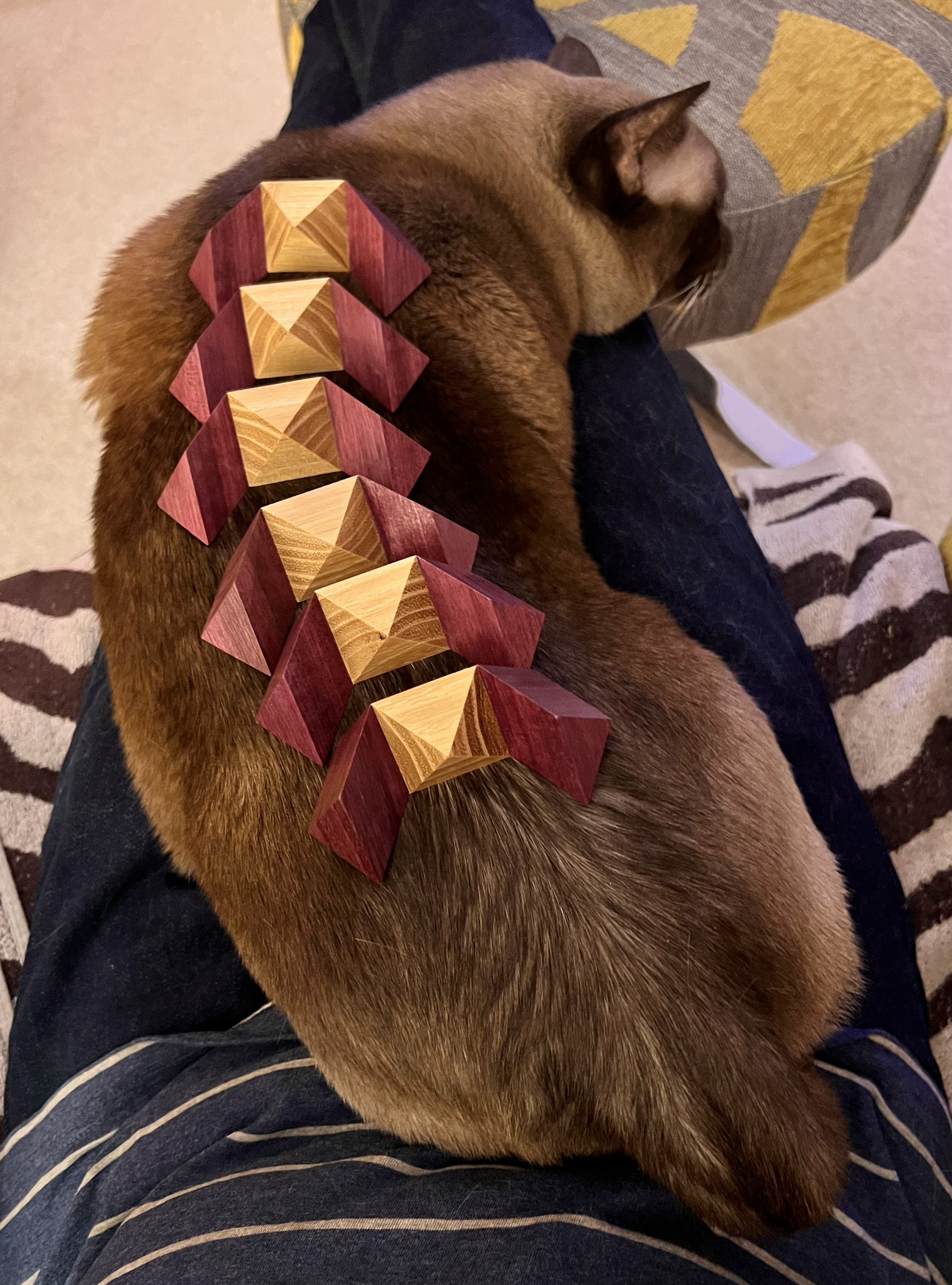
Triumph is a classic design form Stewart Coffin (design number 15). He made
quite a few of these which are based on the
classic Diagonal star puzzle
with alterations in the extension pieces at each end. The star is made from
Acacia and Purpleheart and looks stunning. Jakub has decided to send this out in
the classic tower formation and this is relatively easy to work out what to
push/pull to separate it into two pieces and then completely dismantle:
Six identical pieces
The precision with this is superb! There are no gaps anywhere and the sliding
motion as you separate the halves is delicious. I used Burrtools many years ago
to exhaustively examine all the possible assemblies and there are quite a lot of
assemblies (approx 1200) but most are not attractive even though they fit
together. I found just 3 or 4 particularly attractive ways to put the puzzle
togther and you should have a nice time experimenting with this one.
Be careful! The corners are so perfect that they are sharp and whilst you are
unlikely to cut yourself, you may find handling it uncomfortable. The pieces
fit so perfectly that it can be quite difficult to get everything aligned
perfectly to allow the final assembly to slide together. It is very satisfying
when it does.
He came in useful at last!
I did not think that anyone could make this puzzle as perfectly as Scott
Peterson who made me a copy many years ago and which sits dead centre in my
display cabinets in pride of place. I actually think that this one from
Pelikan is pretty much as perfect as his! You will need to keep these well
temperature and humidity controlled to keep them moving well but it is worth
the effort.
Triumph in tower form from Pelikan and Scott Peterson
I do hope that Pelikan choose to make the Triumph companion and the Fusion
confusion as well because they really should be considered as a set.
Four Corners
It's also quite hard to take a good photo of this
Four corners is another of Stewart Coffin's Diagonal star based designs
(this one made from Acacia and Wenge) and seems to be a less common one to
be made judging from the complete lack of information or photos on
the Puzzle-place wiki. Although John Rausch has some wonderful pictures on
his site. As before this one comes apart into halves and then into 2 groups of 3
identical pieces that are just slightly different to the Triumph pieces:
Just a small difference from Triumph but a large difference in what is
possible
Experimenting with this one I tried to establish whether there are any other
assemblies and as far as I can fathom the rotational symmetry of the pieces
means that only the 4 cornered assembly is possible. Again, it is a
delightfully perfect fit as they are all slid together and apart.
This morning it occurred to me to try and mix the pieces up from the 2 puzzles
and see whether they would fit together and then whether it would be nice. I
will let you decide:
I think they look great!
It will be fun to experiment a little more when I have some time.
This gorgeous creation has been made using Mahogany, Maple and Purpleheart
giving a really lovely looking cross design. In the last batch of Pelikan
puzzles there was a release from Osanori-san which also involved 4 twisted burr
sticks fitted into a frame. This particular varian has a very shallow frame and
very simple obstructions protruding into the cavity. The sticks are as simple as
they can possibly be which means there is a lot of possible movement right from
the outset. The first couple of attempts, I got a little lost and had to
backtrack each time but eventually I found a rather promising sequence that
almost released the first piece. Getting it actually to come out proved a little
elusive until I had a quick look on both sides and realised what could move.
After that I had my four sticks and frame and realised just how simple the
shapes had been:
As simple as it gets!
Having taken my photos and rearranged the pieces from their removal
orientations, I found the reassembly a fair challenge. If this was given to a
puzzler having been already taken apart then it might prove really quite a
challenge - it would certainly be completely beyond me but many of the better
interlocking puzzlers would find this a great challenge. Well worth adding to
your Osanori collection.
Broken Box
Broken Box by Lucie Pauwels It was sent out assembled but I was
rather stupid and dismantled it immediately!
I was rather curious when I took this from the packaging. The beautiful Wenge
cube inside the Cherry wood box looked odd - there were magnets and I wasn't
certain what they were for. So I dropped the cube out the centre and it fell
apart into 9 horrifyingly awkward components and a box that was "broken". I
wasn't certain what the point was apart from maybe put the pieces back in and
maybe rearrange the box halves into an alternative shape around the cube. I
initially decided "just" to put it back together again as I had received it. I
wrote "just" because this was a horrifically tough task for an assembly puzzle
dunce and it took me a couple of hours! I then thought I might try to make the
flattened tray version and so far have completely failed! How can creating
such a simple shape be so damned difficult? I put it aside to play with the
other puzzles for a bit.
Jakub later sent me the instructions and showed that there were quite a few
more challenges:
Two tray designs but one with a "twist"
Chair type designs but with a pretty limited access in one
I have no idea how I am going to solve this one!
These puzzles can be solved in 2 ways - you either make the shape first and then add the box frames to it or assemble the box and try to put the pieces inside afterwards. Burrtools tells me that there are hundreds of assemblies for some of the shapes but I have absolutely no skill in finding them! Lord knows how long this will take me! This will be tremendous value for money to any puzzler who purchases it as well as a really fantastic series of challenges. I did manage just one of the assemblies so far:
I think this was more luck that anything!
The other puzzles in the release are Maahes designed by my friend Terry Smart and previously made by Stephan Baumegger - it had been in my top ten of 2016. I have no recollection of the solution and will need to try again with the Pelikan version. Dino 2 is another of Alfons Eyckmans' wonderful burr zoo creations which will have a cute little dinosaur inside the usual 14 piece burr. Tau by the incredible Volker Latussek looks amazing and very reminiscent of one of my all time favourites from Laszlo Kmolnar, the No holes barred puzzle I reviewed in early 2016. Volker has told me that he is particularly proud of this design which means that it will be incredible! Unfortunately there is a small mistake in the copy I have been sent and Jakub is having to make them again before they can be released. I hope to review these puzzles next weekend once I have had time to play.
This blog post was produced a day earlier and in a hurry because I am working
the weekend yet again - the solution to this one nearly killed me and I have
not even attempted to reassemble it yet! It may remain in pieces for the rest
of time which is unfortunate because Mrs S actually likes the look of it.
This fabulous creation which has been mass-produced thanks to PuzzleMaster's use
of a Kickstarter campaign is now available for everyone to try out but you
should all be warned... the level 10 is very well deserved! This is a seriously
complex and difficult puzzle.
It had originally been designed by Jerry back in 2019 in a simpler form called
Cranium which was iterated over a period of time until it reached the current
(considerably harder) form. Later that year, one of the earlier versions was
produced by Eric Fuller in a very limited edition (this one had 26 pieces and
was called the Berro-skull). As it got more and more complex, it was only ever
made by 3D printing and never in any significant numbers. Jerry has been known
to produce small batches of stainless steel puzzles, one of which I reviewed
(along with the PuzzleMaster anodised aluminium version)
here. He did attempt to produce the 67 piece skull in steel himself but could not
find a way to do it himself and his local fabricator could not work with such
tiny pieces. Luckily for us all, Leon Stein (owner of PuzzleMaster) decided to
spend the time and effort working with Jerry to get this produced and
functional. The end result is stunning!
I backed the Kickstarter campaign but it is now also available as part of the
PuzzleMaster own brand
metal puzzle collection at a very reasonable price of $144CAD. Believe me, for a puzzle of this
complexity with this many well-finished parts in any material, this is a very
good deal. In stainless steel this is bordering on unbelievable! You could say
it is a steelsteal. It is a substantial item at 7 x 6 x
5.1cm and weighing in at 800g. Mrs S straight away told me in no uncertain
terms that it was not allowed anywhere near the kitchen work surface or floor
tiles - if I break any of them then she would break me! For heaven's sake,
don't show her the picture at the top of this blog post!
I was again too frightened to start on this for a very long time but
eventually screwed my courage to the sticking point and had a fiddle. Much to
Mrs S' amusement, there was no progress for an embarassingly long time. I was
able to find that the wooden mouth shape was easily removable and also found
another move of a single piece but nothing would slide off/out. Bugger! I
think it must have taken me another 4 or 5 days before the next move became
apparent to me much to my relief. This wasn't because of any flaw in the deign
or manufacture - I was just rubbish and did not attempt the correct move for a
long time. Having found that next move, pieces started to be removable...lots
of them and I got "the fear". I quickly backtracked and put it back together
again and left it for a while. Several days later, having found some more
courage (I seem to recall that gin helped), I did it again and went a bit
further by removing about 10 pieces. This was fun! Great fun! Then I tried to
backtrack and had a pair of pieces that I could not replace - I am blaming the
gin but you may think it was me being a simpleton. I was able to put it back
together with that pair of pieces left outside the puzzle and after a bit of a
panic, I could work out from the holes left where they went and reassembled it
properly.
That experience frightened me quite a lot and I left it alone for several
weeks until my workload meant that I had to find something to solve soon or
there would be no blog post this week. Once my fear of no blog post and
exceeded my fear of the puzzle, I started again and decided that the best
thing to do was to lay all the pieces out as I removed them and backtrack
regularly during the disassembly. Of course, once I was about 10-12 pieces in,
I was unable to return to the beginning and there was a huge flurry of effing
and blinding as I desperately tried to work it out. Yes, I scared the crap out
of myself again and decided I would take a few videos of the dismantling so
that I might possibly stand some chance of reassemble. The video had to be
taken over several attempts due to the need to feed a very loud Burmese cat,
having to deal with Mrs S making very disparaging comments about my prowess
and due to my general incompetence. I got stuck on the disassembly on numerous
occasions and on several occasions had to desperately try and work out where
some random piece of metal had come from after it fell out from inside with me
having no clue of the original position. When I looked back at the videos to
try and see where these pieces had come from, I realised that quite a bit of
the recording was 1. out of focus, 2. out of site of the camera and 3. not
helpful with my mystery pieces.
After about 4 hours of swearing and being laughed at I could take a photo -
this is the pieces carefully arranged in a rough order that they came out in 3
batches - believe me, this is NOT a spoiler!
This may be how it stays forever more!
I have wrapped the pieces up in the white pillowcase that I have used to provide contrast for the photo to try and prevent the curious cat rearranging the order or even running off with any pieces. I hope that I can one day reassemble it - I am desperately looking at my rubbish videos to see what I can do. The review left on the PM site from Tyler (a well known puzzler and friend) states that if you take your time about the disassembly then you should manage to put it back together. I tried to do that but at some point lost track and just proceeded anyway. I think that I might be in trouble - wish me luck! There are hundreds of solutions on the PM site here but predictably this one is not amongst them - GULP!
A real quick one today as I had to write the work rotas yesterday (including August and September with the school holidays). It took me 8 hours or more and I am fed up sitting on my arse in front of a computer!
When the PuzzleMaster Kickstarter campaign came to an end, they offered the
chance to buy some of their metal puzzles and add it to the rewards that you had
purchased. Most of them I already owned but the Cannon was a puzzle that I had
seen before and played with (loaned by a friend several years ago - thank you Michel) but never
managed to obtain my own copy. I couldn't resist it at $30CAD. This is a remake
of a classic puzzle and it has been very well done.
The puzzle is rated as 7 on PuzzleMaster's 5-10 scale and I think this is
about right. It is beautifully presented and really nice and shiny in Brass with the painted red cannon trolley. The aim is to release the cannonball from within the barrel of the cannon - it is sort of a very simple sequential discovery puzzle. I did find it quite humorous that there are instructions telling me that the trolley is only for decoration/display and not to be dismantled to solve the puzzle.
In all, it took me only about 5 minutes to solve but part of that will have been because I had played with the other version, The manufacture of this is spot on - tolerances are perfect and, if you have never seen it before there are a couple of very nice Aha! moments during the solve process.
The cannonball blends in with the granite Keep it away from cats and toddlers!
Whilst it is not difficult, it is a lovely classic puzzle that everyone should have in their collection - it is perfect for showing to non-puzzlers to get them hooked on the aha! moment. Unfortunately it is sold out at Puzzlemaster for the moment but it is available from Brian and Sue Young in Australia here and if you don't own the Houdini's torture cell yet then go and buy it with the Cannon together (a special deal here).
Hi everyone, today I have another wonderful guest post from the official PuzzleMad foreign correspondent. Somehow Mike always seems to sense when I’m struggling for something to write about and sends me something perfect to fill the gap. It’s not that I’ve not acquired anything new (see my New Additions page) - I’ve bought a fair bit from Eric and just got from Aaron but solving has been a problem. I’m not very bright and solving takes me a long time and time is not on my side these days as the powers that be want us working our arses off to try and catch up with a bit of the enormous backlog of operations that haven’t been done during the pandemic. Mike, however, has been busy solving and has produced a wonderful set of reviews for you here. Thank you, my friend.
Aloha Kākou Puzzlers,
Another puzzle assortment from the PuzzleMad Hawaii Office this week. Nothing heavy, just some items from one of my rare Puzzlemaster orders, and a couple others from elsewhere. But let’s skip the pleasantries shall we, I’m really just not in the mood today. Straight to the puzzles!
Free Willy The little ball bearing is Willy in this case.
First up is Free Willy. This is a JC Constantin design, and a very attractive one at that. The body is a fragrant laser-cut wood and I believe the jail bars are stainless steel. I have been looking at this puzzle ever since it first came out. I was instantly intrigued (Ed - me too! I played with this at an MPP when Wil handed it to me to play with). It had a completely unique look and the expectation (hope) was that a unique puzzling experience would follow. My hesitation had a lot to do with the modest difficulty level. I find Puzzlemaster (and many others) to generally overrate difficulty, so I suspected that Free Willy might not be sufficiently challenging at a Puzzlemaster 7. It might even be a complete bore. Add to that the 40 loonie price tag and you have the perfect recipe for dithering. But as you can see, my curiosity finally got the better of me.
Free Willy should not stump you for too long, but it is definitely not trivial. I think 7 was a good rating by Puzzlemaster. It is not immediately obvious how to free Willy from the cage, but all the clues are there to be read, and there is no trickery, per se. The puzzle concept was new to me, which was a relief. I highly doubt you have a puzzle that works like this in your collection. There is a little thing at the end that I think will surprise and delight you. It was unexpected and made me smile. (Ed - it made me smile too)
I rather like this little puzzle and am happy to have finally purchased it. It is a great design both aesthetically and puzzle-wise, and it’s also perfectly suitable to hand around at a party. These are the little gems you hope for when making a Puzzlemaster order. The price still seems a little high, but that’s how it goes sometimes. On the shelf it goes!
Willy freed!
Shifting gears for this next one, we consider a little item I ordered from Alex’s PrintsAndPlastics shop on Etsy, Lockpick (Level 10). Alex makes a variety of 3D printed items and seems to be a puzzle afficionado. His Lockpick was only 10 USD, so although I was pretty sure I knew how it worked, I scooped up a copy anyway. That’s cheaper than my lunch. I actually don’t know how you can 3D print anything at all for 10 dollars. I suspect you can’t.
Not only is it inexpensive, it’s a good-sized puzzle. Also very light-weight. As expected, the mechanism turned out to be a blind maze. One must navigate the hasp-like part through the center of the puzzle until it pops out the top. As they say, this is not a puzzle lock, it’s a puzzle in the shape of a lock.
Back side of Lockpick Level 10
Lockpick will be a very quick solve for most puzzlers. I can’t in good faith recommend this puzzle to anyone wanting a challenge. I don’t think that will be insulting to Alex; he acknowledges that the Lockpick line (there could be 10 total eventually) are solidly on the easy side. That said, I’m perfectly happy with this little lock and I must say that Alex provides excellent service. It seemed like it arrived in my mailbox the next morning (along with a nice personal note; Etsy people are nice that way). Alex also has a puzzle box-type object at his shop, possibly sequential in nature. His comment section has variable reviews, but I am intrigued. It looks like there might be some novel mechanics. Unless I miss my guess, and I never do, Alex has the puzzle design bug. Hopefully we’ll see more from him in the future.
Lockpick Level 10 disengaged.
That little nub on the lower right winds through the maze.
Moving briskly along, how about a packer? I came across a copy of JC Constantin and Perry McDaniel’s T-Party puzzle recently and made it my own. This is an old Bits and Pieces product, instantly recognizable by its very modest attention to quality and workmanship (Ed - it’s a real shame that B&P didn’t take more care over what they did. There are some great puzzles in their repertoire). No precision milling will be found here, but it has a nice heft to it and the anodising is passable. Its inexpensive.
T-party - more T than party
T-Party consists of an aluminium box along with a lid and four T-shaped pieces, which are in a nice red colour. The objective, if you couldn’t guess by now Kevin, is to pack the T’s into the box such that the lid closes fully. The lid is not flat on the bottom, but rather sticks out (into the box) a little bit.
There is a T-Party in the Slocum collection, made in wood by Mr McDaniel himself, dated to 2002. I believe that’s the acquisition date. So it appears to be an early twenty-first century puzzle, one might even say millennial. Someone should fact-check that. (Ed - I’ll leave that to an eager reader)
I solved this one without undue bother. A few false starts were had, then I found an arrangement that work perfectly. From the perspective of building pieces up from the base, it was not a clearly intuitive, or clearly geometric, shape. Scott Elliot provides a good review of the puzzle at his lapsed blog here. From Scott I learned that T-Party evolved from the classic, flat 4-T puzzle, which makes perfect sense. Looking over Scott’s blog page, I also now want a copy of his Guile in the Box puzzle, an even more radical extension of T-Party. Very cool design. I don’t think there are many around.
T-Party solved. (Ed - hahaha! Really?)
I have to agree with Scott that the Bits and Pieces T-Party suffers for its lack of precision fit. Scott noted that there are alternative, inelegant solutions which detract from the puzzle (surely not an issue with Perry’s hand-crafted version, though). I think my solution was the “correct” solution. But I also think that given the solved orientation of the pieces (90° tilt from 4-T’s horizontal), the geometric beauty of the correct solution will not be apparent to most. It wasn’t to me until I looked at the solution. The solution diagram didn’t initially look like it matched what I did, but after removing the pieces carefully, it was indeed the true configuration. The point is that most people will just jigger the pieces in until there is a closest packing. That works just fine, since there are limited options. The alternative approach, necessary to achieve fully orgasmic Aha! (Ed - orgasmic? Wow, that’s quite a puzzle!), is to construct the shape outside of the box, or at least visualise it outside, and then pack accordingly. You should try it that way, but you don’t have to. Anyhow, T-Party is a great little puzzle to own. I love it, flaws and all. I’m a sucker for metal and I’ve also been doing a lot of packing puzzles recently, so the timing was perfect on this one. (Ed - that makes us a perfect team! I’m a sucker for wood and seldom try or, even less often, solve packing puzzles)
Ok, time for one more before Kevin drags me off-stage with a giant cane (Ed - Mrs S won’t let me have weapons!). Let’s talk about the Paperclip puzzle by Keith Winegar. You can get this at Puzzlemaster like I did, when they restock (sold out at the moment). Like Free Willy, I was instantly attracted to this puzzle. Its hard to explain. The wood, the jigsaw joint, the bolts, the paperclips. Mixed media quirkiness has an undeniable draw. Nice size. Nice walnut. Nice beveled edges. Nice paperclip.
I confess that I have not followed Keith’s work very closely (Sorry Keith! That’s changing now). I was aware of his Capital Politics, but didn’t get that one because I was not sure how deductive a puzzle it was. Seemed a little trial and error, everything hidden, etc. I had definitely noticed, recently, his raft of jigsaw shapes at Puzzlemaster. A couple of those are on my wish list, pending financial recharge. But Paperclip had me at fist sight and never let me go. Being made of walnut, prince of hardwoods, didn’t hurt. That is my current favorite wood of all time (Ed - sigh! You really need to look through my Flickr gallery to see some much nicer woods)
Keith beveled the edges nicely for us and the internal mechanics are simple but effective. You can see that there are two nutted bolts, one on either side of the jigsaw cut. The two sides are held together by a combination of the jig (preventing lateral movement) and a pin or rod of some kind (preventing up-down movement).
Paperclip underside
(Ed - odd choice of background!)
How is it you ask? I’m about to tell you. It’s fun. Paperclip is a very nice little puzzle. I really enjoyed it, although my initial solve was not via the intended method. Separation can be achieved in an alternative way, but it is not ideal and I knew there had to be a better way. That way was something I had considered originally, but bypassed under a rationale that many other puzzlers will surely share. There is a bit of a grey area for puzzles like this, knowing just what moves are permitted. I would just suggest that you go with your instincts, no matter where they lead you.
Nice effort and truly a unique offering from Mr Winegar. Like the other puzzles in this post, it is not highly difficult and does not strive to be. It is mainly an exposition of its concept. Puzzles in this category are highly enjoyable and often hit that crucial 10–15 minute sweet spot (less for some in this post). Good stuff all round. Without any doubt, I will be getting a few more of Keith’s puzzles in the near future. He had me at Walnut! (Ed - sigh)
Obligatory solved shot.
Ok Kevin, that’s all I have to report from the Hawaii field office. Stay well my friend!
Thank you Mike! Some brilliant puzzles there! You have been pretty busy. Hopefully I’ll get a chance to play with some of them myself someday. Me and the readers are certainly grateful that you are able to step in at just the perfect time. You’re a lifesaver... or maybe a blog saver!
Jerry McFarland is another craftsman whom I consider a good friend! He never fobs me off when I ask silly questions and seems genuinely interested in what I have to say about his puzzles. Many years ago, before I started on this rather expensive time-consuming pathway, I had seen that Jerry had created an interlocking puzzle/burr in the shape of an elephant. I had lusted after one since the beginning and have been badgering him to remake them for quite a few years. Jerry generally has a very low boredom threshold and seldom remakes puzzles or even makes a batch of puzzles for long. He only ever committed to letting me buy one if he every decided to make more.
Why was I so keen on the elephant? I love special shapes and I love Jerry's puzzles. But this had become almost a grail puzzle for me. Ever since my mother died a few years ago, I had wanted one of these as a reminder of her. My mother's family had been refugees from Germany in 1939 and arrived in the UK with only the clothes they were wearing. The authorities decided that England was full at that stage and they sent the later refugees out to the colonies to live. My grandparents were shipped off by boat to Kenya and were told they could buy a plot of land in the countryside with a grant the British government gave them. These store keepers had to learn very fast how to become farmers or die of starvation. My mother was born out there and used to tell tales of growing up with wild animals occasionally rampaging through their farm. She was particularly fond of elephants as several used to wander through quite frequently. After she returned to the UK in her 20s she continued to collect all sorts of ornaments to remind her of her country of birth. She had a nice collection of elephants that I managed to snaffle after she died (many of them had been bought by Mrs S and I over the years). I even managed to get her a puzzle elephant - the rather lovely but not terribly difficult elephant burr from Jakub's Pelikan puzzles. It was one of my favourite things to do when I visited, to take it apart and leave a pile of pieces on her coffee table. She would never even try and assemble it but would harangue me about being a bad son until I put it back together.
She was very intrigued by the lion I bought from Stephan Baumegger and after she died, I took her collection of elephants back into my care and most have been in my living room watching me in the evenings. Out of the blue Jerry informed me that he had some new ideas for a Burrlephant version 3. That was sometime last year and I had almost forgotten about it until he contacts me a few weeks ago to say that he has been successful and would I like to try out the prototype? I doubt that 30seconds went by before I said absolutely and let me send you some money! The puzzle arrived a couple of weeks later and to my horror, Mrs S insisted on a quarantine! She is much worse than a wild animal when angry so I had to just accept her rule. I was absolutely delighted when I took it out of the box:
Ebony eyes mimic the real thing
This puzzle was one of the first that he had made entirely from exotic woods and, as you can see is stunning. This has been constructed from Jatoba, Bloodwood, Bubinga and Ebony as well as metal and magnets. The size is a very decent 11cm high, 16cm long (including tusks) and 5.5cm wide (11cm if you include the ears). It is surprisingly heavy. Jerry always marks the pieces that can be mixed up to ensure that the assembled puzzle is smooth and no small differences in size ruin the look. The feet have been labelled:
All nicely labelled!
Initially nothing can move apart from there seems to be a spring inside as the tail can be pushed in and springs back into position. I pressed this tail many hundreds of times hoping that it would free something up to move - there are quite a lot pieces that are screaming at you to be locking mechanisms (especially if you have seen any of Jerry's other work). Of course he would not have made it quite that simple. I played over a few evenings, gradually finding more and more interesting features and getting further and further through the puzzle. Let me say this puzzle is not for the squeamish - you have to do a series of unspeakably horrible things to the poor elephant before finally tearing him asunder. There are basically 4 locking mechanisms holding the elephant together and, whilst not terribly difficult, they are great fun to explore and discover. The third lock really took me quite a while to work out - 3 evenings before I finally got it.
Having worked out all the locking mechanisms, there was no way I was going to take it apart in the living room with a cat on my lap! I had to wait until the weekend before I could dismantle the lovely elephant completely and scramble the pieces.
No longer recognisable as an elephant!
Certain pieces may not be shown here to avoid spoilers
The "key piece" has Jerry's usual maker's mark and the year. Mine has serial number 2 for which I am eternally grateful. The reassembly is also fun. Not so much because the locking mechanisms are hard to do in reverse but because after scrambling the pieces and not paying enough attention to what goes where, it is a nice challenge to put everything in the right place in the right order.
I know that Jerry will be making a few more of these over the next few months but I don’t know how many. If you want one then you should ask early as Jerry’s poor attention span will force him to move onto something new before long. It’s not a terribly difficult puzzle - I think it is pretty much just right! This is one of my most prized possessions - it is stunningly beautiful, it is a masterpiece by the Master himself and best of all, reminds me of my late mum! It is not on the shelf with my other McFarland puzzles:
Top 2 shelves from Jerry
Below that are cubes from Alfons and my prize possessions - wooden Hales puzzles
Jerry's "Caramel case" aka the 42 Piece burrset
The Burrlephant now lives in my living room watching me whilst I sit and watch TV or play. I think it will stay there forever! The rest of my menagerie is there watching over me and Mrs S:
Yet again in my hour of need, I receive an email from the Mike Desilets, the official PuzzleMad foreign correspondent, offering help with a truly wonderful article. I have been working on a particularly fun and beautiful puzzle for a couple of weeks now but have gotten to a point where I’m rather stuck. I’m currently waiting for inspiration to strike me but with the dirty looks that Mrs S is giving me, it may be her who strikes me instead! I need to stop swearing at puzzles whilst she is watching TV. Without delay I’ll hand you over to Mike for a fascinating romp through a wide range of challenges.
Aloha Kākou Puzzlers,
Today’s Foreign Office installment will be a puzzle pot-pourri. I have a few tightly-focused articles in the works, but none of them seem anxious to finish themselves. Sometimes this stuff becomes actual work and motivation drops off a cliff accordingly (Ed - I know that feeling!). So, in the interest of procrastination, I decided to adopt a more classical blog approach and simply take pictures of stuff I have worked on recently and opine. Less depth, more variety.
We begin where we left off with Hip-flask. In the midst of writing the Hip-flask post, I ordered a copy of Felix’s Titan (in the UK get it here). It was bound to happen. The puzzle is just as advertised: two brass hemi-spheres, inexplicably joined. It is very beautiful, as only a metal sphere can be. This would be a worthwhile purchase even if it were not a puzzle. Having now seen the quality of the interior machining, I really wonder how this can be made so inexpensively, and in the UK no less.
Titan, by Felix Ure.
A nice even patina is developing; no polish necessary.
It didn’t take long to realize that my first impressions of the puzzle, based on various online sources, was correct. This puzzle falls squarely into the mystery-object category. There is an internal mechanism holding the pieces together and something is clearly rolling around inside. The hemispheres rotate past one another freely, until they do not. They also separate slightly, but nothing internal is visible. I tried the standard solutions, followed by non-standard guesses, followed ultimately and inevitably by random shaking, twisting, spinning, and pulling (Ed - now that is my kind of solution method!). After a solid week and a half of this, an hour or two each night in front of the television, I achieved separation. The early solvers were right, it’s a great feeling when it comes apart. By the time it happens, you have basically lost all hope. It’s really quite a pleasant shock. Of course, you shouldn’t pat yourself on the back too much. This is an exercise in patience, not cleverness. For myself personally, if not for the TV multi-tasking, I’m not sure I would have stuck it out. I’m not getting any younger, after all, and I can test my patience in other, more productive ways. That said, I am THRILLED to have opened Titan. The internals are the very definition of beauty. The mechanism is simple, principled, and obviously very effective.
Below is an image of the internals, if you are interested. It does not show everything, and certainly not the critical components. I doubt VERY much that this will help you solve Titan, but out of an exceedance of caution Kevin will put it behind a spoiler button:
Ed - to be honest I’m not sure this really helps!
B-Lock II - Brass body and steel shackle
Packaged in a beautiful embroidered bag
Nice touch Boaz!
Moving right along, I also had a chance to play with Boaz Feldman’s B-Lock II this week (Ed - I reviewed it in March). This had been on my shopping list for a while, but I always found some reason or other to push it aside in favor of other purchases. I enjoyed B-Lock I (Ed - reviewed here), but hadn’t heard or read much about the new release. Now that I have it, I regret putting it off, and you should not hesitate the way I did (Ed - both are often available direct from Boaz on his web store). This is a really fun puzzle lock and I would even go so far as to say that it is underrated, or at any rate under-appreciated. With the likes of Rainier and Shane producing great stuff, and the legacy of Dan Feldman himself hanging over the sub-field, you can see why this might occur. But B-Lock II doesn’t have any pretensions at that level, and I think Boaz would be the first to admit that. What B-Lock II does have is a high-quality build and a very original and clever mechanism (to me at least, admittedly not a lock expert). I can tell you, without fear, that it has two components, and these must synchronize before the lock will open. One is a common lock ‘gimmick’ and the other is something new (to me).
B-Lock II is not particularly complex, just very crafty and efficient, especially given the limited material provided by an off-the-shelf padlock. After you initially open it, you will not know exactly why unless you study the internals. If you immediately close and reset, it could be a while before you get it open again. For me this puzzle provided a solid half hour of entertainment, which is precisely what I want from a lock in this range. In fact, I think we could do with more locks of this type: affordable, available, fun, and very well crafted. We often get the last two, but not always the first two. Overall, I think it’s a real winner from Boaz and I heartily recommend it. It is worth remembering that Danlock was not invented overnight (Ed - available here and here). With what we have seen from Boaz thus far, I can’t help but think that he is building toward something.
An unlocked lock.
Ok, enough of that. I can only take so much cutting-edge puzzlery (Ed - is that a word?). Time to retreat into the annals of history. Out of respect for my gentle editor, and in light of the possibility that he can write prescriptions (I can indeed!), and would do so for me if I please him sufficiently (not across the I won’t), the remainder of the post shall be not only historical, but also decidedly Anglo-centric.
Bike parts
So let’s look next at a fun little puzzle called “BILD-A-BIKE,” which I gather from the Slocum Collection website originated in the mid-1950s. I imagine it was produced right through the 1960s as well, but I really don’t know and there is not much information available online. BILD-A-BIKE was produced and sold by Chad Valley, a company Kevin is no doubt familiar with (Ed - never heard of it! Have you heard of every small company in the US?). Chad Valley were, at least in the previous mid-century period, a premier English toy company (Ed - I wasn’t born then!). They have a fascinating history which you can find at the Woolworths museum webpage here.
Chad Valley was a toy company, first and foremost, but most every toy company had mechanical puzzles in their product lines at that time. In addition to BILD-A-BIKE, Chad Valley also produced a couple of boxed sets of entanglements, all of the standard sort. They produced a broad range of jigsaw puzzles as well. Otherwise the line was 99% toys and games. Despite a long and honourable history, Chad Valley basically ceased to exist in any meaningful way following their 1978 purchase by Palitoy. The product line was chopped up and sold off and independent production ceased. Subsequent owner Woolworths attempted to revive and capitalise on the Chad Valley name in the late 1980s as part of its ill-fated modernisation programme. During this effort, Chad Valley was reoriented as the face of a line of toys directed to the very young. The brand remains that way today under new owner Argos, virtually unrecognisable from its historical roots.
True enough, although the playing will flake and chip with normal use, a stainless version is needed
For the mechanical puzzle aficionado, BILD-A-BIKE is probably the most interesting Chad Valley product. It is a put-together puzzle in which you quite literally build a bike (or perhaps I should say bild? Check this). The pieces are nickel-plated iron, or maybe steel, I’m not sure. The pieces are “rustless,” as the packaging proclaims, but only to the extent that the nickel plating remains intact. You will probably have to look hard to find a pristine set. If you do find one, and want to keep it that way, then do not BILD-YOUR-BIKE!
As for solving, it is not any great challenge. The wheel/handlebar and wheel/seat connections are a little tricky. It is definitely a challenge to keep the front part assembled as you work on the back, and vice-versa. Dexterity is definitely required. Light force is also required, since the assembled bike is largely held together by tension.
Although obviously targeted at a younger demographic, BILD-A-BIKE is an enjoyable little puzzle for all ages. There is no Ah-ha! element to speak of, but it is very satisfying when the pieces come together and take the shape of a bike. I recommend this puzzle as a cool-down after solving Titan. In the final analysis, BILD-A-BIKE is a charming footnote in English mechanical puzzle history. I humbly suggest that my editor and patron MUST purchase one and also that he MUST give it a prominent place on his shelves. I await photographic proof. (Ed - I’ll see if I can find one)
BILT
Ok, time for one more, staying on the English theme. How about a shunting puzzle? I did a post a while back on these. Kind of a rare class, but they always fascinate me. When I came across a copy of Chunnel Trouble? a while back, I snapped it up without a second thought. Chunnel Trouble? (that question mark is going to get tiresome) was made by distinguished, though tragically inactive, English puzzle producer and seller Pentangle. Chunnel Trouble? is a fantastic revival of a classic shunting problem, probably THE classic shunting problem. It also sports a contemporary and quite ingenious design, packaging, and marketing approach. It is, in effect, a nineteenth century puzzle in new clothing.
Chunnel Trouble? Not really.
Although there is plenty of shunting (or switching) involved with actual Channel Tunnel operations, it likely bears little resemblance to the Chunnel Trouble? layout. Regardless, Chunnel Trouble? is a delightful design. According to the box, the trains can pass each other in 33 moves. The siding looks like it will hold only two cars, if that. This puzzle can alternatively be solved using slips of paper, or whatever objects you prefer (except marbles); you don’t necessarily need to own the actual puzzle. Most shunting puzzles are that way. The physical version looks very well made, possibly in maple, and most definitely in England.
Why do I seem a little cagey in my description? Well, that’s because I have not actually played with, or even touched, this puzzle. It’s a rare occurrence. I cannot play with this puzzle for the simple reason that it is in its original packaging, sealed, untouched, and unspoilt. The Channel Tunnel was constructed between 1988 and 1994. I don’t know the actual date for this puzzle, but it should fall within that range, or close to. Kevin or the MPP chaps will doubtless enlighten me. I do know that it is currently 2020. So given the time gap, whatever it may precisely be, I clearly can never break the seal on this puzzle. I could not bring myself to do it when I first bought it, and after anguished consideration, I’ve decided that I never will. Pristine examples are a sacred trust. Also, given the fact that the puzzle can be ‘played’ any number of other ways, there is really no call to grub it up like a complete barbarian. Instead, I’ll just squirrel this copy away until it is the only unopened Chunnel Trouble? left in the world, the fundamental conceit of the vintage collector.
Instructions to help get you out of Chunnel Trouble.
This English puzzle jig is fun, and I definitely want to leave my editor brimming with tears of nostalgia (Ed - that would only happen if I could remember any of these toys). Here then, is one more. It slots in somewhere between the last two on the temporal plane. It is called Perfect Circle, part of the Waddingtons House of Games Mindbender series from the very late 1960s and early 1970s. There are at least six other puzzles in the series. Perfect Circle was apparently developed by House of Games, a Canadian company, and then licensed and manufactured by storied English game developer and producer John Waddington LTD. “House of Games” was traditionally part of the Waddington moniker, and it seems to have come and gone periodically over the course of the previous century. How it ended up in Canada I’m not sure. In any case, after a long history of service to the game-playing English public, Waddingtons was sold to Hasbro in 1994. I assume it is now no more than a residual-value brand name like Chad Valley. Check out this fun article for a trip down memory lane. If you want to learn about Waddingtons contribution to the war effort, definitely check this out. That must have been quite an A-Ha! moment for the boys.
Perfect Circle.
A low cost, high value puzzle from Waddingtons.
Back to the puzzle. Perfect Circle requires you to make a perfect circle (is there another kind?) out of 16 variously-cut pieces of colored cardboard. There are four shapes and three colors, as the instructions indicate. This is not the whole story though. There are actually eight distinct pieces, because two of each of the four shapes is a mirror reflection of the other two. They certainly look the same, but they are not interchangeable. This is tremendously important, and starkly apparent, once you try to comply with the matching rule on your as-yet imperfect circle. The rule that makes this puzzle more than a simple geometric assembly is that no two colors may touch side-on-side.
The rule of engagement.
Initially, upon dumping the pieces out, it seems like Perfect Circle might be a hair puller. Soon, though, you realise the importance of symmetry and things begin to accelerate. You will also quickly differentiate the outer pieces with curvature from the inner pieces without. It all starts to come together as you mix and match pieces.
Although finding the solution on first assembly is possible, know that at least two distinct circles can be formed which will never meet the matching rule. I had to work through both of these before I discovered the correct assembly, and actually began to think my puzzle was broken at one point. I had become obsessed with certain circle designs that seemed so beautiful they simply had to be correct. The puzzle fooled me, to its great credit. Yet again I had willfully disremembered the Tungsten Rule of solving: once you establish the theoretical impossibility of a given solution, you MUST move on (Ed - where did that come from?). Anyhow, it was a really fun solve and I highly recommend this modest little puzzle.
Is the circle perfectable?
Kevin, capstone of my arch (Ed - I don’t think I’ve ever been called that before!), I think you can find Perfect Circle for well under a tenner at any given boot fair (Ed - not in this age of social distancing it’s not!!!). Take poor Mrs S out of the house for once in your miserable life- make an afternoon of it. Your ulterior motive need never be known. It will be just between you, me, and 100,000 random blog readers. Whack! Ouch! Ed - Mrs S will not ever go to a boot fair!! She only shops in the finest of retail establishments! I’ll need to look on eBay.
That’s all for today folks. Hopefully this post was a good change from the usual foreign office material. It was definitely refreshing for me. Ok boss, over to you for the wrap-up...
Wow! What an odyssey! I enjoyed that a lot, thank you, my friend, for a fantastic romp through puzzles old and new, cheap and rather expensive, but all looking quite fun! I am really so grateful to you for taking the time to write for me and the readers and for providing me with some entertainment. I always look forward to what you produce - it’s always something I’d never have found myself and it makes me think.




 I was rather curious when I took this from the packaging. The beautiful Wenge
cube inside the Cherry wood box looked odd - there were magnets and I wasn't
certain what they were for. So I dropped the cube out the centre and it fell
apart into 9 horrifyingly awkward components and a box that was "broken". I
wasn't certain what the point was apart from maybe put the pieces back in and
maybe rearrange the box halves into an alternative shape around the cube. I
initially decided "just" to put it back together again as I had received it. I
wrote "just" because this was a horrifically tough task for an assembly puzzle
dunce and it took me a couple of hours! I then thought I might try to make the
flattened tray version and so far have completely failed! How can creating
such a simple shape be so damned difficult? I put it aside to play with the
other puzzles for a bit.


