Showing posts with label Guest post. Show all posts

Sunday, 20 March 2022

Dig Ears Revisited

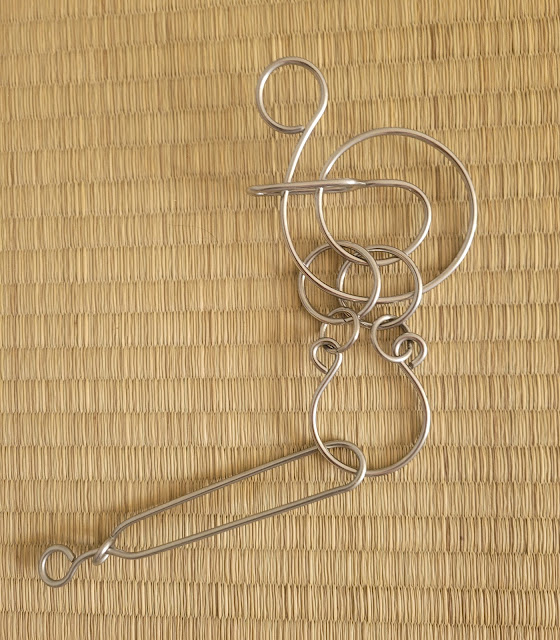
Shuai Chi’s plucky little Dig Ears.
Yet again, my good friend and PuzzleMad foreign correspondent, Mike Desilets, has sprung into the breach! I have had a week off and been away in a place with extremely poor internet access. Whilst puzzling was possible - I never go anywhere without some of my lovely toys to help me ignore Mrs S. Whack! Ouch! Sorry dear. Somehow, as he always does, he senses (does he have some form of ESP?) that I need him to fill in for me and an article arrives in time. Thank you mate, I really owe you! Over to Mike:


Aloha Kākou Puzzlers,

This shall be a very modest post. I’m trying to keep the typing fingers limber more than anything else. I also, unexpectedly, experienced some great puzzling over these past few weeks, so wanted to spread that joy. Without further into, let’s start in with a really fun new disentanglement from Shuai Chi - “Dig Ears.” (Ed - I discussed it here) It was included in Aaron Wang's last annual mega-batch of puzzles, which I insist is his best and most diverse yet. Shipping has been a challenge for many makers and purchasers this past year, no surprise to most of you, and Aaron’s box took a good several months to arrive. He remained in close contact during the whole period, however, tracking the package; it was never a serious concern. Aaron’s service is as outstanding as his puzzles. (Ed - I totally agree)

Whenever I get Aaron’s annual package, I immediately search for the one or two puzzles that are below level 10 (Ed - hahaha, me too!). As those of you in the know, know, Aaron’s disentanglements are always very challenging. I’ll just go ahead and all-caps that, VERY challenging. Aaron basically invented the 10+ category. I have yet to solve a complete batch before the next one arrives (some 12 months later). At this point I am faced with an impossible backlog. I believe this is the case for the entire PuzzleMad staff. (Ed - seeing as that is just you and me, I definitely agree!)

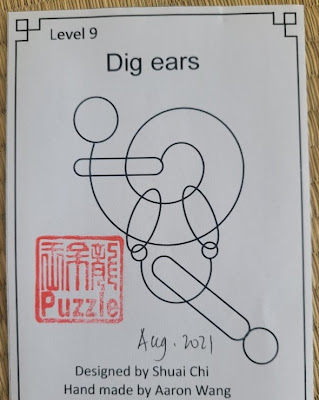
The insert.
Anyway, when I saw Dig ears clocking in at a manageable level 9, I knew I had a chance.  Also, no string involved, yet another plus. Three weeks and a few widely interspersed sessions later, I had the shuttle off and had also achieved repeatability. It was a great day to be alive! The old hands know what I mean. (Ed - 3 weeks? That is pretty good for this one! I think it took me 2 weeks and I am supposed to be quite good at wire puzzles)

I highly recommend dig ears to all serious puzzlers, even if disentanglements are not your thing (which seems to be quite common, unfortunately). It’s hard to express the brilliance of this modest little puzzle. Shuai has done a really great job here, and I can see why Aaron chose to make it. Like most innovative disentanglements, it takes known elements and combines them in a new way that is at first (and sometimes forever) quite baffling. In this case, you immediately recognize the classic ‘cowboy hobble’ form of the main component, but then the spiral arm is extended a full extra turn. The other dangly bit is hung off the main body with it’s two rings and finally the shuttle hangs off that. The very first move seems obvious, but the second is far less so. I would even say that it’s the main challenge of the puzzle. Once you have that licked, the third and fourth should fall into place without tremendous effort. Reassembly will be a little tricky, even if you were wise enough to pay close attention to your procedure. If I’ve learned anything at all doing this stuff, it’s to slow down and study individual moves before taking next steps. Even with this, however, there is a degree reverse-solve required; things just don’t look the same going backwards. By the end of the process, however, you should fully understand the puzzle. It’s really unlikely you will get it back together unless you do.

This is a very satisfying puzzle, and it is not impossibly hard. Just regular hard. You can (and should) THINK© your way through this one. In fact, I would say that the THINK-fiddle ratio is about perfect. My personal thanks go out to Shuai for creating this design, and also to Aaron for the flawless craftsmanship. Proportioning and tight tolerances are really critical for this kind of puzzle. It’s a stainless-steel beauty and will take an honored place in my collection.

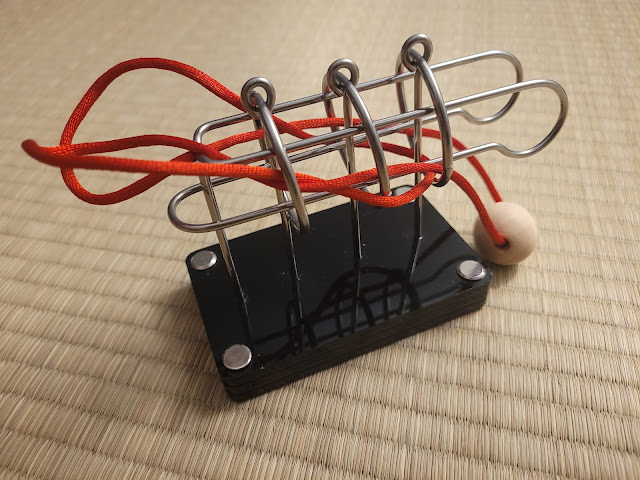
Dig ears has inspired me to work diligently on this new batch and resist the procrastination which these really hard entailments inspire. I was well on the way to solving “cable car”, but somehow got myself all mixed up in the middle of the process. I need to gather my wits and get back at that one. But I can tell you already, for a fact, that it is a great puzzle. And also, a very handsome puzzle. It would be on my top shelf, if my house had shelves.

Cable Car. I love this one. I’ll love it even more once I solve it.
(Ed - I also bought this one - it's actually called Cableway, I was thinking that it would be a relatively straightforward N-ary type puzzle but the construction of the doubled over frame means that the expected N-ary simple moves cannot happen. At present I am completely stuck on it and still at the beginning)

Before we close, I’d like to throw a quick ‘me too’ in the direction of Allard Walker, friend of the blog, who recently posted on Join Liu’s Axes and Hammer puzzle. Kevin Sadler, occasional contributor to PuzzleMad, also gave it a very positive review in July of last year. Those gents have about covered it, so I’ll only say that I fully concur. This is truly the freshest, most interesting take on Robert Boomhower’s 1966 classic in a very long while. That’s really saying something, since it is one of the most widely copied and modified disentanglements of all time. Axes and Hammer is also extremely well-made and I have been fondling this puzzle in my front pocket (as far as you know) for days on end. (Ed - we all believe that is what you are doing in your pocket!)

Axes and Hammer from Join Liu, 2020 IPP Design Competition entrant.
Finally, I want to extend a heartfelt Thank You to Cubic Dissection for the beautiful Slideways puzzle I recently received. I was lucky enough to be the winner in their last puzzle lottery. It was a pleasant (and shocking) surprise; like my editor, I never win anything at all, not a damn thing. This little puzzle is stunning, as you would expect from Eric and his dissectors. It reminds me that I should perhaps be more diligent about tracking CD releases. To be honest though, the very thought of participating in a quarterly electronic mad scramble is stressful and off-putting. Most likely I will continue to check in late and search for table scraps. Fortunately for people like me, CD often produce multiple editions of the very best puzzles, which helps a lot.  

Slideways, among the best CoMo puzzles of all time. You can’t have too many copies. If I had to have just one, it would probably be this CD version.
(Ed - Yes I have to agree about how good a puzzle this is - I have a metal version of the plain burr and also a couple of Pelikan variants - stunning puzzles and fun to fiddle with)

Ok, that’s all I have, back over you Chief…


Wow! A nice romp through some really wonderful puzzles! If you get anywhere with Cableway then you might have to give me a hint. Thank you so much for all your efforts and I hope that you continue to enjoy your puzzling and chat with us about it soon. Take care mate!

Sunday, 12 December 2021

Mike Saves My Bacon...Again!

Happy Sunday everyone! I have been rather strapped for time yet again - work has been very busy both with clinical stuff and quite a lot of admin too. I had to work yesterday and have not really had any time for puzzling. Despite this, thanks to my good friend, Mike Desilets, the official PuzzleMad foreign correspondent, I still have a fascinating post for you. I don't know how he does it, Mike always seems to sense when I am struggling for time and comes up with the goods for me/you. This time he did it in the guise of asking for some help with a puzzle he had been struggling with but I know that he is too good a puzzler to need help and it is just an excuse to get in touch with yet another article. I hope to get back to normal puzzling this week (although I am working next weekend as well) - if anyone else has a nice article for the PuzzleMad readers then please get in touch. Over to Mike...


Aloha kākou puzzlers,

I know we have yet to close out the story of the Great 13, but let’s please forget about that for a while longer. Instead, the PuzzleMad Foreign Office, Hawaii Branch, offers up this quick and dirty post, designed specifically to provide Kevin with a free weekend (Ed - yay!). Free from blog posting, that is to say, not free from his actual day job, which does not respect weekends. He deserves so much more, but this is all I can muster at the moment. Today I share with you some recent output from the PuzzleMad Workshop, which is conveniently located in a sub-basement 200 feet below the current Mrs S’s house. (Ed - how come I don't have access to this area? It would definitely solve my storage issues)

John Horton Conway (1937-2020)
Years ago, George Bell turned me on to a very interesting problem known as Conway’s Soldiers. This problem was first proposed in 1961 by the eminent mathematician John Horton Conway. John has, tragically, left the room, having been one of the very early covid victims. But he left behind a massive legacy in a variety of fields. The Conway’s Soldiers problem, or puzzle, is surely among the mildest of Conway’s accomplishments. If you’re not familiar with John Conway’s varied contributions to mathematics, go check the wiki right now. They’re quite remarkable. And, unlike the great majority of mathematics (and mathematicians), also interesting, relevant, and accessible to the average fellow, at least in broad strokes. Most puzzlers probably know Conway from his combinatorial game theory work, of which Conway’s Soldiers is a small piece.

 Disentanglers might be familiar with his knot theory work. Everyone is surely aware of his Game of Life (Ed - I programmed this into my school Tandy TRS80 in 1979 and even learned Assembly language because the Basic was too slow). If you hadn’t kept pace with his recent work, Kevin, then I highly recommend checking out his (and Simon Kochen’s) Free Will theorem and its implications for the ever dubious, but somehow inextinguishable, deterministic worldview. I actually thought that whole thing was put to bed decades ago, but I suppose people are still free to choose determinism (or are they?). Anyway, the point is that you will benefit greatly, and in unexpected ways, from engaging with Conway’s vast and varied body of work. 

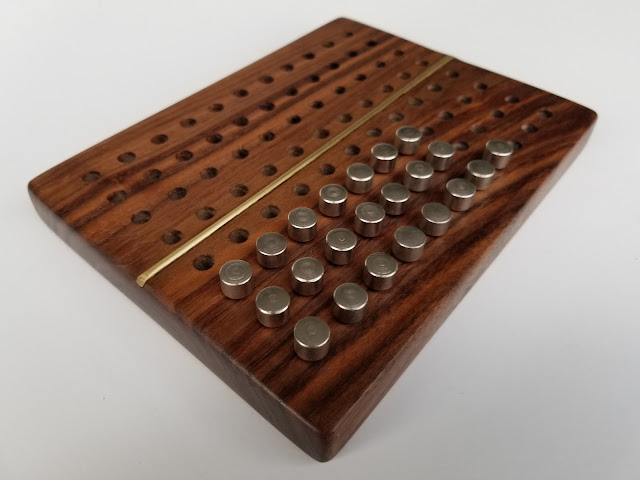
Conway’s Soldiers, the mechanical puzzle.
For my part, being a simple puzzler, I was drawn especially to Conway’s Soldiers and its peg solitaire aspects. A couple years ago, in a flash of brilliance, I realized that creating a physical version of this abstract puzzle was within my ability. It is truly the simplest of designs, consisting of gridded peg holes and a line dividing the plane. A full year and a half after the initial inspiration, I made the puzzle. The lag was partly due to the location of the PuzzleMad Workshop, which is not convenient for me (or Mrs. S, for that matter).  (Ed - I NEED to know how to get there - it will allow me to make puzzles and even get a 3D printer!)

Conway’s Soldiers poses a simple question: Using conventional (but non-diagonal) peg jumping rules, how far above the “line” can you get your pegs? No amount of trial will ever prove an answer, of course, so in terms of a mechanical puzzle, it is not really a “solvable” problem. The question can only be answered (proved) mathematically, and Conway did this, showing that the fourth row is the maximum possible. His proof utilizes the golden ratio, by the way, which is fascinating in itself. It was later shown that allowing diagonal moves will get you as far as the eighth row. There are numerous web pages about the puzzle where you can study previous work and variations. You need to read the 2007 article by George Bell and his colleagues Daniel Hirschberg and Pablo Guerrero-Garcia, The Minimum Size Required of a Solitaire Army. Bell et al. solve a problem that actually does make a good puzzling objective: what is the minimum number of pegs needed to achieve a given row?

Look at those rings Kevin!
(Ed - drool! That is some beautiful wood)
Although not rigorous, you can kind of work this out yourself on the board. The trivial row 1 and 2 arrangements are shown below, mostly as an excuse to insert more pictures of my pretty game board. But I won’t give the solution to rows 3 or 4; you’ll have to read Bell et. al. or do the experimental work to figure those out. You can, however, assume that the number of pegs needed to achieve row four is equal to or less than the number peg holes on either side of my board (Ed - OMG - that looks quite a tough challenge). 
Solution for row 1, requiring two soldiers.
Solution for row 2, requiring four soldiers.
As you can probably guess, the PuzzleMad board is made from American Black Walnut and the pegs were scavenged from an old Setko puzzle. It is fairly simple to construct, just drill a grid of evenly spaced holes and insert a dividing line. Drilling the grid was tedious but straightforward. The line, in this case, is an inlaid half-rod of brass. Inlaying it was actually very tricky and stressful, but it did turn out well in the end. I learned in the process that you can use a drill press as a rudimentary router. I was afraid this might overly stress the bit, but it was actually a really smooth cut. Overall, a nice little DIY project for the amateur puzzle-maker.  (Ed - sob! One day I will make some puzzles...probably after I have retired)

In perspective.
John Conway has left us with a very enjoyable little diversion in the Conway’s Soldiers puzzle. Even if you cannot follow his fourth-row proof, you can surely figure out, eventually, how to arrange and sequence your army to achieve it. You can also, if you like, dwell on the more philosophical “diminishing returns” aspect of this problem. I think most people would intuitively believe that any level above the line is achievable, given enough soldiers, but the truth is that there is a hard theoretical limit, and that limit is surprisingly low indeed. 

That's about all I can muster for this mini-post Kevin, please take us home my friend...


My goodness! Thank you so much Mike. That was wonderful! You have given me (us) a nice bit of enjoyable reading to do and anything involving JHC and also George bell is always fun! I absolutely love the beauty of your home made constructions (even if they were apparently made under my home - I was totally unaware that I even had a basement).

Mrs S has had her booster yesterday and is feeling quite poorly - I had better go and offer her something sweet and sustaining as well as maybe some paracetamol or ibuprofen. Be careful out there everyone. Go and get your booster shots. The evidence seems to be that Omicron is significantly more transmissible and even if it tends to cause slightly less severe illness overall (we don't actually know that for certain yet) then by sheer numbers, a lot of unvaccinated people are going to end up in hospital or even dead. In our hospitals, the ONLY Covid admissions are the unvaccinated or the immunocompromised. The current vaccines with booster DO protect against severe illness. A Covid death is a very unpleasant way to die - go and get yourself immunised and help protect your health services as well as the vulnerable and yourselves.


New PuzzleMaster kickstarter campaign
Whilst you are here, there is a Kickstarter campaign being run by the PuzzleMaster guys: They are crowdfunding the production of three fabulous looking new metal puzzles. The skull is a design by Jerry Loo and consists of 67 interlocking pieces - it looks incredible! The other two puzzles are level 9 and 10 on the PuzzleMaster scale and also look fun.  This will run until New Years Day and certainly looks worth your attention - I have backed it (backer number 25).


Mind the gap
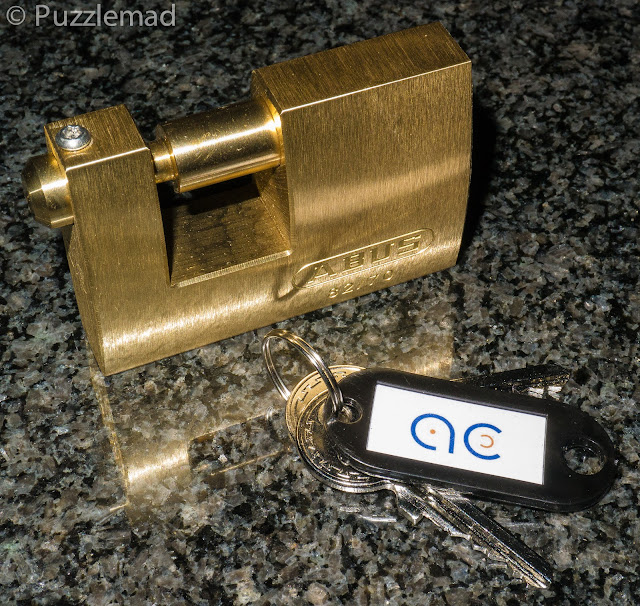
Also, my friend Andrew Coles, has created another puzzle lock, the "Mind the gap" puzzle. It will be available to order from his site quite soon. I have received my copy and hope to play soon. 


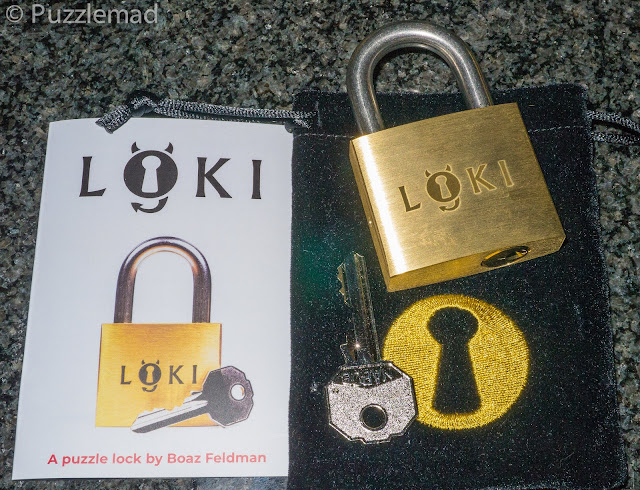
I have had no luck yet solving Boaz Feldman's latest creation - Loki, and suspect that locks are too difficult for me!

Sunday, 27 June 2021

ACT II: Breitenbach’s Great 17 Variant

William Breitenbach’s Great 17 variant, as interpreted by me, channeling Calvin O. Brown.
How does he do it? Despite having massive upheaval in his life, my friend and co-conspirator Mike Desilets manages to produce not just a bit of fluff (usually how I would describe my drivel) but a major puzzling exposition. A deep analysis of a subject that completely confounds my powers of understanding and at the end leaves me with a much deeper knowledge of a subject that everyone is aware of but very few get to properly understand. I have had a tough week at work and have only just managed to solve a couple of puzzles yesterday. This guest post gives me a bit of a breather in my publishing schedule - thank you my friend.

Over to Mike...

Aloha kākou puzzlers,

Following fast on the heels of the previous Foreign Office post, and at the sufferance of my editor and patron, I present today YET MORE peg solitaire (Ed - hooray! I need to learn more). I only hope that George B., John B., and Kevin find this interesting. If anyone else does, that’s a bonus.

As you recall, we left off looking at an unproduced variation on William Breitenbach’s Great 13 puzzle design. We saw that, with only slight modification, the Great 13 can be infinitely expanded, and in either ‘direction’ to boot. Having discovered this, Mr Breitenbach took the time, effort, and expense to acquire a design patent for what I have designated the Great 17 solitaire puzzle.

But that is not the end of this story. As observed in the last post, you cannot realistically expand the Great 13 puzzle much over 17 places for practical reasons of size. It is also far from certain that progressively increasing the number of places in a solitaire puzzle enhances the puzzling experience. Quite the opposite, at least in my experience. But it is possible to modify a solitaire design in another way, and that is to tinker with the rules for allowable jumps. As you shall soon learn, this is precisely what Mr Breitenbach did.

Patent illustration for Great 17 variant.
Breitenbach’s exploration of the hidden potentialities of the Great 17 resulted in a very interesting variant, for which he applied and was granted a U.S. Patent on April 25, 1899 (downloadable from here). We will call this Great 17 variant 17v. For temporal context, Kevin, this patent was awarded one month after the Great 17 design patent was issued, and a full three months BEFORE the patent of the now-classic Great 13. It is also worth noting that the 17v patent was issued as a utility patent, whereas the Great 13 and 17 patents were design patents (you can tell this from the patent numbers, which are different sequences). Utility patents are specifically awarded for the mechanics of an invention, how it functions, whereas design patents are intended to protect the form or appearance of an invention. I don’t know exactly what to make of Breitenbach’s patent choice, but I have the nagging feeling it is meaningful.

Considering the distinctive parallelogram shape of 17v, it seems clear that more than a little thought went into the design. Stretching and squashing the puzzle, although not directly affecting play, was clearly intentional. Maybe this produces a little visual confusion. If nothing else, it certainly distinguishes the puzzle from G13 and G17. This may actually have been critical to getting the patent application past the patent inspectors/researchers. Possibly the utility patent choice also came down to this as well. Two design patents for VERY similar designs (not to mention G13) may have been a hard sell. I don’t know if the utility side of the U.S. Patent shop researched design patents when checking for originality.

Can you spot the difference between 17v and the original Great 17?

Appearance considerations aside, let's take a look at what Mr B came up with. It’s pretty straightforward actually. Taking the basic Great 17 structure, four of the diagonal movement options are removed. You can also conceptualize this as the complete removal of the center rectangle, which it is. We are left, then, with two concentric rectangles connected to the center position by eight radial lines. As George Bell rightly observes (and he of all people would), the result is a clock solitaire-like structure. If you don’t know what I mean by clock solitaire, first of all, shame on you, and second, please go to George’s solitaire website immediately and educate yourself. George’s article on clock solitaire is provided here, to save you a few clicks. I also highly recommend you purchase the only commercially available instantiation of clock solitaire from the very good folks over at Creative Crafthouse. (Ed - I have it and it is a fabulous version)

Made for George and now available to buy with quite a few challenges in the booklet
Once you have done all this, you will understand why 17v is clock-like. The fatal flaw, however, is that 17v is rectangular, not round, on the outside. Hence, you cannot communicate all the pieces continuously around the dial, only the corner pieces. From a clock’s perspective, this is intolerable. But it is possible to “clockify” 17v (see below). Rounding the outer race gives us a proper clock shape with 8 outer positions and 8 inner (as opposed to 12 outer and 6 inner for standard clock solitaire). Play around with these, if you will, and note any interesting properties in the comments section.

Some Breiten-clocks.
Setko-style Breitenbach 17v.
As you know by now, when I find an obscure historical puzzle, I am compelled to make a version. Predictably, I modeled it on the standard Setko 5.5 x 5.5 inch board in American black walnut. Note the Eye of Sauron, which is a little menacing and probably not the best choice (Ed - the whole thing is stunning!). I also could not think of a good way to inscribe ‘guidelines’ to show the allowable moves. Thus it’s somewhat abstract and probably not suitable for general consumption; but hardly a problem for the seasoned solitairian, of course. I did make the effort to retain the precise proportions and angles of the patent illustration, so on that count at least, it is a faithful instance. It may well be the only instance, in existence.

Pretty grain and perfect pegs.


George Bell and John Beasley have given this little puzzle some thought, and also some computational treatment for good measure. From George’s work, we now know a few things about the 17 variant (Thanks George! Let me know if I don’t get this right). In addition to the standard center compliment problem, other compliments are also solvable. It is important to first observe, however, that the puzzle has only five unique positions (1, 2, 4, 5, 9 can represent them). Of these, compliments for positions 1, 2, 5, and 9 are solvable. Position 4, somewhat inexplicably, cannot be solved for compliment. If you remove the position 4 peg, you can only end at positions 1 or 17. Beyond compliment problems, there is a broad range of ending position solutions for starting positions 2 and 5. From either of these, you may end at 7, 8, 10, 11, 13, or 16.

Place numbering schema for George Bell’s analysis
The larger point, Kevin, is that there is always more to a solitaire puzzle than the conventional center compliment (as we already saw with the Great 13 in Act I). One of the most enjoyable and original challenges, for me at least, comes from the good Doctor John Beasley. John proposes removing the center peg and ending with only the four corners in place. The corners can (and must) move, some of them at least, but they must end back at the corners. This is a very clever challenge the discovering the unique dynamics involved is hugely satisfying. It is comparable to learning an entirely new board. (Ed - for some reason, when I thought about that challenge my whole body went cold and I shuddered! It sounds impossible!)


I’m sure there are many solutions to the central vacancy/four corner problem, so it won’t be a great spoiler to present one of them here. I show this one because I really like it, and I really like it because it demonstrates the beauty possible in a solitaire solution. That’s important, because when you find a beautiful solution, you tend to remember it. And if you remember in a manner that doesn’t involve rote memorisation, one could even say you ‘understand’ the solution (Ed - hahaha! Me? Understand one of these? NEVER!). Consistent with the highest PuzzleMad standard, you have solved the puzzle.

It takes a little work to follow the solution movements in the illustration above. Sorry, that just the nature of trying to show the solution in a reasonably compressed manner. You can actually just look at the final movement sequence and its beautiful symmetry, that’s all you need to understand its attraction. And thanks to the mysterious properties of the Breitenbach Singularity, the final two movements can even be made simultaneously! (Ed - I noticed that and find it somewhat unbelievable. Quite beautiful!)


Since you all seem to enjoy cryptic solitaire movement diagrams as much as I do, I’ll treat you to a couple more. These are intended to beat to death the point made above and also way back in Act I, to wit, solutions to peg solitaire puzzles are ideally more than arbitrary movement sequences. For Breitenbach’s Great 17 variant, I happen to have found a couple interesting solutions. Check out the image below. This is a pleasing clock-work solution. The beauty of a solution like this one is that once you discover the basic concept, you will always and forever know how to solve the puzzle. An arbitrary, unstructured solution, by contrast, will generally need to be memorized, which I suppose counts for something. But under the Puzzlemad solving hierarchy, it is unquestionably a lesser form. A memorized solution, like a random string of numbers, is unlikely to stick in your long-term memory. A concept-based solution, like the password you use on all your accounts (with minor variations), generally will.


My favourite and most memorable center compliment solution is not clock-style, however, with all due respect to George and John. There is actually a solution so simple in concept that I guarantee, once learned, it will stick. It is relentless and rather gruesome actually. It is based on the fact that pegs on a radial line, any radial line, can be formed into a type of buzz-saw. It takes just two moves to set up (if using the vertical and horizontal lines in the diagram, the moves are actually mandatory). After this, simply transport all the outer pegs to the center position, one-by-one, and dispose of using the reciprocating peg. Be sure that the final pair is adjacent to your set pegs, and then perform a clever little clean-up operation. This works with the original Great 17 as well, of course, but I didn’t seem to see it on that board. The diagonals beg your attention on the Great 17, but without them the radial structure dominates and I think facilitated discovery of the cross-cutting solution.

I’m sure there are many other interesting concept-based solutions for you to find. I wanted to share these two mainly to illustrate and drive home the point that peg solitaire can and should be far more than a series of trial and error attempts ending in an arbitrary solution. The sophisticated puzzler should aim higher, and solitaire boards will reward those who do. I suspect most casual puzzlers don’t know this about solitaire. I didn’t until I finally started to THINK©.

This wraps up the trio of Breitenbach solitaire puzzles, one of which is well known and has echoed forth to the present day. The other two were apparently never produced for one reason or another. Circling all the way back to my original declaration, I think the Great 13 was the right choice to produce, and indeed its seems to have hit the sweet spot for both the turn-of-the-century and the modern puzzle consumer. Once the Great 13 was on the market, there was likely no need for a slightly larger and very similar looking Great 17, nor indeed its bastard variant, 17v. For the 21st Century metagrobologist, however, they sure are fun to toy around with. (Ed - I'm not so sure - my brain hurts now. It is probably better with a physical puzzle in your hands.)

I suppose that is QUITE enough peg solitaire for one day. After suffering through this article, you are probably all desperate to get back to Kevin’s beautiful puzzle porn. Me too. But please stay tuned for Act III, which will be delivered to PuzzleMad HQ whenever I get around to it. No headache-inducing diagrams next time, I promise. Now, as always, a closing word from the most tolerant and beneficent editor you will ever have the pleasure to write for...


Beneficent? Wow! I have never been described as that even by the present Mrs S! Thank you so much Mike! What an exposition! I am truly amazed at your skill and knowledge. You certainly made me Think and even made me go back to George's peg solitaire board and play - yes, I failed to solve almost all the challenges yet again. I love the idea of these and love that they can be properly analysed but I wish I had the ability to look at a board and see an approach/solution.

Mike is right that next week will be back to the usual semi-incoherent rubbish that I usually post on the internet! I have been trying to acquire and solve some new interesting stuff for you.website

Sunday, 9 May 2021

The Breitenbach Singularity

Setko’s Bullseye, grandchild of W.C. Breitenbach’s Great 13.
Hooray! I am finally feeling better! Thank you to those of you who sent well wishes, I really appreciated it. I was contacted by Mike apologising that he had let me down but he really hadn't...he had sent today's post the day before I got sick and it had been my intention to edit and post it last Sunday but could not get out of bed or off the loo for long enough to even log on. I have lost a considerable amount of weight and Mrs S has said that this confirms that I am "full of $&*t" as it all left me over a torrid 5 days. So, today is the long awaited next post in the Setko series from my wonderful friend and PuzzleMad foreign correspondent, Mike Desilets:

Before I let Mike take over, I must point you all to the TwoBrassMonkeys store where Big Steve and Ali have released Number 4 in their Brass Monkey series. Promising to be different to the previous iterations, they claim it a "puzzler's puzzle". How could any of us resist? I haven't and it should be posted to me tomorrow. I will no doubt let you know my thoughts but if it is anywhere near as good as number 1, number 2 or number 3 then I will not be disappointed. Go buy it whilst stocks last.

Now over to Mr D...


Aloha kākou puzzlers,

Since the last communique from the PuzzleMad Foreign Office, Hawaii Branch, I have enjoyed a lively correspondence with noted peg solitaire analyst George Bell, and at a degree of separation, even more noted mathematician, computer scientist, and peg solitairist John D Beasely. What follows is largely inspired by those exchanges, but of course the foolishness, misrepresentations, and errors are all my own. It is a fairly small subset of the community that take a serious interest in peg solitaire puzzles, which is unfortunate, but hopefully this post will encourage many of you to give them a try. The cost to value ratio is exemplary. (Ed - I have asort of fascination for them but really do not have the skills to solve them).

Now, I have to confess right off, the English 33-peg swiss cross and its many variants, of which you are all painfully aware, have never been my thing. These DO deserve your attention, and George Bell has given the musty old cross some especially serious attention, (article here) which you should make it a point to study (yes, you will always receive a homework assignment from the Foreign Office). But working a 33-peg board is often a real pain in the arse (Ed - I am sooo pleased that you have used the correct expression and not the American donkey!), especially the constant board resetting needed when, a good 25 jumps in, you discover an irretrievable peg. Let’s put it this way for now, those standard commercial boards are really just gateway drugs; there exist better, more potent drugs, if you are willing to search them out. 

So then, how does one improve on a classic puzzle? If it involves 33 moving pieces, a good first tactic would be simplification. The well-worn truism applies: the most elegant puzzles are those wherein a minimal elements produce maximal challenge. Geometric symmetry doesn't hurt either. The 33-peg cross board has a very pleasing shape, to be sure, but it does not shout elegance (which should never be shouted, Kevin) (Ed - as an almost cockney, I have nothing to do with elegance!). This was noticed well over a century ago during puzzling’s Golden Age, and many great solitaire innovations were the result. We will focus in on one particular designer from that era and see if we can’t expand our consciousnesses ever so slightly.

Original 1899 design patent drawing, The Great 13.
Kevin Sadler, Eggman to my Leper Messiah, you know exactly where we are heading now don’t you? Yes! We are going to look at the brilliant work of late Victorian era puzzle designer William C Breitenbach. The cultured among you will instantly know Breitenbach from his most influential and long-lived peg solitaire puzzle design, The Great 13 Puzzle. The design for Great 13 was patented by Breitenbach on July 25, 1899 (Patent). You will find a nice picture of it in your copy of Slocum and Bottermans, New Book of Puzzles (turn to page 99). Regrettably, I cannot show you a picture in this post because I am writing several thousand miles away from my stuff. I’ll include it in Act 2, at a later date. 

The rules of Great 13 are just as you would suspect: jump peg-over-peg (marble-over-marble if you are lucky enough to have an original), in any direction, removing the jumped peg. The center starts empty and the puzzle is solved when you discover a series of jumps which place the final peg back in the center. This is known in the industry as the center compliment problem. With only 13 pegs, and a beautifully symmetrical design, I consider this puzzle as among the most elegant of the entire class. Mr Beasley observes that the allowance of diagonal moves “does tend to make the game too easy.” Fair point. However, I think for the average person-on-the-street, it’s a fine and fun challenge. The general public was, after all, the intended audience for the Great 13. There is a replay-value angle as well. Solving Great 13 once does not guarantee success on the next try. As we will explore in Act 2, the ability to solve a puzzle is one thing, the ability to solve it every time is quite another. The later is the gold ring and the PuzzleMad standard. (Ed - if only I could solve things more than once!)

For some very useful analytics on Breitenbach’s Great 13 design, please now flip to page 10 of John Beasley’s 2014 IPP paper An update to the history of peg solitaire (Download it from here). Mr Beasley has generously provided some hard boundaries for your exploration, regarding especially what is and is not possible to achieve on a 13-hole diamond board. In so doing, he also provides the motivated puzzler with many fun challenges beyond the classic center complement. Quoting directly from the article:

“With the help of diagonal moves, the following single-vacancy single-survivor problems can be solved:

  • Initial vacancy at 1: the final survivor may be in any hole except 6 or 8.
  • Initial vacancy at 2: the final survivor may be in any of the eight holes around the edge.
  • Initial vacancy at 3: the final survivor may only be in hole 1 or 13.
  • Initial vacancy at 7: the final survivor may be in hole 7 itself or in any of the four corner holes.”

Position assignments for Beasley’s analysis. 

Based on this, you can generate quite a number of unique challenges, even considering the redundancies inherent in a symmetrical board. The latent potential of the Great 13 as a multi-challenge puzzle, so critical to modern commercial puzzle design, was put to its greatest effect by none other than Nob Yoshigahara in his Hoppers. Hoppers was produced by Thinkfun starting in 1999 and is still going strong. Don’t be fooled by the juvenile design, this is a puzzle you should pay attention to. Someday I will do a post about the gems known only to the 5 to 10 demographic. You are walking past fantastic and noteworthy designs every time you take your kids to the toy store (or section). 


Early Bullseye from Setko.
Your instructions.
I don’t know how many versions of Great 13 have been made over the years, but it’s a lot. According to the patent text presented further down, design patents were good for 7 years at the time Breitenbach was working. By 1906 then, the Great 13 design had entered the public domain. Since it was a design patent and not a utility patent, the basic scheme could have been used by others much earlier. It was actually, but that is a story for Act 3. (Ed - soo many acts in this play!)

At any rate, I’m not aware of many produced examples during this early period, based only on a quick survey of the Slocum and Hordern-Dalgety online resources. I do know that by the mid-1960s numerous versions had been produced in the US, most of which are still available and relatively cheap on auction sites. My favorite version, and I think one of the earliest from this resurgence, is Calvin Brown’s Setko version, called Bullseye. That’s clearly a better name, by the way, than Great 13; far more expressive. Bullseye was offered in walnut and oak, with characteristic Setko brass, aluminum, copper, or nickel-plated-something pegs. No other version comes close in terms of raw quality. (Ed - I will need to find one of these in Walnut with nice pegs for my own collection)

Setko means business with these ‘pegs’.

A little back-of-the-box ad work.
I’m not going to focus on the handsome versions just mentioned, of course. The images you see here are instead of Calvin’s earliest issue of Bullseye (as far as I can determine), consisting of a modest pine board with authentic #¼-28 x ½ heat treated socket head cap screws. Prior to producing puzzles as a serious business venture, Calvin Brown’s peg puzzles were in the service of his actual business, manufacturing and selling set screws. The text on the box is pretty clear, and if you’ve handled the Setko ‘pegs’, pretty convincing as well. This is definitely at the top end of the “advertising puzzle” quality hierarchy of the time, and certainly a significant investment for a hand-out. But then recall (from previous post), that Mr Brown had, around this time, patented several new puzzles of his own invention. He was a puzzle guy, so this was probably a completely natural course of action, regardless of cost. It was the first important step on the road to building his independent puzzle business. 

Hoyle/Stancraft marketed version of Bullseye (Setko manufactured). Copper pegs on walnut.

Again, for emphasis, I am without access to my stuff. Otherwise I would show you the pretty versions. The best I can do right now is the above Hoyle (Stancraft) version of Bullseye gleaned from the web. More sophisticated packaging, but still made by Setko. If you don’t have some version of Bullseye in your collection, you really should. If you’ve already spent too much on puzzles this month, as my editor surely has (Ed - how did you know?), you can just make one with a piece of paper and some farthings. I have it on good authority that Mr George Bell does this regularly, it’s perfectly legitimate.

Cool as they are, I wouldn’t highlight the Great 13 and Bullseye unless there were something more to the story. Kevin wouldn’t keep me on staff if I couldn’t tell you something you didn’t already know. So, for the next part, I’ll limbo under that bar. (Ed - so flexible! I'd just fall in a heap)

The Great 17 (13+4=17).
The Great 13 puzzle (and its' later reproductions) gets all the attention from collectors and analysts, and it is no wonder, given its simple elegance and great longevity. It has the advantage that it was actually produced and sold. But, as most designers tend to do, William Breitenbach also explored other variants, none of which appear to have made it to market. One example is what can only be called The Great 17. This design was patented March 28, 1899, four months before the Great 13 patent issue (Patent). 

Looking at the Great 17, we see that it is an extension of the Great 13, simply adding an outer square perpendicular to the last. Rules of play are not listed in the patent, but we can assume they are precisely the same. This extension, adding only four new peg places, obviously complicates the puzzle quite a bit. It may just be the answer to the easiness issue dispensed with above. 

Unfortunately, you will have to look elsewhere for any kind of technical analysis of the Great 17; I don’t have anything whatsoever to offer. I can only hope that the recreational maths portion of the readership become intrigued (Ed - George, please feel free to send me stuff to append or even create an extra guest post). The questions here are potentially much broader than simply establishing parameters, maxima, minima, etc for a larger version. What we should be concerned about are Great N problems. Thirteen is apparently the limiting minimum size for this puzzle, but it can be extended infinitely thereafter. At every iteration, you simply add an outer square. It's in the picture below.

Infinite possibilities, of a single type.
Great N analysis would look at what this growth entails. Take something like the fewest moves for center compliment. What is the growth curve of that quantity? Is there a formula for determining the fewest moves for arbitrary n? Would a brute force calculation end up NP-complete? Or, from a puzzling perspective, is there an elegant way to always achieve fewest moves, some kind of deep pattern that remains consistent as n grows? There are dozens of questions of this kind. (Ed - I wish I understood what you were talking about! George?)

This could take forever to solve.
Alas, you will never get the answers from Kevin or I, that is safe to say. This requires the services of the gentlemen mentioned earlier. Let’s shelve the technical stuff for now. In a practical sense, as a mechanical puzzle, you can’t really grow the Great 13 much past 17, because each new growth doubles the area of the puzzle. It isn’t obvious at first, but looking at the progressive G-13 to G-21 images above, you can see it better and measure off the changes. Visualize folding. The newly added area for each iteration equals the previous (now inner) total area. With this doubling rule in effect, a Great 13 puzzle, beginning at a very modest 2-square-centimeters will after 26 iterations be the length of George Bell’s great state of Colorado. It gets big fast. It also gets small fast. I wasn’t quite right previously when I suggested that 13 was the bottom. As it grows outward infinitely, so too does it grow infinitely inward. There is no bottom. The Great 13 puzzle is simply a slice two layers thick (so to speak) of an endless fractal.

This is all very interesting, says Kevin, but what does it all mean? Well, my friend, the Great N perspective answers the age-old question of why there is a point in the middle of Mr Breitenbach’s puzzle, and why the center compliment is the most beautiful form of play. As the internal squares become smaller and smaller, in an infinite progression, they converge on the precise center of the puzzle, ending in a dimensionless point. Notice that all the other peg places are on vertices of the squares. The Great N center peg, however, is on a special point which can be thought of as encompassing all vertices and all lines (the dimensionless point of collapse). That is why it is appropriate to place a hole there, why it is especially appropriate that it be vacant at start of play, and why it is surely most appropriate that the final peg end in the center, effectively swallowed by the singularity. Kevin, you dullard, Great N theory allows us to finally construct a solitaire puzzle in which NO PEGS REMAIN! (Ed - I am definitely a dullard - you lost me several paragraphs ago!)

That concludes Act 1. We have not even gotten to the good stuff yet. The third Breitenbach design is a real kicker and I can’t wait to tell you about it. And Kevin, thanks for the very kind mention a few posts back. It’s always a great honor to have my musings on PuzzleMad. You’ve built something really special here and I’m thrilled to be a part of it. I’ve just consulted the staff and we agree that the Foreign Office is committed to another 10 years of unscheduled, infrequent submittals. Take us home my friend...


Wow!!! What a tour-de-force! Thank you so much, my friend. I am in awe at your puzzle writing skills. You make me look like a rank amateur. You have even committed yourself to another two articles on a similar subject. These puzzles look so amazing and I really must try and obtain some tice copies for my own puzzling and collection. I have very few vintage puzzles. My words from my tenth anniversary post were very sincere, you have considerably helped me in this journey and I am very grateful for everything you do. I am looking forward to another 10 years of guest posts from you.


Sunday, 4 October 2020

What once was lost, now is found...

Calvin O. Brown and Setko.

Setko reproduction courtesy of the Puzzlemad Workshop, Hawaii Branch.
Hi guys, at this very moment, I will be working anaesthetising the elderly old ladies of Sheffield who have broken their hips ot the young crazy ones who have gone out in the pouring rain on their motorbikes and lost control at high speed. There's always someone who needs putting back together...even on a Sunday. Luckily for me, my good friend and PuzzleMad foreign correspondent (pretty soon in this strange world we won't be allowed to use the word foreign) has stepped in at exactly the right time with a fantastic exposition on a puzzle and story I have never come across before. Thank you Mike, over to you...

Aloha Kākou Puzzlers,

The last few foreign office submissions have been rather light fare. It was fun writing those, but in all honesty, it was mostly procrastination when I should have been working on this present post (Ed - I really enjoyed them!). I’ve been “working” on this post for well over a year, and I’m sure by the end you will be wondering why, to which I can only reply that you’ve probably never tried to write something interesting and half-intelligent for an international audience containing an abnormally high proportion of geniuses. It’s a little intimidating. Let me just say this: Kevin and I don’t intend to metagrobologise (Ed - is that a real word?) indiscriminately all over your computer, if it can at all be helped. Hopefully the long lead time has led, in some small way, to a better post.

We return, once again, to the less-traveled realm of the vintage mid-century puzzle. As you know by now, I have a particular attraction to this under-appreciated period. Many of its mechanical puzzles clearly benefited from the broader design aesthetic of the period. This is pleasing to those of us who believe that a great puzzle should also strive to be a beautiful puzzle. Those that follow, I think, achieved that end.

Zig-Zag, a Calvin O. Brown original.
First up is Zig-Zag. Zig-Zag is the invention of little-known puzzle designer Calvin O. Brown (1907-1970). Mr Brown was president (and founder) of Set Screw and Manufacturing Company, originally based in Bartlett, Illinois. Set Screw was established by Mr Brown in 1935 and remains in operation today, still family owned and operated. Moreover, one of Calvin’s granddaughters runs Setko, an offshoot company and direct descendant of the original Set Screw. The current Setko does not make puzzles, but rather various specialty screws and fasteners. The Setko name, however, was originally established by Mr Brown for his puzzle line, once it had developed into a marketable commodity. You’ll see it in that context for anything pre-1972. Fellow (and far superior) collector Rob Stegmann has a very complete collection of Setko puzzles. I am nearly there, only one more to go I think. Rob and I also have one Setko that you will never find. More about that further down.

Detail from the Zig-Zag patent, showing goal state.
Calvin O. Brown was an innovator in his field and was awarded a number of patents throughout the 1950s for various set screw innovations, including both the screws themselves and their manufacturing process. At precisely the same time, he also patented four puzzles, mostly of the peg-jumping transpositional type. One of these was Zig-Zag, filed in 1955 and awarded in 1957. You can check out the full patent here.

Zig-Zag with box and instructions.
Tannins in the walnut clearly affecting the box, except where shielded by pegs (top) and the price tag (bottom).
Zig-Zag is really a very fascinating puzzle, and I think that had it been introduced during the golden age of puzzling, it might be counted as one of our classics. Like the best of the early puzzles, its superficial simplicity belies a confounding complexity. Let looks at how it works.

Zig-Zag consists of two types of peg and the puzzle board consists of 15 holes and a trough. The pegs need to be arranged in the trough in such a manner that, following the placement rule, the receiving holes are filled in an alternating, or zig-zag, pattern. The placement rule is where the action is, of course. And it’s quite simple. For a given arrangement in the trough, you must alternately 1) place a peg in a hole, then 2) place the next peg at the end of the trough. Repeat, placing the third peg in the next adjacent hole, then the fourth peg to the end of the trough.

That’s sounds pretty simple, but what you soon learn is that the pegs placed at the end of the line come to the front very quickly, and they must be in the correct sequence to maintain the alternating zig-zag above. Did you pay attention to this second order arrangement when you placed the pegs? Perhaps. But soon you also find that you will encounter a third order arrangement that must also work currently. The puzzle is to find this deeply nested ordering. At least for me personally, the third and fourth order was at the very periphery of what my brain could keep track of. It required work, analysis, and a modicum of trial and error. I spent a solid 20 minutes, as I recall, in deep thought, homing in on the solution. I was quite ecstatic when I solved it (Ed - I think that this sort of thing may be beyond me - I am terrible at sequential move puzzles). The correct starting sequence of pegs in the trough, once you find it, does not look like it should produce any kind of ordering whatsoever, but by following the simple replacement rule, the alternating zig-zag pattern materializes.

The solved state.
Although this entire puzzle is based on one exceedingly simple rule, its potential complexity goes up dramatically as you add more pegs to the line-up. Observe that you hit the second arrangement (the pegs you put at the end) after working through the first run (15 pegs). The second arrangement is half as long (7 pegs). Following that, you have a third tier that is half again as along (3 pegs). Then a fourth, which is extremely short, but since it is so deeply nested, it is anything but trivial. If there were 24 pegs, you would go yet another tier deep. If there were 100 pegs, you would be nested seven deep. That is nearly unfathomable. Mr Brown chose exactly the right peg count, in my opinion, at 15. It is just right to deeply stimulate the mind, yet is solvable in a reasonable amount of time. There is also a very satisfying balance between deductive analysis and trial and error. Few puzzles hit this mark so squarely. If you read the full patent, Kevin, you will find that Mr Brown describes another possible version which consists of 18 pegs in three different colors. This sounds very interesting and I am surely going to give it a try at some point. But all things considered, the Zig-Zag version that he ultimately produced was undoubtedly the right choice, especially for public consumption. (Ed - it also helps that it looks beautifully made)

After about here, you really need to think.
How far will this arrangement get you?
I am fond of sequential-type puzzles and have played with many, but Calvin Brown’s Zig-Zag was a truly new experience for me. It seems to exercise a different part of the brain than most other puzzles in this diverse branch. Researching my modest puzzle library, I could find no prior example of this puzzle. That, plus the fact that Mr Brown took the time and effort to patent it, suggests that it truly is something new and original. It certainly was for me, and that tends to happen less and less for me these days. To my thinking, this puzzle is not a variation on a theme, it represents a new theme. That gets me very excited. It’s the whole reason I do this. (Ed - and this excitement comes through and keeps me interested in stuff I don't have myself)

In the US, you can find Zig-Zag on Ebay semi-regularly. There are plenty of copies out there, so don’t overpay. But know also that this is a very high-quality puzzle. I have a lot of peg puzzles from this period and I can tell you that they do not come any better. Having pegs made by a machine shop that produces high precision set screws is clearly the way to go. Calvin knew this only too well and he originally used his puzzles as a marketing tool for his screws. If you get your hands on one of the Setko advertising puzzles, you will find that they use actual hex cap screws. More on that aspect in another post. The playing board is solid American Black Walnut, "Prince of Woods". Let me qualify that for my wood-enthralled editor, Prince of “North American” Woods (Ed - hahaha!). If you are ever honoured to behold the use-worn black walnut stock of an eighteenth-century colonial flintlock rifle, you would understand my bias (Ed - I am not likely to come across one of those in 21st century Sheffield!).

The back, with original tag. The collector side of me loves these details.
So that is Zig-Zag. Now we turn to a much different Calvin O. Brown design. This one is lovingly referred to by Rob Stegmann and myself as the “Lost Setko.” Why? Because this puzzle was never actually produced, as far as either of us can tell. It is the only puzzle that Calvin patented by did not see fit to add to his Setko line. That is unfortunate, but I have an idea why he made that decision. 

The patent was filed in 1953, making it one of Mr Brown’s earlier puzzles. The full patent is here, if you want to have a gander. The patent actually includes two distinct, but related, puzzle designs. We will be dealing with the simple circular example on the right (see below).

Illustrations from “Lost Setko” patent.
Puzzles that were patented but never produced are a mysterious breed. In order to fully experience these puzzles, you generally have to make them yourself. Given my deep appreciation for Mr Brown’s work, it was inevitable that I was going to make myself a copy of this puzzle. I’m no master craftsman, Kevin will attest (Ed - you are a whole lot better than me!), but if it can be made with a wobbly table saw, rusty drill press, and some sandpaper, then I can manage (Ed - I only have sandpaper!). Peg puzzles are squarely in my boathouse.

To keep my reproduction (I realise an unproduced puzzle can’t be reproduced, but just go with it please) authentic I used a nice scrap of Black Walnut. I then bought a cheap Setko puzzle and harvested the pegs. My version is probably as close as one can get to what Calvin would have produced. My only innovation was to mark the special holes with small brass inlays. Setko typically brands a circle around special holes, as shown in the patent drawing.

Calvin O. Brown Patent No. 2,778,641.
Beautifully turned pegs from Mr. Brown’s shop
The Lost Setko is comprised of a circular arrangement of 11 holes and five pegs; four of one colour and the fifth a different colour. Probably the most enjoyable part of the manufacturing process, apart from inhaling wood dust, was figuring out how to make the 11-sided regular polygon, or hendecagon. And guess what Kevin? You can’t! Not mathematically exactly, at least, since the internal angles of a hendecagon are an infinitely repeating decimal (147.27272727272... ad nauseum). But you can make something close enough. I used the method illustrated by Anton Ernst Burkhard in 1698, courtesy of the Wikipedia page linked above. This gave me the perfect excuse to buy a new protractor and compass (Ed - I cannot resist a bit of maths). To the right is Anton Ernst Burkhard’s 1698 copper engraving showing a handy technique for approximating a hendecagon. It works.

On the playing board, two of the 11 holes are marked. These marks denote the starting and finishing positions for the odd-coloured peg. Let’s call it brass, since that’s what I used on my reproduction. The brass peg starts in one of the marked holes, with two silver pegs on either side. Using conventional peg-jumping, one solves the puzzle by forming the exact same arrangement centered on the opposite marked hole. It’s a clever idea. Like Zig-Zag, this sequential movement puzzle was new to me.

A single simple circuit will obviously not be enough, but it's a good place to start.
The first time I tried to solve this puzzle, I futzed around for quite a while trying to out-think it. I assumed there was some hidden-in-plain-sight trans-configuration necessary. In a way I was right, but I was really over-thinking it and got nowhere on the first try. During my next session, I figured it out rather quickly, using a more straightforward process. I suspect Mr Brown didn’t move forward with this puzzle because, upon reflection, he considered it too simple. A significant number of people would surely discover the solution on the first try, I agree. This would tend to discourage production. Also, unlike every other puzzle Setko produced, the lost Setko has almost zero replay value once solved.

Although interesting and original, this puzzle is simply not on the level of Zig-Zag or the two transposition puzzles he also patented (and eventually produced). That said, I had great fun with it. I’ll also freely admit that it got the better of me the first time around. I think Rob solved it much more quickly, unsurprisingly. I sent Rob an early, more rudimentary reproduction in mahogany a few years ago. Rob, if you are listening, I have a copy of the improved version with your name on it. (Ed - Rob deserves this for the huge contribution to our community. His site is a constant source of information and enlightenment to me).

The Lost Setko in its (likely) native packaging.
What about the other ‘lost Setko’ described and illustrated in the patent, the one shaped like a figure 8? Great question. I hope to have some information to report on it in the near future. I have a piece of wood about the right size, so once I achieve critical-motivation, I’ll make a copy and give it a play. Yes, I could just analyse the patent diagram and probably figure it out, but where’s the fun in that? This is a mechanical puzzle blog, after all. Kevin would have my radish if I did something like that. Also, I really want to draft those intersecting heptagons. (Ed - Radish???? Why on earth would I have your radish? Where do you store it? I have a first class honours degree in anatomy as well as my medical degree so I know that you don't have a radish as part of you and I really don't fancy having to reach inside if you have inserted it somewhere!)
 
A few thoughts to conclude. Calvin O. Brown died quite young by modern standards at 62. This is unfortunate for many reasons, not the least of which is that he would likely have continued to give the world original puzzles, had he the time. There is a lot more to say about Mr Brown’s puzzle endeavours and their evolution, and I have only scratched the surface here. I’ll offer a minor teaser, though, and mention that his puzzles eventually went “national” and formed the backbone of Stancraft’s ‘Hoyle Bookshelf Games’ series. But despite commercial success, it is clear that puzzles were not just a business venture, they were a true passion. Based on the originality of his design work and his attention to quality craftsmanship, we can recognize in Calvin O. Brown a kindred spirit from another era.

Black walnut, among its many superior qualities, takes a high polish.
Progressive sanding down to 1500 grit followed by linseed oil does wonders.
(ED - OMG that's absolutely stunning! Well done.)

Ok, Kevin, that’s all for today. Give our fine readers their well-deserved sendoff!


Wow! Thank you so much - this was an amazing exposition on a fabulous vintage puzzle. I am so grateful for your help keeping me publishing when I get busy and providing an aspect of puzzling for the readers that I know next to nothing about. These look really amazing - both from a puzzling point of view as well as the beauty of lovely wood and polished metal. Once my bank balance has recovered from my recent splurge of purchases (Big Steve and Ali's Kong puzzle on Kickstarter and hopefully I will have got a copy of Juno's upcoming puzzle too) then I will have to have a look out for a nice copy of the Zig-zag puzzle on Ebay. Hopefully I will get home at a decent time to be able to advertise this on social media.

Keep safe everyone.