Not my photo - this was done for Jakub by
Ivan Danik I unpacked them in a hurry after work and Mrs S was distinctly
unimpressed with 8 puzzles arriving I moved them into my study as
quickly as possible to prevent violence occurring!
I have written this ahead of release date due to work pressures. My goodness
what a week and a bit! Having returned from a week off I have had to pay for it
dearly by working my little butt off - 2 weekends in a row and some late
finishes at work have meant that trying to solve the latest Pelikan release has
been a huge challenge. I have not managed to solve them all yet but I have
beaten 6 in a Herculean effort. Let me say, that effort has been worth it - I
think this might well be the best Pelikan release ever.
We have (from back left):
The Cup designed by Ad van der Schagt (also designed the
Fourfold puzzle)
Onto the puzzles and I will start with the centrepiece which I have not even
attempted yet - it is the pick of the bunch and deserves my full attention
and not a quick fiddle and fail.
Castle Builder Set
Castle Builder Set designed by Tamás Vanyo (made from Oak)
This incredible design and work of art created by Jakub and Jaroslav is a sort
of freeform pattern creating puzzle (I am not actually certain how it should
be
classified). I saw this design from Tamás back in January when he published it on his
FB page and it intrigued me. The beauty and intricacy of the pieces were
unusual and I was hopeful that it might be produced in large numbers for the
puzzling world to try. I was not surprised when Jakub showed it to me - he is
probably the only craftsman that I know who would take on such a huge
production challenge like this.
Even the instructions are beautiful!
The aim is to build a castle with a path from the bottom level to the
top that doesn't involve jumping. This sounds easy and just a matter of
lifting the pieces out of the frame and placing them where you want them.
BUT...whilst each of the pieces trapped in the frame seems to have a 2x2
footprint and looks like they should lift out, they won't actually come out
easily. There is a gap in a corner and they will slide around but this was not
helpful in my early casual play. I remembered the previous framed puzzles that
Pelikan had made and realised that the frame comes apart allowing the pieces
to be slid out and also shows why they are trapped:
The pieces have protruding feet!
From here, it can be seen that the pieces are based on a 3x3 footprint with the
consequence that they cannot lift vertically out of the frame and also means
that constructing your castle requires more thought than just placing the pieces
just where you want them for the stairs and paths to line up. This will need a
fair bit of space to spread out and then some considerable thought to design
your own special castle. I have not yet tried to solve it yet due to time and
space constraints but can't wait to get to it - it will be a fun new challenge
and when finished will look absolutely stunning on display! This will need to go
on the sideboard in my dining room - don't tell Mrs S!
Alexander has taken the puzzle world by storm over the last few years. He has
designed some of the most complex and yet still fun interlocking packing
puzzles I have ever seen and I just cannot resist his stuff. Luckily for us
puzzlers, Jakub also agrees that his designs need to be made available to the
world. The fun thing (just like Osanori-san) is the ability to create
something that looks simple, with only a few pieces which aren't even that
complex but requiring real thought and experimentation to solve. Sliders 2 is
simply amazing but it comes with a warning...it might frighten you too.
When it arrived, the 4 pieces were placed in the 3x3x3 box in such a way that
I seriously struggled to remove them - this was a hint of things to come.
After 5 minutes of swearing and upsetting Mrs S, I got my pieces for the photo
and realised that this was a lot different to the
previous Sliders challenge
(and, I think, better for it). The 2 sliders are identical which means that
the puzzle can be solved in any orientation and interestingly they are held in
place without intruding into the puzzle space - they purely block the entrance
and oh boy, the really block it! The aim is to create a 3x3x3 cube from the 4
pieces and place them such that they completely fill the entrance (there will
be empty cubies below that top face).
Having solved it (with a considerable struggle), I went to Burrtools and found
that there are 21 possible ways to make a 3x3x3 cube but only 9 assemblies
that have a complete face. This is going to take you quite a bit of thought
and I would not be surprised if you need a little hint (I did). Alexander
contacted me before I started to play and told me that...
This took me quite a few hours to solve and is probably my favourite of
this release - it is super difficult, super fun and frightening too. I would
very much suggest that you don't leave this in the solved position for storage
because once you have forgotten the solution the chances of dismantling it
blind without using a Burrtools file is pretty low. Well done Alexander and
Pelikan for a fabulous creation!
Alfons is one of the absolute masters of clever burr designs and he has been
adding more and more puzzles to
Goetz' Burr zoo
over the last few years. This wonderful design which looks like a 10 piece
burr (an unusual number) actually has 2 hidden pieces inside. As the name
implies the external whales and internal whales dance around each other a fair
bit before the puzzle comes apart. It has been gloriously manufactured using
bright vibrant woods (Wenge, Padauk, Purpleheart, Maple and Cherry) and the
attention to detail is stunning - the whales have eyes made with contrasting
dowels that have been shaved flush with the surface. It is this craftsmanship
that brings us back to Pelikan again and again.
The movements of the pieces are smooth with the fit being just tight enough
where needed to keep it stable and the internal whales (which you realise are
there when suddenly a beady eye is looking at you) slide freely as required
using gravity to manipulate them. The initial pathway is a lovely bit of
experimentation without too many false paths and actually seems pretty logical
for the first 15 moves or so. A few of the moves need precise placement of the
pieces first which caused me to be blocked for quite a while - I thought that
I knew what I had to do but it wouldn't work and only after an hour or so of
searching for a hidden path did I realise what I had done wrong before
continuing on my way. About 20 moves in I got stuck...the puzzle was quite
stretched out with several pieces that looked like they should be removable
soon but I just couldn't find the release mechanism. Back and forth I went
before I suddenly found a very lovely compound move involving a bunch of
pieces at once and Aha! The first piece came out. The puzzle has a perfect
challenging level of 27.6.6.2.2.1.1.2 and the removal of pieces 2 and 3
are still a tough challenge despite being only another 6 moves each - the 2nd
and 3rd pieces took me another hour to remove. The pieces remain well held in
place, if a little squishy, as they slide and partially rotate on each other.
There doesn't seem to be any rotational shortcut and even after 3 pieces have
been removed the whole thing stays together without collapsing into a heap.
This was a fabulous challenge, extremely well made and my second favourite of
the bunch.
The whales have been released
Maybe if you are a genius you can assemble it from memory or even work it out.
I will definitely be using Burrtools to put it back together.
Dr Latussek is, quite probably, one of the most clever and interesting puzzle
designers in the world just now. He creates challenges that are much more
involved and require a lot more understanding than most other designers. A
huge number of his designs are too difficult for me because I seem to have a
mental block with certain pattern type challenges and block packing puzzles
but I am aware that many other puzzlers absolutely adore his challenges. I
just wish that my brain worked like his does. It was with considerable
trepidation that I picked up the Soma Squartata from the pile sent by Jakub. I
did not understand the name and once I had removed the pieces from the box
(Volker always instructs a special delivery arrangement), I was extremely
frightened by the complexity of the pieces - this does not look like a Soma
cube! Luckily for me, Volker always sends me extra information when Jakub
sends the puzzles for me to review. This time the extra information included
an explanation of the name and the complex shape of the pieces.
This puzzle IS based on a Soma cube shapes but for each of the pieces of a
soma cube, a quarter has been removed leaving a sort of spindly more complex
shape:
Using just one piece as an example it can be seen how it has been
carved out leaving just a "quartata"
All seven quartered or squartata'd
The aim of this incredible puzzle is, as with all soma cubes, to place the
pieces into a cube formation and back into the box so that the opening is
completely covered. Initially I was very frightened of this because I thought
it might be one of those anti slide type puzzles that Volker seems to love and
my brain doesn't understand. Thankfully, that is not the case. It is "just" an
assembly puzzle with an extra constraint of requiring the top face to be
complete. To me, this was a fabulous fun challenge - it is basically an
interlocking challenge - I have ben enjoying the TICs over the last few years
and this is similar without the rotations. I did find a couple of assemblies
that did not have the completed face and this will be useful for storage. The
requirement of the completed face really adds to the challenge and allows you
to home in on the one unique solution. It took me quite a few hours to find an
assembly that would work but the fun prolonged by the need to place the pieces
in the correct order otherwise the assembly gets blocked. For once, a puzzle
from Dr Latussek that I found challenging and still very possible - a huge
amount of fun which has been beautifully made from Wenge and Acacia by Jakub
and Jaroslav.
Osanori-san designs fabulous packing puzzles which I have reviewed many times
on this blog but he also is very well known for his stunning interlocking
designs that require a very well hidden sequence of moves to dismantle (some
of my favourites have included the various Galaxy puzzles (see
here,
here and
here). This gorgeous
creation in Ash and Wenge has a beautifully edged frame and 4 pieces
interlocked inside. Obviously the aim is to take it apart and this is much
easier said than done.
It becomes clear quite quickly that the name of the puzzle comes from the fact
that the 2 pairs of identical pieces have been arranged symmetrically in
several directions (rotational in the X/Y plane and also in the X/Z plane).
There are quite a few moves possible and I found myself getting stuck several
times in a loop because the symmetry seemed to force me to do something which
the moves on the other side just reversed. After about a ½ hour of fiddling I
suddenly made a breakthrough and found a move that did not seem to force me
round in circles and from there the pieces dance around each other a bit
before finally the first piece can be removed. It is a nice clever sequence as
one would expect from Osanori.
The pieces and the frame are symmetrical too
Having taken this apart in the evening, I left it overnight and set to the
reassembly from scratch with only a very vague memory of the sequence I had
previously found. The challenge is absolutely perfect! It takes a lot of thought
and discovery (with several false starts) to reassemble the puzzle - the sense
of satisfaction for someone like me who is terrible at assembly puzzles like me
was fabulous. This one is right up there with the Galaxy puzzles in my opinion.
JB4A
JB4A by Osanori Yamamoto (made from Bubinga and Maple)
A release from Pelikan would really not be complete without one of
Osanori-san's wonderful small packing puzzles. This is one of my favourites so
far - it is made from a gorgeously coloured and grained Bubinga and is a
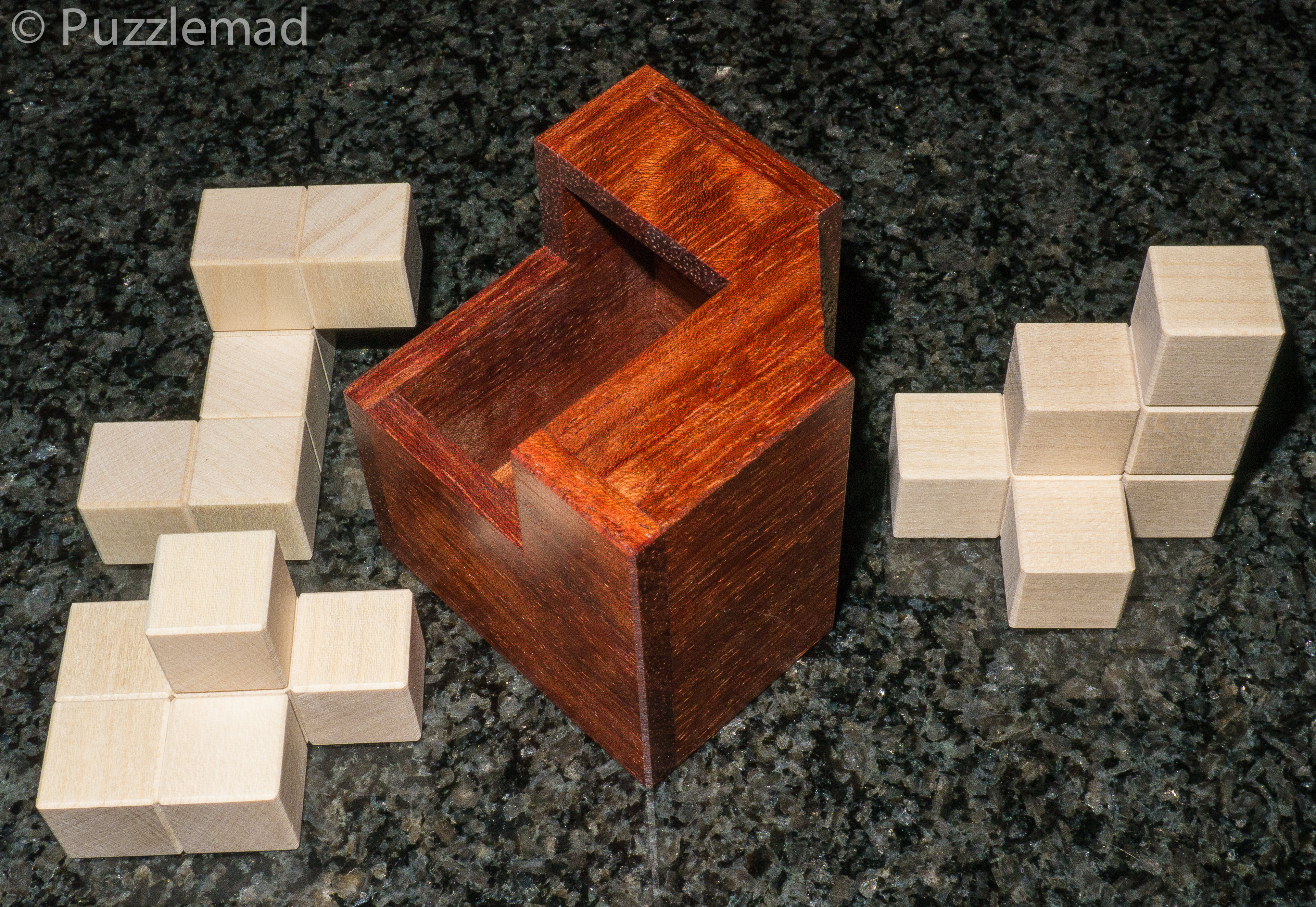
seriously fun challenge. As always, there is a small shape to be made (this
time a 3x3x3 cube) from some pretty complex pieces with what at first looks
like a rather large opening which you might think would make the puzzle much
easier. However, the end result has to have the pieces completely covering up
all the openings once finished and with such a big gap this really limits the
options. The large hole on the top does allow initial easy insertion but these
pieces are quite large and complex and then movement and access get blocked
pretty quickly. Looking at the shape of the small columnar hole in the box
gives an idea of what is going to be required/possible during the solve but
actually doing it is another thing entirely.
No spoiler here
These puzzles look almost trivial when first picked up (especially with the
large entry hole) but the reality is that they are a proper challenge for any
experienced puzzler. I really enjoyed it - the puzzling time for me was about 2
hours and the sense of satisfaction at the end was fabulous.
TILL
TILL by Dr Latussek (made from Garapa)
This lovely chunky puzzle design by Dr Latussek looks wonderful in the yellow
wood. It is named after Till Eugenspiel who was an early 14th century resident of Saxony and a prankster
responsible for a "chapbook" on which his name sake owl and mirror could be
found. The aim of the puzzle is to use the pieces to create mirror symmetric
shapes using 2 (easy) or 3 of the pieces (harder).
I am terrible at pattern finding and symmetry puzzles but the size and tactile
nature of this one was quite appealing. It is a nice thing to sit in an
armchair with and fiddle with 3 relatively simple shapes and put them together
to try and find mirror symmetries. I have found 3 symmetries using 2 pieces
and 2 solutions using 3 pieces. Interestingly one of the three piece
assemblies has mirror symmetries on several different faces. This is a really
nice gentle challenge that is suitable for all grades of puzzlers - I think
kids would find this fun and might help teach them about symmetry.
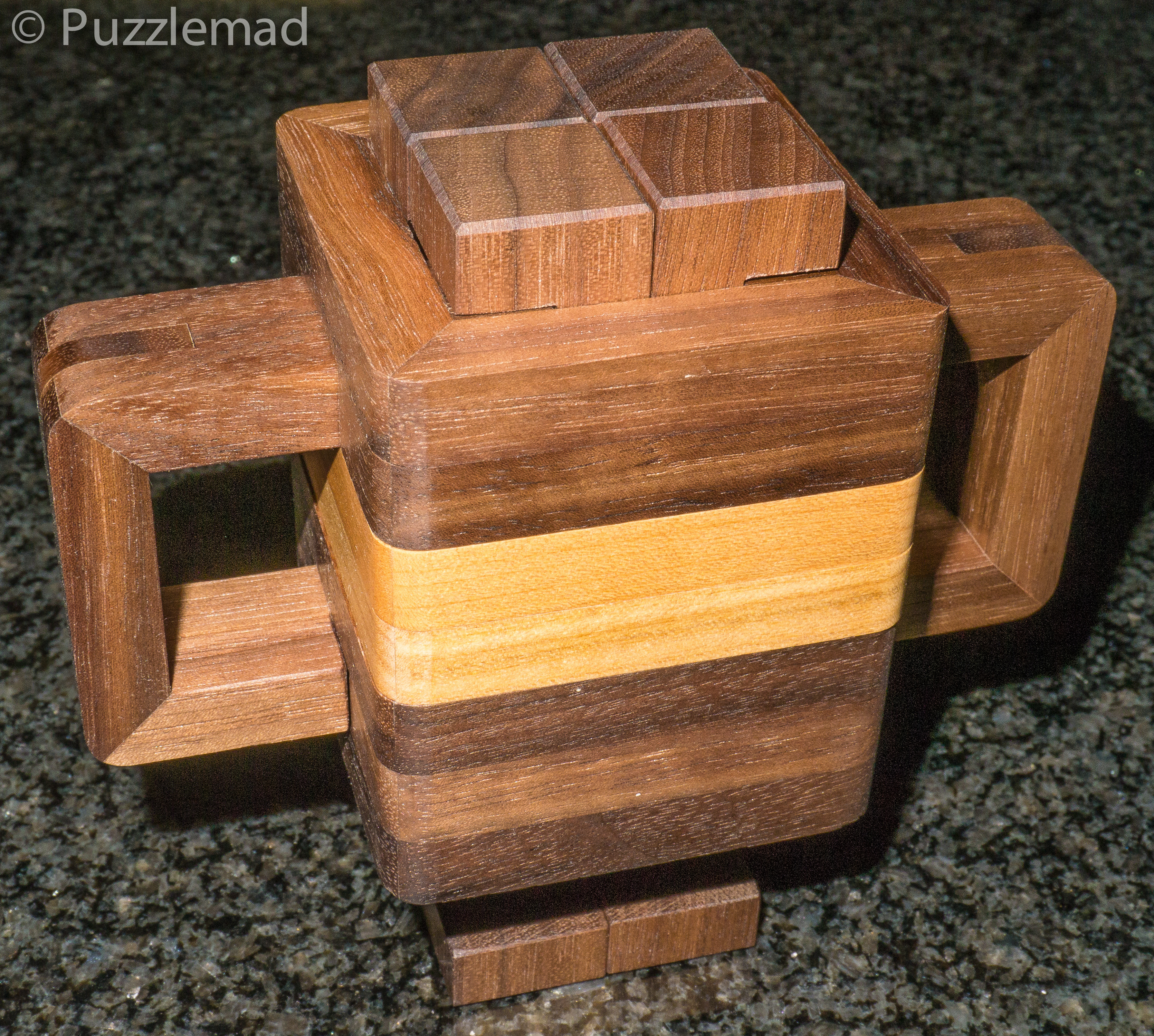
This last puzzle in the current release is one that I have not had time to
solve yet. It is absolutely stunning made from American Walnut and Cherry.
This will be a very tough puzzle to dismantle - I love these specially shaped
burrs but the combination of rings, boards with burrsticks through the centre
do make for a tremendously difficult challenge. It has a level of
22.6.5.2.1.2.2 to take apart and will include quite a few sideways movements
of the rings as well as the burrsticks. I always seem to struggle to find the
appropriate shifts and then get lost. I look forward to trying this new one as
I have never seen a burr from Ad before.
All these puzzles should be available from Pelikan within a week or so - whatever you buy, you will not be disappointed, they are all lovely to look at on display and really nice challenges to puzzle on. I am sure that for those of you in North America who would prefer to buy more locally then they will arrive at PuzzleMaster not long after that.
This has been written ahead of time and set to publish at my routine time. Having had some time off work, I have to pay the price by working two weekends in a row! Sob!
Whilst I am here, can I ask that you all think about the awful atrocities that are going on in Ukraine. One of our fellow puzzlers, Peter Grabarchuk, has asked that I highlight to you what is happening and request that you consider doing anything you can to help out. Either give to a charity that is helping in Ukraine or that is helping support refugees. Anything you can do will help out and ease a terrible situation.
Back to the puzzling…
My friend Eitan has been rather busy with work and having a family over the
last few years and seemed to have almost withdrawn from Puzzle design and
manufacture. My other puzzles of his were the incredible
Eitan's star
(one of the most difficult and marvellous twisty puzzles ever mass produced)
and the
Master Curvy Copter
which he designed and used Shapeways to 3D print for me. With some
considerable surprise I saw him offer up a new design called Ziggurat, which
he was 3D printing himself. The Ziggurat is a massive Mesopotamian pyramid-like structure usually with 2 to 7 stories. Eitan was going even more massive with EIGHT! How could I resist? I jumped on the offer and sent off some electronic
money (not actually a lot) and got some feedback from him that the colours
that I had chosen were great. I waited for the US and UK postal services to
get their acts together and finally took delivery.
In the meantime, Michel van Ipenburg had written about it in his newsletter as
well as pronounced on Facebook that it was a very nice fun design which was a
great relief. Michel is the foremost connoiseur of the N-ary puzzle group and
if he approves then it is definitely worth purchasing.
Eitan had thoughtfully sent the puzzles out with 6 of the plates already
assembled into a stack connected to a display stand and another 2 extra plates
were loose in the box ready to be added to the stack. Initially, I did wonder
why he had started the puzzle off for me and possibly gone halfway but then I
realised that he had actually been very clever and thoughtful. The stack of 6
was definitely not ready to just start adding the other 2 to. The stack had to
be completely dismantled before the reassembly with 8 was going to be
possible. Having 6 ready assembled allows the puzzler to explore the sequences
and understand the puzzle before embarking on the main odyssey. Once apart, the clever design of the plates and how they interact with each other across 3 layers is apparent and I was further impressed with Eitan's skills. The 2 colours have plates that are mirror images of each other.
I spent a
couple of evenings on my chair watching TV working out how it worked and got
ready for the full assembly - there were going to be a LOT of moves that had
to be done in the right order and in the right direction.
A very interesting beginning
Hidden by the spoiler button is the initial stage for the first assembly -
having to do that was completely unexpected and very nice to realise. Once I
thought I had it begun, it was time to begin the arduous process of working my
way through the many many moves to stack the plates tidily. Everything moves
very freely and easily despite the 3D printing. I initially just worked my way
through but on 3 occasions realised that at some point I had turned myself
around and was heading the wrong way. In fact, the first time this happened, I
only realised that I had done this when I returned to the start
position...DOH! Having inadvertently back-tracked 3 times, I decided to take
notes to prevent further errors and to also allow me to take a break and obey
Mrs S' commands with work to do around the house. I hate to think how many
extra moves that I actually ended up performing but I got there in the end:
All 8 plates locked together
Stacked! As Eitan intended
I love it! The sliding mechanism places no strain at all on the very delicate thin tongues of plastic and it is a fun puzzle to explore. It will not be something that you solve multiple times but the experimentation and assembly was a pleasant diversion and even getting lost in the path multiple times only added to the enjoyment. It is ready now to go on display in my N-ary section.
Thank you Eitan, I look forward to future designs from you now that you are back designing again.
Yet again, my good friend and PuzzleMad foreign correspondent, Mike Desilets,
has sprung into the breach! I have had a week off and been away in a place with
extremely poor internet access. Whilst puzzling was possible - I never go
anywhere without some of my lovely toys to help me ignore Mrs S. Whack! Ouch!
Sorry dear. Somehow, as he always does, he senses (does he have some form of
ESP?) that I need him to fill in for me and an article arrives in time. Thank
you mate, I really owe you! Over to Mike:
Aloha Kākou Puzzlers,
This shall be a very modest post. I’m trying to keep the typing fingers
limber more than anything else. I also, unexpectedly, experienced some great
puzzling over these past few weeks, so wanted to spread that joy. Without
further into, let’s start in with a really fun new disentanglement from
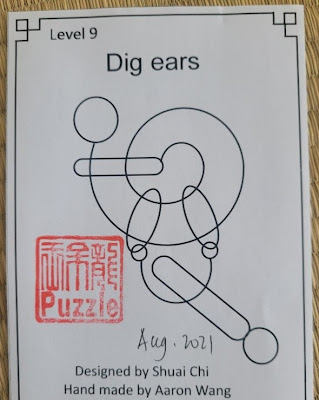
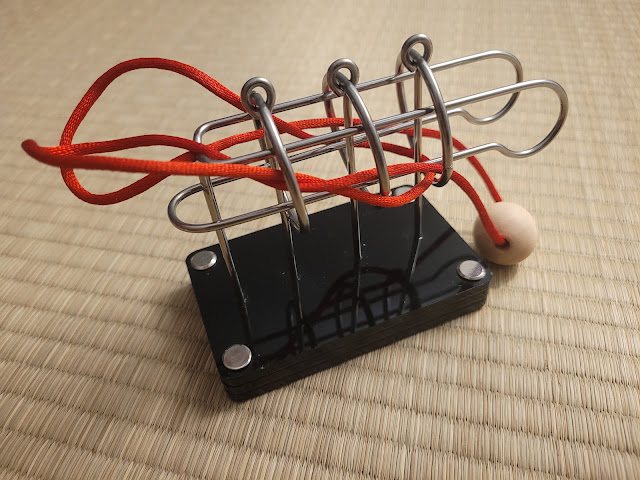
Shuai Chi - “Dig Ears.” (Ed - I discussed it
here) It was included in
Aaron Wang's last annual mega-batch of puzzles, which I insist is his best and most
diverse yet. Shipping has been a challenge for many makers and purchasers
this past year, no surprise to most of you, and Aaron’s box took a good
several months to arrive. He remained in close contact during the whole
period, however, tracking the package; it was never a serious concern.
Aaron’s service is as outstanding as his puzzles. (Ed - I totally agree)
Whenever I get Aaron’s annual package, I immediately search for the one or
two puzzles that are below level 10 (Ed - hahaha, me too!). As those
of you in the know, know, Aaron’s disentanglements are always very
challenging. I’ll just go ahead and all-caps that, VERY challenging.
Aaron basically invented the 10+ category. I have yet to solve a complete
batch before the next one arrives (some 12 months later). At this point I am
faced with an impossible backlog. I believe this is the case for the entire
PuzzleMad staff. (Ed - seeing as that is just you and me, I definitely agree!)
The insert.
Anyway, when I saw Dig ears clocking in at a manageable level 9, I knew I
had a chance. Also, no string involved, yet another plus. Three weeks
and a few widely interspersed sessions later, I had the shuttle off and had
also achieved repeatability. It was a great day to be alive! The old hands
know what I mean. (Ed - 3 weeks? That is pretty good for this one! I think it took me 2
weeks and I am supposed to be quite good at wire puzzles)
I highly recommend dig ears to all serious puzzlers, even if
disentanglements are not your thing (which seems to be quite common,
unfortunately). It’s hard to express the brilliance of this modest little
puzzle. Shuai has done a really great job here, and I can see why Aaron
chose to make it. Like most innovative disentanglements, it takes known
elements and combines them in a new way that is at first (and sometimes
forever) quite baffling. In this case, you immediately recognize the classic
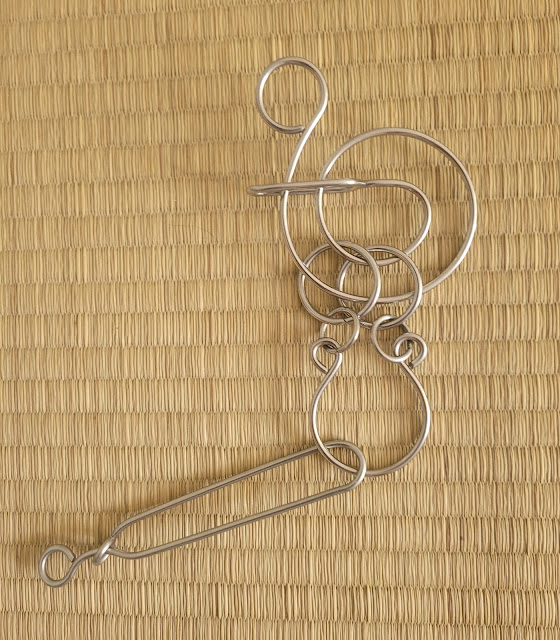
‘cowboy hobble’ form of the main component, but then the spiral arm is
extended a full extra turn. The other dangly bit is hung off the main body
with it’s two rings and finally the shuttle hangs off that. The very first
move seems obvious, but the second is far less so. I would even say that
it’s the main challenge of the puzzle. Once you have that licked, the third
and fourth should fall into place without tremendous effort. Reassembly will
be a little tricky, even if you were wise enough to pay close attention to
your procedure. If I’ve learned anything at all doing this stuff, it’s to
slow down and study individual moves before taking next steps. Even with
this, however, there is a degree reverse-solve required; things just don’t
look the same going backwards. By the end of the process, however, you
should fully understand the puzzle. It’s really unlikely you will get it
back together unless you do.
Dig ears has inspired me to work diligently on this new batch and resist the
procrastination which these really hard entailments inspire. I was well on
the way to solving “cable car”, but somehow got myself all mixed up in the
middle of the process. I need to gather my wits and get back at that one.
But I can tell you already, for a fact, that it is a great puzzle. And also,
a very handsome puzzle. It would be on my top shelf, if my house had
shelves.
Cable Car. I love this one. I’ll love it even more once I solve it.
(Ed - I also bought this one - it's actually called Cableway, I was thinking
that it would be a relatively straightforward N-ary type puzzle
but the construction of the doubled over frame means that the expected N-ary
simple moves cannot happen. At present I am completely stuck on it and still
at the beginning)
Before we close, I’d like to throw a quick ‘me too’ in the direction of
Allard Walker, friend of the blog, who recently posted on Join Liu’s Axes and Hammer
puzzle. Kevin Sadler, occasional contributor to PuzzleMad, also gave it a
very positive review
in July of last year. Those gents have about covered it, so I’ll only say
that I fully concur. This is truly the freshest, most interesting take on
Robert Boomhower’s 1966 classic in a very long while. That’s really saying
something, since it is one of the most widely copied and modified
disentanglements of all time. Axes and Hammer is also extremely well-made
and I have been fondling this puzzle in my front pocket (as far as you know)
for days on end. (Ed - we all believe that is what you are doing in your pocket!)
Axes and Hammer from Join Liu, 2020 IPP Design Competition entrant.
Finally, I want to extend a heartfelt Thank You to Cubic Dissection for the
beautiful Slideways puzzle I recently received. I was lucky enough to be the
winner in their last puzzle lottery. It was a pleasant (and shocking)
surprise; like my editor, I never win anything at all, not a damn thing.
This little puzzle is stunning, as you would expect from Eric and his
dissectors. It reminds me that I should perhaps be more diligent about
tracking CD releases. To be honest though, the very thought of participating
in a quarterly electronic mad scramble is stressful and off-putting. Most
likely I will continue to check in late and search for table scraps.
Fortunately for people like me, CD often produce multiple editions of the
very best puzzles, which helps a lot.
Slideways, among the best CoMo puzzles of all time. You can’t have too many copies. If I had to have just one, it would probably be this CD version.
(Ed - Yes I have to agree about how good a puzzle this is - I have a metal version of the plain burr and also a couple of Pelikan variants - stunning puzzles and fun to fiddle with)
Ok, that’s all I have, back over you Chief…
Wow! A nice romp through some really wonderful puzzles! If you get anywhere with Cableway then you might have to give me a hint. Thank you so much for all your efforts and I hope that you continue to enjoy your puzzling and chat with us about it soon. Take care mate!
I may have said once or twice on this very website that I am rubbish at
packing puzzles and I stick by that assertion whole-heartedly. I have
accumulated quite a few packing puzzles over the years and they give me a huge
headache. I have gotten much better at the 3D interlocking type puzzles from
Osanori-san
and
Alexander-san but any puzzles that involve placing lots of pieces (especially very similar blocks in a cavity) stump me. I have only managed to solve the Euklid for Kids and still not managed the other 2 Euclid puzzles and the Fermat, with only 3 pieces but a non rectilinear geometry, have me beaten. I just don't have the skills to work them through and am reduced to trying hours and hours of random attempts which I cannot keep track of. If there is a logical approach to them I just don't know it. I am in awe of Nick Baxter who not only solves them with little difficulty but seems to be able to find extra solutions. One day I will saw the top of his head off and examine his brain! Don't tell him though or I suspect he might avoid me. To my eternal shame, I cannot even solve a one piece packing puzzle - bought from Eric back in mid 2020 - it's "just" a big block to be placed in a box...it shouldn't be that tough! Tray packing puzzles with complex shapes are also a huge problem for me - is there a technique for them? I just don't know. I have a bunch of Alexander-san's puzzles which I dip into quite frequently and so far I have only managed to solve a few of the very easiest of them:
First I counted the notches and the protrusions and they don't equal each other - bugger! Then I looked at how many notches I could make by placing pieces side by side - it still wouldn't match. Maybe there was going to be a huge gap but estimating the surface area of the tray and the total area of the pieces told me that there was a pretty close match and no big gaps. Time to be systematic and look at the lengths of pieces and estimate where they could fit when placed in pairs. It wasn't really successful in a way that I was expecting but I did manage to fill large parts of the tray with almost no gaps at all - the unequal pairing of notches and protuberances seemed to be less of an issue this way. I seemed to be filling the tray quite well. Until the last piece would not fit. At this point, rather than tip it out and start again, I did try moving tiles around and swapping a few without mucking up the really nice tray filling that I had achieved. Gradually, the tray filled better and better until I was left with one awkward piece which looked odd.
What if I can??? Oh, you sneaky man! That is very clever and really quite tough. The Ice 9 has a very lovely Aha! moment which cannot be found randomly. It will start random, move to a definite thought process which won't work and then noticing something special.
I think I did take about the requisite 3 hours making this rather good value for money. You should definitely consider getting one or two of these challenges! Maybe it is time for me to pick up Alexander's puzzles again?
A
couple of weeks ago
I showed of Bruno's
Caffe Latte
packing puzzle and have to say that despite it being a packing puzzle, I
absolutely adored the process of solving it (I hope that all of you have gone
out and bought your copy?) He had sent me his
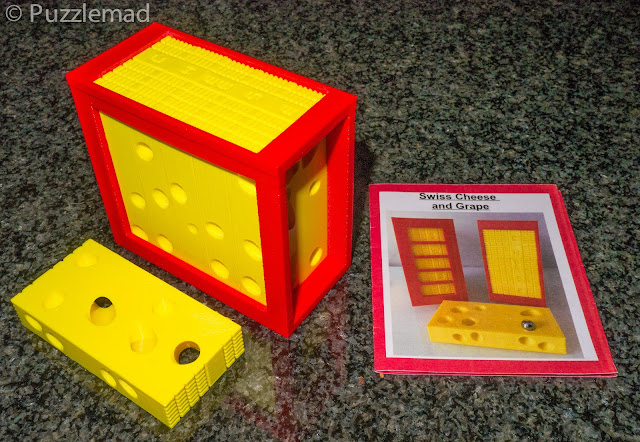
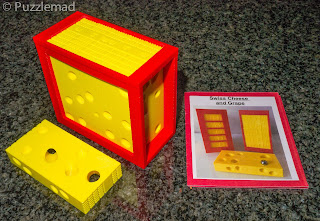
Swiss Cheese and Grape
puzzle as well which was really admired by the very discerning Michel and I just
needed to find time to play. I had actually expected to have some time this week
but something went badly wrong. My week rapidly filled up with work and my
puzzling time disappeared. I even failed to attend the virtual MPP yesterday due
to work (bloody virus!!!) and the last puzzling opportunity passed by.
I decided to give it a go this morning and early afternoon in the hope that I
would have a tale of rapid success for you today. How foolish am I?
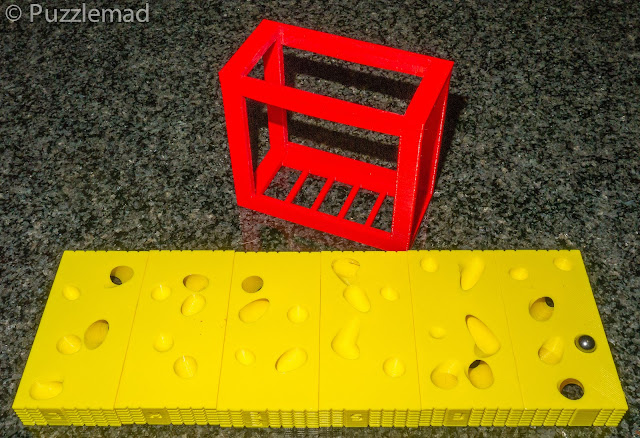
The standard maze plates
The premise of this wonderful design is to place your 6 cheese slices into the
frame in such a way as to allow the holes that run through will allow the ball
bearing/grape to drop all the way through from one face to the other and out. I am not sure where this falls in the puzzle classification - I wonder if it straddles two classifications? It is certainly a Maze but this is one where the maze has to be created by the puzzler.
The slices have the letters from the words "SWISS CHEESE" spread across
them. Each slice has multiple holes...some blind ending and at least 3
passing obliquely through to the other side. Therefore it is a simple matter of
stacking them so that the exit hole of one matches up with an entry hole of the
next and so on. Easy peasy? Sigh! Maybe for Michel (or you) but definitely not
for me. I really thought that an hour or so experimenting would get me to the
end and a success story. Alas in answer to my question above...I am VERY foolish
- or really really dense!
I have spent a good 3 hours on this today and so far gotten absolutely nowhere! Maybe I am rushing it to try and get a blog post? All this has shown me is the title of the post - "You Cannot Rush a Good Puzzle". I will continue working on this one and hopefully get some time to solve it during the week.
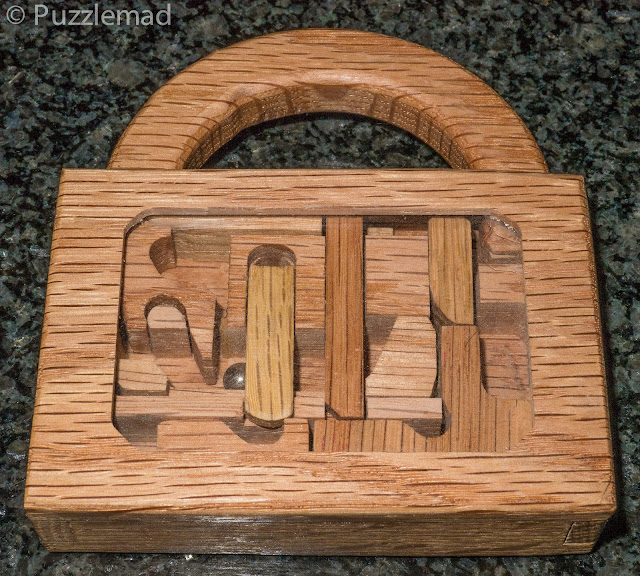
Unfortunately I am working this weekend and so only have time for a quickie -
it's still a goodie though! Who would have thought that you can make a lock out
of wood? I certainly wood not have thought it possible but then what wood I
know? Even more interesting is when the entire workings of the lock are visible
through an acrylic Window.
Allard reviewed
the Window lock back in November and I couldn't resist asking Dick if he was
going to make any more. He said that he was thinking about it and wood let me
know if he did. I was truly delighted when he contacted me at the end of January
with an offer of a copy. My version was made from a different wood to Allard's
and had an extra feature...the ball bearing which, I suspect, made one part of
the solution a little easier to perform.
As the name states, everything is on show and yet it is not just a simple
matter of looking and doing to open it. I have been fiddling for a week or so
before I managed the complete solution. The first possible movement is
relatively obvious because all you can do at first is roll the BB around
(which does nothing) and look for anything else that might move. Once you have
found what else moves then your vistas open up into a bit more confusion. Yep,
movement happens and immediately there is something that screams to be done
but due to the fancy angles Dick has cut the wood at, everything just slides
back and forth without achieving anything. It's a sort of mesmerising sliding
back and forth but that doesn't help you open the blasted lock.
Next, there is something else that screams at you to try and it requires more
dexterity before you can make it happen (and sometimes I couldn't make it
happen). At this point there is an audible oooooh! in the room (Mrs S doesn't
mind those sorts of sounds) and more things become apparent. There are magnets
inside - knowledge of which actually doesn't help you and even if you are not
careful can seriously hinder later moves. At this point, I got stuck for a
week...I could make another "thing" happen inside and it was very satisfying
but did not appear to get me anywhere near to opening the "blasted" lock. I
was beginning to understand why Allard had enjoyed it, The next couple of
evenings were a succession of failing and succeeding to do the first move or
two and then "click" swearing under my breath. I was missing something
crucial.
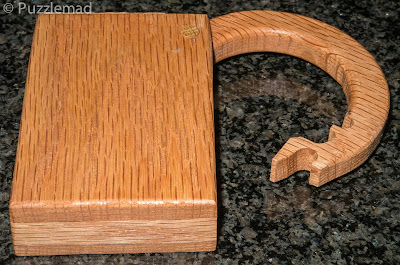
This clever puzzle literally has everything on show through a window but
seeing it is not enough - you need to think and plan an attack. It actually is
not that tough but the moves are not obvious until you try to work out a
pathway to releasing the shackle. I absolutely love it! I really wish that I
was able to open my other lock from Dick. I bought the Hensel Lock in 2017 and
have not gotten any further than a few moves in! I am truly terrible at
locks/burrs/packing/puzzles in general!
Whilst chatting with a new friend on FB messenger, I came to the realisation that I
have a problem...I haven't tidied up my desk in 6 months! I actually know
where everything is but Mrs S is starting (actually she's continuing) to get
annoyed at me! Do you think I should tidy up? I actually think I could leave
it a while longer:
I have been chatting on and off for several months with a lovely Parisian puzzle
designer, maker and
seller, Bruno Hemon.
This has probably been a rather frustrating experience for him as my
communication ability over the last couple of years has been rather hit and miss
due to my rather high and extremely unpredictable workload. A few years ago he
wanted me to give my opinion on a couple of his designs and I ended up pointing
him at my expert friend Michel to get a really decent assessment of his puzzles.
Michel writes a regular newsletter and gives his quick assessments of puzzles
that he has bought each month. I was very pleased to see that a couple of
Bruno's designs featured in them and was really delighted to see that Michel had
put one of Bruno's designs in his top 3 acquisitions of 2021 - for a puzzler and
collector of Michel's standing, this is a huge tribute to both quality and
puzzle standard.
The very prolonged conversation ended with Bruno telling me that he was
sending a couple of puzzles as a gift to evaluate. I was a little mystified
when I received a notification of a German parcel being sent to me and could
not understand why this could be or who it could be from. Mrs S clarified it
for me earlier this week when she kindly opened the package for me to find out
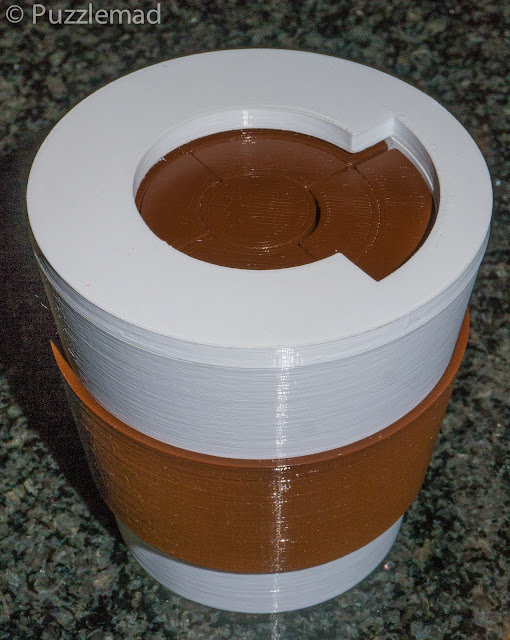
who had sent me something. Nicely packed with a little card was the Caffe Latte puzzle (complete with sugar cube) as well as the Swiss cheese and grape puzzle which I have yet to explore. He has quite a few other puzzles on his site and I will probably head back there to make a couple of purchases when my finances settle a little. I couldn't resist the Caffe latte as my first challenge. I loved the shape and idea as it reminds me a lot of the type of packing puzzles that I adore designed by Alexander Magyarics - it's a simple idea made difficult by having a very restricted entry hole. The addition of the sugar cube which may end up mobile within the puzzle is a nice extra touch. Having a cylindrical shape was also going to make it more difficult due to the fact that pieces could swivel around the central axis.
Whilst waiting for a critical care bed before a big operation would be allowed to start, I was going to have a little while with nothing to do but be bored twiddling my thumbs. I am NEVER bored! I always have lots of toys with me, either to confound my colleagues or, more usually, to solve for the weekend blog post. Out came Caffe latte.
At home later that day, I work out how to disassemble the shape through a limited entry and decide it's time to put it all together. Problem number 2...2 of the pieces will not fit through the hole in the top at all! I am not sure how this wasn't immediately obvious to me from the beginning but I now have to work out how to get these quite large pieces inside without snapping them. Each needs a rather accurate rotation to place it and once one is inside then the other gets tougher too (especially if you place some of the smaller pieces in first). I finally work out how to get these pieces inside and realise that I cannot remember the assembly. Sigh! I'm a bear of very little brain! Time to remove everything - a real struggle to do and then take notes on each required move. One of the most interesting features of this challenge is that the whole of the assembly needs to rotate inside the cup to align pieces to accept and move subsequent pieces. This puzzle probably cannot be modelled in burrtools for this reason.
Next, using my notes and working everything in reverse, it's assembly time. This needs bit of dexterity and a bit more swearing. After 2 days, it is assembled but without the sugar cube. Time to start again. Another batch of swearing and I restart the puzzle with the extra piece and realise that it gets in the way a bit. A very specific couple of moves are required and these are even more fiddly but the end result is a perfectly sweetened Caffe Latte ready for a photo and a drink:
What a wonderful challenge!
Disassembly is also a challenge once you have left it a while because the view inside is extremely restricted.
Bruno has outdone himself - this is a fun challenge and is definitely worth you all having a look at. Whilst you are on his site, there are quite a few other challenges - a similar type of puzzle, the Espresso coffee and Michel's winner, the Hexabox. I will be going back soon!
Halfway through last year I restarted purchasing twisty puzzles after a
little hiatus (mostly induced by fear of how difficult the newer puzzles
looked). This batch I worked through gradually over a few weeks and
published about them
here
and
here
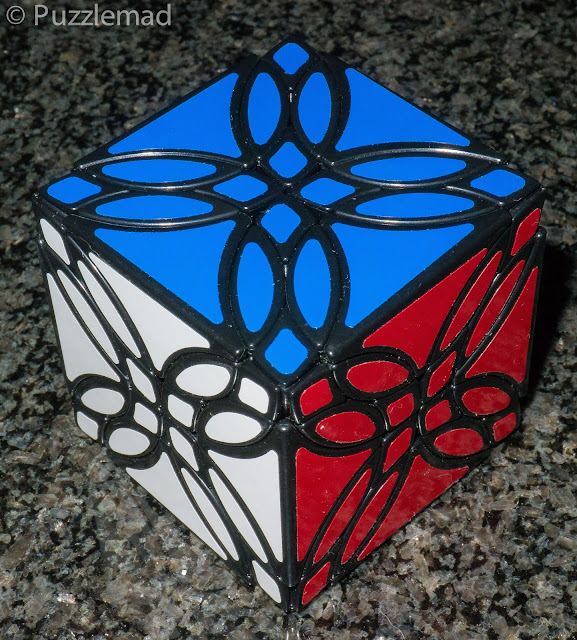
but the Master Clover cube caused me considerable anxiety...as an edge
turner it is going to jumble and to shape-shift which is normally a fun
challenge but with so many layers, this was potentially going to be painful.
If you are not familiar with the concept then let me quickly explain.
Normally with edge turning puzzles, the individual pieces are restricted in
their positions to certain orbits and cannot leave them. However, a jumbling
move occurs when a partial turn occurs of an edge which lines up the cuts
enough to allow an adjacent edge to be rotated. This can cause
shape-shifting if it isn't lined up with the opposite side or "just" take
pieces out of their usual orbits. Part of the attraction to me with these
edge turning puzzles is that there are two distinct solves to be done - a
non-jumbled scramble can be mostly solved using an entirely intuitive
approach without any fancy algorithms and just a bit/a lot of thought and
planning - this is great fun usually. Then a jumbling scramble makes for a
much tougher solve needing even more thought and often needs a more fancy
algorithm or commutator to solve (and half the fun is working out these
commutators). It also ends up with a hugely shape-shifted nightmare puzzle.
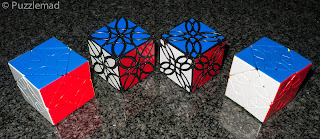
Inner edge turn and outer edge turn
A jumbling turn in process (outer edge)
I had put off the final one in that batch until just this week. It
frightened me to death! I recalled that many years (2013) ago I had bought
and eventually solved the big brother of the Master Clover Cube, Eitan's
Master Curvy Copter
and the process it had nearly killed me. It was a seriously difficult puzzle
with a lot of shapeshifting and a hugely difficult set of commutators to
find.
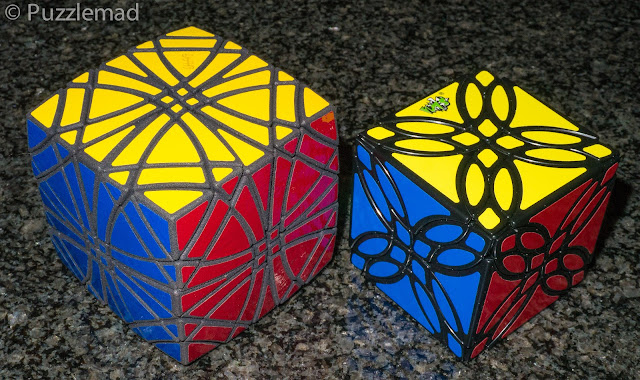
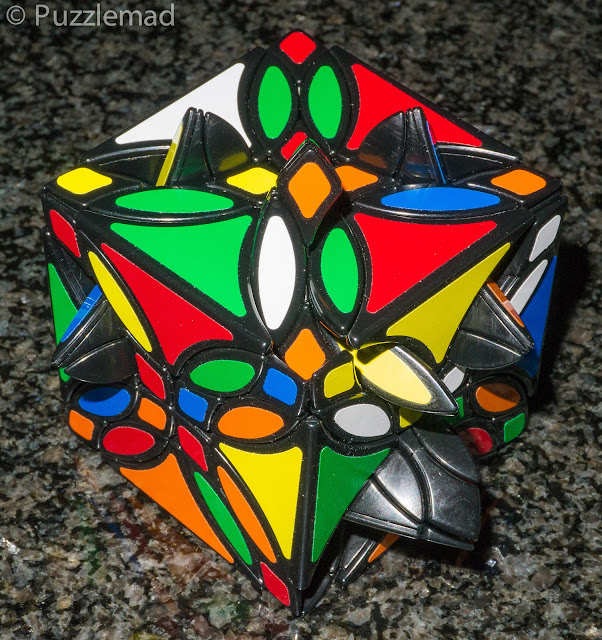
Are they subtly different? Both Master edge turners but a lot more
pieces in the Curvy copter
Eventually after procrastinating a long time, I ended up discussing the
puzzle with
Derek who happened to be working on it at the same time. My fears seemed to
fall on deaf ears and, as usual, he started to badger me to get on with it
and eventually I succumbed when he practically screamed "DO IT" at me via FB
messenger. This shamed me into at least trying a non jumbling scramble in
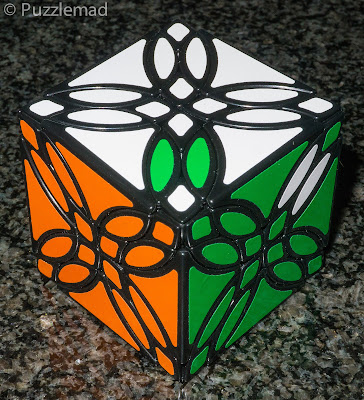
the hope that it should be solvable by intuition:
"This should be fun", I thought/hoped and my initial approach was similar
to how I solve the ordinary Curvy copter or
Clover cube.
I basically do it layer by layer working my way up from the white face.
The petals in the Master clover cube are split up so it was just a matter
of creating the white face (easy) and then assembling the 2 side faces of
the corner pieces and then adding in the half petals. With delight I
noticed that the centres and the corners are not separable so solving one
solves the other. It can be a little arduous but I managed to get half of
the puzzle solved really quite easily. I was on a roll and then I hit a
problem - the half petals in the remaining half are much harder to pair up
when there is very little room to play in. One of the most important
things I realised was that doing the puzzle layer by layer always ends up
with a scenario where there are single half petals that cannot be placed
in the end game without doing jumbling moves to finish. I was ever so
slightly disappointed in this but I should probably not have been
surprised. It was always going to be unlikely that such a complex puzzle
was going to end up with nice easy intuitive 3 cycles of pieces. Having
solved the lower half, I was able to turn the puzzle back to that
orientation and experiment with the jumbling moves to see what effect they
have. In a normal Curvy copter, the double jumble swaps a the two opposite
petals on adjacent faces as well as either side of the cube. This can
occur here but it is possible to split the inner and outer edge jumbles as
below:
A single jumble swap
Two jumble swaps
Four jumble swaps on both layers
As you can see that matching inner edges with the front outer edge swaps
4 petal pieces. Doing it twice swaps another 4 and then twice more
leaves in a very nice scenario (pictured right). Could I use this? Oh
yes, I was sure I had the puzzle beat...and then this happened:
Reporting my success and struggle back to Derek, he replied that he had
not had anywhere near so much trouble as me with a non-jumbled scramble.
???How is that possible? It transpired that he had reduced it to a
standard Curvy copter first and this could be done without any jumbling
moves at all. I had to have a try and yes this was also a LOT of fun. So
many aspects to just one twisty puzzle. At this point we were both
procrastinating...he said that he had not had time to do a full jumbled
and shape-shifted scramble but practically shouted at me to get on with
it! Gulp! I am, of course, too stupid to say no to an instruction like
that so off I went. I note that Derek has still not fully scrambled his
copy!
First of all, I did a jumbled but not shape shifted scramble and at this
point I was very pleased that I had done my earlier experiments and gained
a lot of experience of what could be moved where - the solve took me a
couple of hours of enjoyable fun. Then it was time to screw my courage to
the sticking place and do it properly:
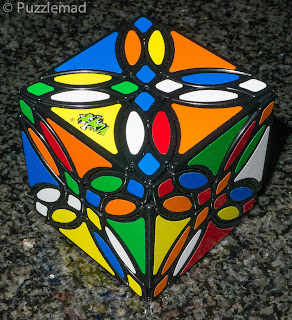
This might have been a very bad idea!
The shape-shifting does seem to get blocked at various points during the
scramble. It is mostly internal and does feel like it could be pushed
past. But my experience with the original Curvy copter plus warned me off
forcing anything. Everything I had learned about the puzzle up to that
point stood me in good stead. Returning to cube was no more than awkward
and then it was just a fully jumbled solve. I love this puzzle! It is
definitely less difficult than the Master curvy copter but in a way that
is a good thing. The vast majority of this can be solved by intuition
alone and then just a bit of experimentation using the already solved half
will provide what you need to be able to complete it. There are several
challenges (non-jumbled, reduction approach; non-jumbled, layer by layer,
jumbled non-shape shifted and finally fully scrambled) - this is great
value for money. I bought mine from the HKNowstore but for those of you in
America/Canada then
PuzzleMaster
have it in stock as well. Go on, give it a try, you will love it!
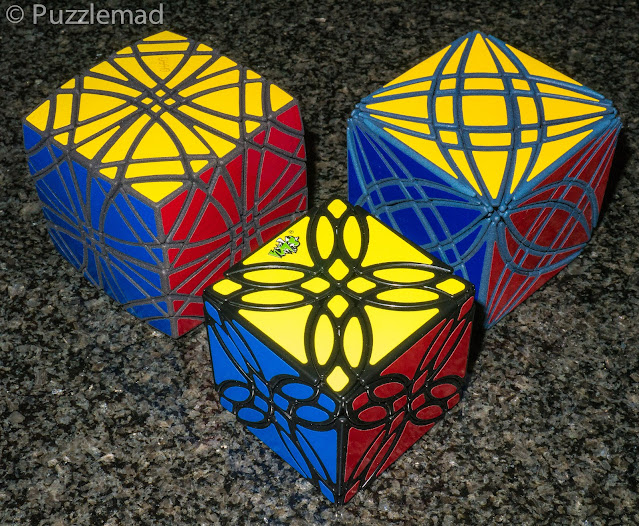
There are a couple of other non-face-turning Master cubes that would be
great if those wonderful cube producers would have a try at manufacturing:
The Master Curvy Copter I have shown and the Master Rex Cube as well would
be incredible:
3 Master cubes - hopefully the back two will be mass-produced