Showing posts with label Magyarics. Show all posts

Sunday, 28 June 2026

Have I Been Scroo'd?

Even Ice Cream Doesn't Help!

Cooby Scroo from Andreas Roever
My car when I got out of work!
Most of you are aware that there's been a bit of a heatwave in Europe recently! It started whilst I was in Italy for the IPP and then hit with a vengeance when I returned home. The UK is uniquely unprepared for high temperatures despite the fact that we have had them for the last few years. Our houses retain heat (they are built for cold winters) and it feels like hell inside (most of my house was 29-33ºC for the last week and my back garden, being south-facing reached 48ºC for long periods of time). During all of this I have been sick with the lurgy that I caught on the plane and feeling like death warmed-up! The only thing that could possibly make it worse would be to share that hellish space with a "woman of a certain age". As a result of the conditions at home, both physical and psychological, and despite being sick as a dog, I was grateful to go and work in an operating theatre with air-con bringing the temp down to 18ºC. I went from boiling sweaty hot to freezing my nuts off back to boiling again.

As a result of this my puzzling skills were even more sub-par than usual!

Nicely presented with a bag and a card
The Cooby Scroo puzzle had been Andreas Roever's exchange puzzle last year in Tokyo. It was brought to my attention at an MPP afterwards when a couple of people were showing it off and extolling the virtues of such a simple idea, so beautifully created. I even had a play with it and marvelled at the incredibly confusing movement and how it came apart easily but was impossible for me to put back together. This was going to be brilliant - tempted...

When a few people placed it in their top 3 puzzles of the year at Peter Hajek's end of year puzzle party, I broke and contacted Andreas for a copy and arranged to pick it up in Italy.

I got a choice of colours when I picked it up and chose a lovely blue, grey, black and white combo.

When I got home and having taken some photos to show off how it moves, I shied away from actually dismantling it for fear of failure yet again.
One pair moved
Second move possible and it gets scary
I showed it off at work and after getting an appropriate "Oh my God!" response. I stopped playing and put it away again. I did the two beautiful moves again and again at home, trying to make myself familiar and comfortable with the conformational changes and eventually I was holding it slightly wrong and it fell apart on me....Aargh! I should have known that would happen eventually.
This might be how it remains!
I recalled how impossible it had been for me at the MPP and I quailed at the thought of getting it back together. It is relatively easy to make pairs or even a trio of pieces:
This should do it - he hopes
This looks great but isn't helpful!
Over the last few days, in the blistering heat with an angry hot woman in the background, whilst feeling like death, I have repeatedly attempted to reassemble this bloody thing! It shouldn't be this difficult! It's only 4 pieces and has only 2 main moves but you mustn't forget how bad I am at puzzles. Yesterday evening whilst muttering to myself and considering femicide as a way to get a little relief, I suddenly managed to get it together. OMG! The relief! Did I dare take it apart again? Not straight away... I needed to relax a little and then try and redo it slowly.

Today, I can now disassemble and reassemble it to order. I can see why so many people loved it. This puzzle is an absolute masterpiece of good design. All we need is for someone to make it in wood (I guess that might be nearly impossible) or possibly make it in brass. Steve or Ali - what do you think? Maybe a collaboration with Andreas might be in order?


Gelateria from Alexander Magyarics

Gelateria - Alexander Magyarics' exchange puzzle in Italy
During a heatwave, there is nothing better than a fabulous refreshing cool Gelato. I thought that attempting the Gelateria puzzle might be refreshing for me. Yes, I was wrong!

Alexander was a "greenhorn" at this IPP and previously they have not been allowed to exchange. This year the committee made a change to the rules and newbies were allowed to do so if they created their own design. Alexander has quite rightfully earned his place attending an IPP due to the HUGE number of amazing puzzle designs he has created over the last few years. You can tell that they are really really good when craftsmen like Brian Menold and Jakub Dvorak use the designs to produce gorgeous wood creations. I have reviewed quite a lot of his designs over the last few years and it was simply amazing to meet him in the flesh after such a long time. Unfortunately, we were both so busy that we didn't really have much time to chat and properly catch up. Whilst I was assisting Jerry Loo in his exchange, I saw Alexander's puzzle and decided that it looked a lot of fun and determined to obtain a copy at the main puzzle party the following day. 

Just a few challenges!
Alexander is a "completionist" - he finds a simple design, modifies it to add extra complexity and then looks for as many associated challenges as possible. I have quite a lot of these in my collection and I am absolutely terrible at solving them. Maybe this would be better? It is at its heart a tetromino tray packing puzzle. We have all played with these as kids - I know I used to play with one belonging to my older cousin when I was about 8 - I loved it. The 5x8 voxel tray can be fitted with 10 tetrominoes in many ways - that is easy. Alexander has created a LOT of challenges (the sheet has 48!) to decrease the options and make it MUCH tougher. The tray has holes in it and you re provided with a set of black blockers that can be inserted into it. The tetrominoes are now restricted where they can be placed because they must straddle the blocker. To get you used to it, he gives a couple of challenges with 8 solutions, 3 with 4, 1 with 3 and 9 with 2. All the rest have just 1 possible solution. 

8 possible solutions - easy?
Hell, NO!
I also took this to work and during a rather long boring orthopaedic operation (after 4 hours and no end in sight, I needed something else to think about), Colin and I set to work on one of the 8 solution challenges. 

This is really REALLY difficult! Neither of us were able to solve it in about an hour of attempts. I have been trying at home in the heat and still cannot get it. I need a way to think about these challenges. There must be a logical way to work it out but I am seriously struggling to get my little bwain around it. 
I appear to have Scroo'd by Alexander as well! Maybe I need another hobby? Whack! Ouch!

If you get a chance to buy a copy then you should absolutely do so. There are so many challenges and they are so approachable even if they are impossible. Alexander's puzzles are sold by PuzzleMaster, by Tye Stahly and possibly by Alexander himself via Facebook or Instagram. Drop him a line. He is delightful to chat to and his puzzles are amazing. 

I have not yet tried the One Way or Another puzzle which won a Jury honourable mention prize in the IPP design competition. That is quite a feat!


Sunday, 19 January 2025

Jagsaw VI - An Exercise In Logic

Jagsaw VI by Alexander Magyarics

I received a nice big package from Alexander at the end of the year and when opened I was delighted to see a whole bunch of interesting challenges in the box - Mrs S was not quite so delighte, however.

I was intrigued to see something that is new to Alex's repertoire, a jigsaw puzzle. As you know I have been a little fixated on Jigsaws recently having had very mixed success at the wonderful jigsaws in trays designed by Haym Hirsh

The interesting thing here is that it is only a six piece jigsaw with no frame and instructions to make a 3x2 array of the pieces:

Instructions that give away nothing except a very big clue...only 1 solution!
 Having seen that there are only six pieces and no restriction of a frame, I decided that this was to be my next challenge this year. After all, how hard can it be? Have I learned nothing from these blasted puzzle designers yet? Apparently not! 

The pieces are standard jigsaw pieces with all the protuberances or orifices being either rectilinear, singly curved or doubly curved which restricts which pieces can intersect with each other. I started initially with random pairing of pieces to see which pieces could interlink and how many possibilities for each piece there was. It quickly became apparent that it would not be possible to solve this with random trial and error. The pieces were too similar and with six of them I could not keep track of what I had tried. Time for a little think©ing. This was going to hurt!

This might make things much harder!
I spent a good couple of days fixated that there would be no interior gaps (i.e. the single curved protuberances would only interact with single curved orifices. I thought that this would significantly limit the number of possible interactions that I needed to try and would leave me with a pure logic based solution. Two days wasted on that - it certainly helped with the logic but, of course, Alex would never make it quite that easy! Eventually the realisation whacked me over the head that there were going to be gaps and irregularities in the outline. The only stipulation in the instructions was that they should fit together in the 3x2 grid. The shapes would restrict the way they could fit together by preventing some fits completely but if there was a gap then that would still be allowable. This then helped me find one piece that could ONLY be oriented in one way on the outer edge. From this, it was possible to work out several possible pieces that might go next but walking this pathway seemed to end in dead ends fairly fast (I was hoping that this was the sort of approach that Alex had intended because my head was hurting quite a lot at this stage). I did need to keep track of 2 or three possible pathways and eventually narrowed it down to decide on another definite external edge.

Once I had worked out this, it became a little bit more logical but still a fair bit of trial and error as every piece had several possibilities.

Finally, after about 5 days, I had my solution. It was very satisfying. This is a rather clever puzzle which needs thought and planning rather than trial and error. It certainly is good for beginners to show them that simple looking puzzles might not be as simple as they appear. Having said that, I think most beginners would give up long before they found the solution. I very nearly gave up myself. I think my Jigsawing period might have to stop for a little while due to brain-ache!

Having found my assembly, I had a fun time putting this into Burrtools to prove to myself that there was indeed only one solution and that it did not fit together with no gaps. Thank you Alex, it was a lot of fun! Plenty more challenges left to do from your box (although Mrs S is threatening to hide the box away 😱.


Sunday, 19 May 2024

So “Easy” That It Took Me a Week

The Persistence of Memory
Just look at the beautiful grain in that!
Having splurged a little while ago and had a delivery of beauties from Brian's wonderful Wood Wonders store. There have been so many fabulous designs produced recently that I had to be pretty choosy in which ones I ordered. Mrs S is already unhappy with the state of my desk and study and I daren't upset her too much more. Of course, no puzzle purchase is complete without something from my friend Alexander Magyarics - he has a warped incredible mind! I particularly adore his cube packing puzzles with a restricted entry and the Persistence of Memory looked fun and not too difficult. Hahaha! Silly me!

It was sold in 2 versions and I am addicted to beautiful wood. Hence the puzzle that arrived was simply stunning - the Box made from Kosso and the pieces made from Boire. Brian stated that this one is similar in design to Collator and, of course, I checked my database of puzzles to see that I definitely had a copy of that one, had solved it and even written about it here. I can see the similarity in design and, as usual, I have absolutely no recollection of solving this one and certainly no memory of how it is solved. Don't tell Mrs S, but I probably only need about 15 puzzles and can rotate through them repeatedly without remembering any solutions - luckily she is very very keen not to read my blog! I guess that I should probably seek out this one again and have a play. 

I have been really really busy with work recently and had little time at home to play. I therefore packed this one into my work bag to show off and hopefully solve during a quiet moment (if I ever get one). The beautiful wood and exceptional finish on this beauty was much admired at work and I even got to play with it a few times. Just like Collator, it has a restricted entry box and 3 pieces of a shape that significantly restricts how they can be inserted inside. Unlike Collator, there are quite a few ways to make a 3x3x3 cube but the entry restrictions are very important. The most complex piece can only be inserted in 3 possible orientations and the next in also just 3. This should cut down all the shapes to attempt and also make the puzzle easier. That may be true for some people but I was seriously flummoxed by the restrictions. After a couple of days of attempts, I managed to pack all 3 pieces inside but the entry holes were not filled - this made me feel ever so slightly less stupid but was not the solution. Perseverance is not only the name of the puzzle but also the name of the game for me! I had to keep at it. Finally, this morning after a whole week of work, I had a wonderful Aha! moment. 

My goodness! That was difficult!
Whilst the assembly of the 3x3x3 cube is simple, the insertion into the box is a significant challenge. It requires 17 moves to assemble it (BT gives the disassembly a level 11.3.3)

I left it assembled for a little while for the photos and to try and forget the moves and found that just disassembling the puzzle is a challenge. It is difficult to see inside the box and work out what is happening. 

This is a really good puzzle - it's probably too difficult to be a casual puzzle to hand to people at work or visitors at home - whilst I am not terribly bright and it took me a week, most casual puzzlers would not be able to solve this in a reasonable period of time. If you get the chance to play with it or find a copy up for sale (along with Collator) then don't hesitate - it is fabulous!
Thank you Brian and Alexander


Sunday, 21 January 2024

Trays and Trays of Thought

A Plethora of torture from Alexander
I will say it up front - Alexander Magyarics is one of the best puzzle designers out there. I don't say it because I consider him a friend, I say it because he has proven it time and time again! You all know it from the rather large number of his designs that have been created by Jakub and Jaroslav's Pelikan puzzles team that have made it into all of our collections. Quite a few of his puzzles have made it into my top ten puzzles of the year and they include 3D packing puzzles with incredible shapes (sometimes requiring rotations and sometimes just rectilinear moves), there are now even a few burrs under his belt which are not just a creation made using the Burrtoools software aimed at getting the highest level possible - the important thing about Alex's creations are that they are interesting and require the dreaded thought© to be solved. This requires something very special or very warped in the head - I leave it up to you to decide.

For the last couple of Xmases Alex has made me a lovely and not so little care package of puzzles he has both designed and 3D printed himself (Sigh! I wish I was allowed a 3D printer but if I wish to keep all parts of my anatomy attached then that is not going to happen). I received 14 of them this time and Mrs S was less than impressed (one thing about 3D printed puzzles is that they do look like child's toys and are not attractive i.e. no "wife appeal"). I reassured "she who frightens police officers to death" that they would be kept out of sight and not left on display anywhere and put them in my study in yet another box of puzzles to be solved - my goodness, I have a huge backlog just now!

This last 10 days "she who makes the sun hide in fear" was up in Sconny Botland visiting the outlaws and I was free to leave stuff lying around and play with them at my leisure. I actually did not have much time to myself due to work but the advantage of tray puzzles is that they take up very little space and can be carried around easily. I had some other toys in transit from various parts of the world and until they arrived had nothing that "had" to be solved fast. Time to play with the packing puzzles.

Rhinnocent
Alex had suggested that I start with this one (I had asked in desperation at preserving my ego for the easier ones). Place 5 of them in the smaller tray and then all 7 in the larger one. Usually I am truly awful at this type of thing and find that all I do is trial and error over and over again because after a while I cannot remember what I have tried before. I started in exactly the same way but within a minute or so, I was able to see some vague logic to them and was able to direct my approach. Wow! I had the small tray done in about 5 minutes and then the larger one in a further 15 or so. Amazing - a feeling of achievement and think©ing had occurred!

1 Billion
This was the second one he told me to do and I really wasn't sure about it. It is very attractive and quite clearly had been designed using Burrtools - how else could he know that there was ONLY one solution? I found initially that I began to place pieces randomly and quickly found myself blocked but there must have been a reason for suggesting this as an early challenge. Alex had asked me why I thought it was called 1 Billion? I suspected because that might be how many years it might take me and hopefully asked whether it was because there was actually 1 billion ways to solve it. I still don't know why the name! Having failed a couple of times, I realised that there are some very complex shapes for some of the pieces and they are very limited in where they can go. Why not start with them? Then move to progressively less complex shapes. After a couple of blind ends in the solve, I had it. Yet again, a tray packing puzzle that required thought© and very little random placement. This is sheer genius design!

Pieces of my Heart
I couldn't resist this one as my next challenge - it looked relatively straightforward - the aim being to create a full heart with it placed in the top left corner. This is Alex's first sliding tile puzzle. I usually find these unrewarding due to the large number of random moves to try and an enormous decision tree that eventually gets created. This apparently can be solved with 45 moves (I did not manage to do it that quickly). Having had such a great time with the previous puzzles I felt that there must be something special about this one too and I was not wrong. Unusually for one of these, the first bunch of moves are very constrained and there is only one path for quite a while. After that, I reached a decision point and took the wrong turn (as usual) but was not led up a huge long dead end with lots of other paths to rule out on the way. The blind ends are relatively short and sweet, requiring a backtrack and searching elsewhere. My memory is awful and this puzzle never required me to commit huge long sequences to memory. I found hot quite rewarding to finally reach the end point - I suspect that about 150-200 moves was used in the end after false paths and backtracking. I may even try it again to see if I can do it in a shorter sequence. Don't look if you don't want to see the end positions.


Finally, I couldn't resist one of Alex's multiple challenge puzzles. The fun thing about a huge number of his packing puzzles from last year as well as this year (and even some of the Pelikan puzzles like Sliders) have multiple challenges to them. I decided to strat with the rather beautiful ICEbreaker:


The pieces look simple (3 copies of the word ICE) and the first challenge had 256 solutions. Now, that is my type of puzzle - even I can solve it (hopefully). Again, this has been created with the aim to make you think© and it worked! My first trial and error attempts failed and I had to look at how the letters interacted with each other. This made it much easier and I quickly found one of those 256. I have not searched for lots more as I won't be able to remember what I have done before. The next challenge with the constraint of having alike letters touching was much more difficult but still a pleasurable experience. Challenge 3 nearly had me giving up - fill the tray leaving gaps in two diagonally opposite corners. I tried to be clever and look at the best way to pack tightly and leave a voxel free in those corners. Well, me being clever usually ends in disaster and I was not disappointed. I spent a good 45 minutes trying the same thing over and over again and it would not work. I then tried something else that was much less clever and this ended in the solved puzzle. I retrospectively entered the pieces into Burrtools to look at the solution set for this challenge and was interested to see that the tightest interaction that could leave a corner empty is not one of the solutions - have I said that this man is a genius? He perfectly led me astray and made me waste my time on something impossible! Challenge 4 was going to be impossible for me and I decided to try for the anti slide challenge. Take 2 sets of ICE and put them in the tray in such a way that none of the pieces can slide.

I have only played with a few anti slide puzzles before and have found that I just do not have the skill set to solve them. Many people at IPPs have loved them and a few have been entered into the design competition. I have played and failed before. But Alex has challenged me and I had to at least try. The problem here is that the pieces are all quite open and the tray quite big when you are only using 2 sets of pieces. I was very surprised at how much fun this was. I initially had pieces freely sliding in an ocean of space and then worked to get them tangled. Progress is very much stepwise as I found that changing positions of some pieces sort of locked bits up but not enough to prevent them all from sliding. I gradually worked my way through moving more and more pieces until there was a big Aha! moment. I had solved my first anti slide puzzle and it was good! I doubt that this will become a favourite genre but it's definitely worth a try and a big bonus as an additional challenge in a tray packing puzzle.

I still have a whole bunch of these to try and a few will always be in my work bag to be taken out during a quiet time. Thank you Alex for a wonderful gift and restoring my faith in my abilities!


Brass Monkey Sixential Discovery Puzzle (BM6)
Yes, it has arrived and the preorders close today. If you want the chance of a slightly early arrival and free shipping then get to the Two Brass Monkey site quickly and place your order. Allard loved his experience of solving the prototype. I have spent a several hours on mine and have not even found the first step (sigh, I am not very bright!) There is a lot of interesting stuff to be seen and it is going to be a huge challenge.

If you wait then it goes on sale formally on February 4th.


Sunday, 5 November 2023

A Bumper Pelikan Crop!

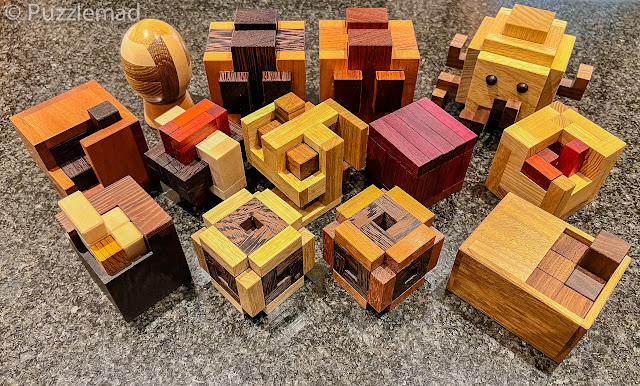
The biggest bunch of Pelicans ever!
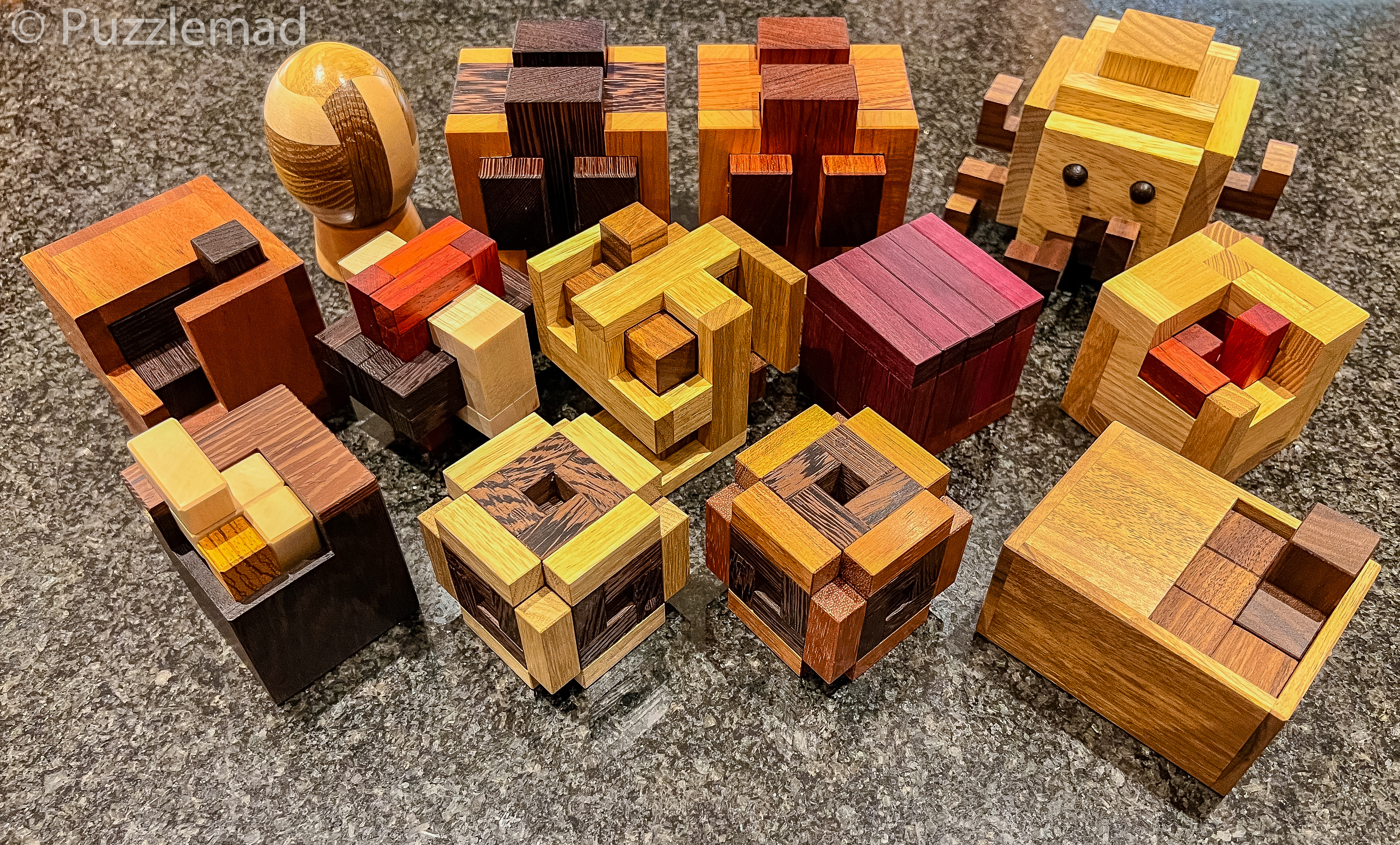
From back left:
Egg - Pelikan (mixed woods)
Hooks - Alfons Eyckmans (Wenge & Cherry or Bubinga & Cherry)
Octopus - Pelikan (Limba, American Walnut and Wenge)
Infinite - Alexander Magyarics (Mahogany & Wenge)
Captain Hook - Alexander Magyarics (Maple, Wenge & Padauk)
Tigridia - Alexander Magyarics (Limba & Ovangkol)
Gem - Osanori Yamamoto (Purpleheart)
Den 3 - Osanori Yamamoto (Acacia & Padauk)
Waltz - Osanori Yamamoto (Wenge, Maple and Zebrano)
3 Piece Burr Flower - Osanori Yamamoto (Wenge & Limba or Wenge & Jatoba)
Dick-Flop - Dr Volker Latussek (Walnut & American Walnut)

In no particular order but mostly the order I worked on them or solved them in:

Octopus
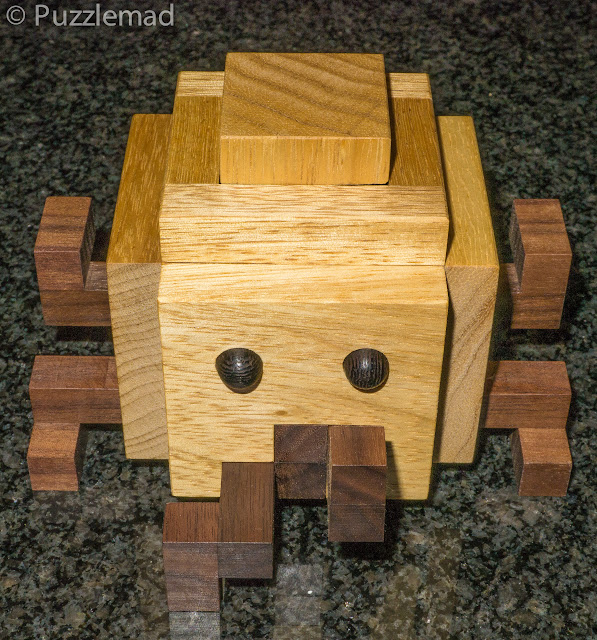
Octopus complete with 8 tentacles!
It seems that no new Pelikan release is complete without one of their own designs, beautifully visualised as some kind of animal. We have had Turtle, Snail, Ladybug and Crab so far, all of which reside on display in my living room. The arrival of the Octopus in the PuzzleMad asylum/loony-bin was greeted by me with a whoop of delight and by Mrs S with a groan of "Oh no, not more!!". She did admit that it was very beautiful. 

This was the one I began with because it's just irresistible. It's pretty big at 13.3x13.3x9.8cm and made of Limba, American Walnut and Wenge. The beady eyes just look at you. Like the crab, it is not just a simple slot together Kumiki puzzle. It is a burr with pieces that interlock in all directions. It all fits beautifully together and the first sliding move is easy to find but after that it gets more awkward. I was able to remove the first two pieces quite quickly and realised that I had not really paid attention to the orientation they came out - the shape of them meant that they rolled off the cat who sleepily acted as my tabletop. Having realised I was going to be stuck soon, I just proceeded with the disassembly. Usually after half the pieces of a burr have been removed it suddenly gets easier but not with this one. I really struggled for another 20 minutes to find the way to remove the final pieces. The main challenge with this will be the reassembly after scrambling the pieces. I almost gave up and went to Burrtools but luckily before I lost the last remnant of my mind, I finally found the correct assembly. 

This puzzle is an essential purchase if you collect Kumiki type puzzles or if you have the rest in the series. For the rest of you it's worth getting because it's adorable and very clever.

Egg
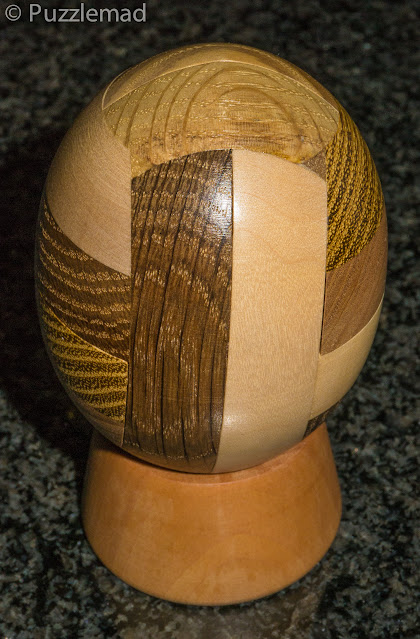
Egg by Pelikan
I had to check with Jakub about this one as it looked familiar but I barely remember yesterday, let alone something I saw in 2016. This is a re-release using European woods of the beautifully turned Egg puzzle. It comes complete with its own lovely turned stand. These puzzles from Pelikan are wonderfully tactile things to hold and caress. The egg is NOT coordinate motion like some of the other spherical puzzles made previously. When it comes to disassembly, the puzzle is not particularly difficult - it is just a matter of finding the correct places to put your fingers to hold it and and push/pull in the right directions. It is not immediately obvious where to put your fingers to do it and it is so wonderfully smooth that you get no clue from running your fingers over it. If you have it just right then you are rewarded with a beautiful sliding motion as it smoothly separates. After a few minutes you have four pieces which look nearly identical and which will only fit back together in one way. Re-assembly is just a matter of thinking it through. This is a joy to fiddle with and looks lovely on display.

Dick-Flop
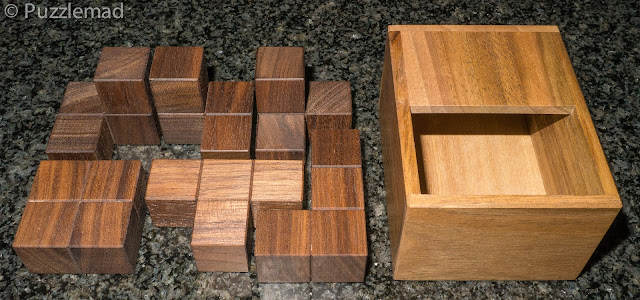
Dick-flop by Dr Volker Latussek
It's just 6 tetracubes from the Soma cube
Here we have another masterpiece from the warped brilliant mind of Dr Volker Latussek! This is what he had to say about it:

"When Dick Fosbury died in March this year, I had no idea that I would find a small series of packaging puzzles and name them FLOP after the high-jump technique named after him. A sports journalist ran the headline "Fosbury Flops Over Bar" after his 1968 Olympic win, comparing the jumping style to a fish flipping onto its back and curling its body after being caught."

DICK-FLOP with its six tetracubes follows FRITZ-FLOP with only five pieces. The boxes are each completely filled and the opening is restricted so that some of the pieces have to flop out of the box.  This is the fourth in his Flop series in which he takes a subset of the standard Soma cube pieces and insists that we stuff them into one of the standard shape challenges that come with the Soma cube. Except.... he makes it much more fun by making us do it into a box through a limited entrance hole. And then, not completely happy with that restriction, he ensures that the entry hole is not a whole number of voxels wide which forces some very interesting and difficult to find rotational moves on the non-planar pieces. It looks like the entrance is 2mm too small to allow two voxels through.
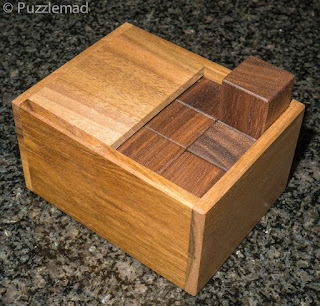

The assembly configuration (Volker always stipulates the assembly shape) is a "near miss" and when you take the pieces out of the box, you get a small hint at the deviousness of that man! Some of the moves just to get the pieces ready for play need them to be perfectly placed before it can happen. The incredible precision of the manufacture by Pelikan is simply stunning - when some of the pieces move and you can almost feel the suction holding them in place as the tolerances are perfect to a tiny fraction of a milimeter.


A quick play with Burrtools told me that there are 78 possible ways to assemble a 2x3x4 cuboid from the pieces provided and I was definitely going to struggle to try them all from memory. I then scrolled through them to find only the ones that have a planar piece arranged vertically along the end (i.e. it can be dropped in last) and after about 15 I stopped counting and decided to peek with squinted eyes at the solution. I just managed to restrict my view to 2 piece positions in the end shape and from here restricted the number of assemblies to be tried down to just 3. I was rather surprised at one of those piece positions that I had peeked at but it really helped me. Even having just 3 assemblies to choose from, actually getting them inside the box was still a massive challenge. It took me about 3 days!

This puzzle is an essential buy for anyone enthused by packing puzzles or the Soma cube. It has been stunningly created by Jakub and team and will be a huge challenge to any puzzler. The Aha! moment is wonderful. 

The Fritz-flop and Soma-flop are still available from the Pelikan website and you should definitely buy the whole set for an amazing challenge!

Captain Hook
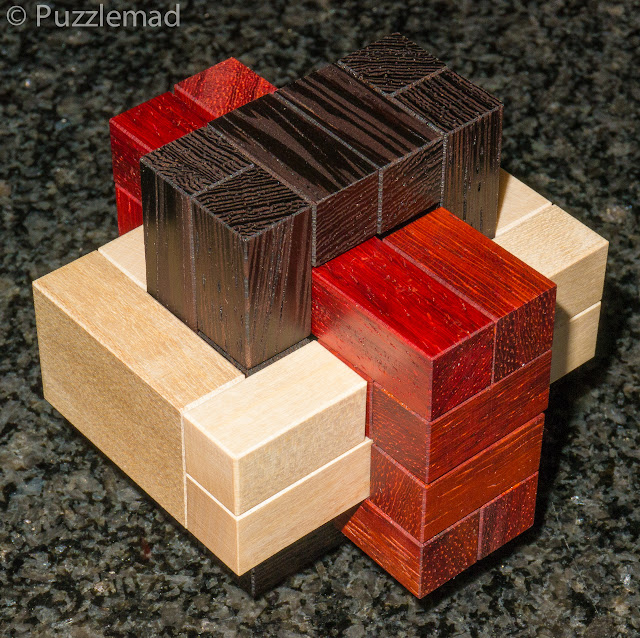
Captain Hook by Alexander Magyarics
Captain Hook is a very interesting board burr made from Maple, Wenge & Padauk. The tolerances are absolutely perfect - this puzzle slides so smoothly. It is something quite new from Alexander Magyarics, whom I am beginning to wonder whether there is anything he cannot turn his hand to and master. I know that you are all familiar with his amazing 3D and 2D packing puzzles and he has designed a few burrs with frames or boxes over the years but I am not aware of any board burrs from him. This looks very like a standard 6 piece board burr when viewed assembled but within a few moves it quickly reveals that it is not what it seems. The movements are interesting and in one case a little unexpected with a very nice pathway to be found. No big blind ends to get caught in and after 10 moves the first piece can be removed. After that 2 moves each for the next 2 pieces and the fact that it is a 5 piece board burr is revealed. I don't think I have ever seen one before. I tried to reassemble it immediately after I had taken it apart and, whilst I had memory of the relative positions of the pieces, there was a critical tricky step that I could not achieve straight away. There is a very well hidden essential move to allow the disassembly and reassembly and if you haven't memorised it then it will cause you to think© for a moment. 

Infinite
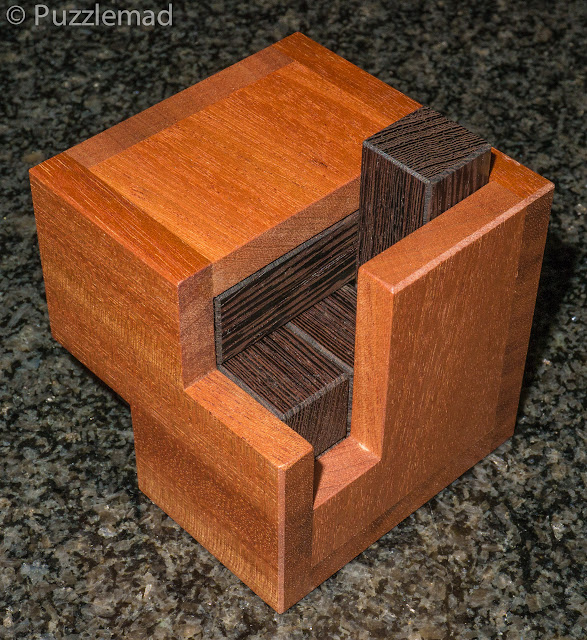
Infinite by Alexander Magyarics
That left side when viewed straight on looks like an infinity symbol
Here we return to classic Alexander Magyarics and it is really, REALLY, REALLY good! It is a beautiful packing puzzle made with a very chunky Mahogany box and just 3 lovely Wenge pieces to be packed. Just 3 pieces? They aren't even that complex! How hard can it be? Oh boy! This is a TERRIFIC challenge. The entry-ways into the 3x3x3 voxel box are quite restricted and must be completely occluded once packed. In fiddling with the pieces I was able to find quite a few arrangements of the pieces into a 3x3x3 cube but none that I found would fit through the openings. 
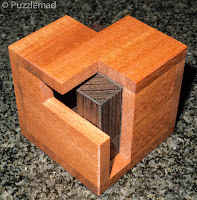
Not solved but fun

Retrospectively, I found 59 cubes with the relevant solid areas using Burrtools but this was unknown to me at the time. Usually I start outside the box and find the required shape but there were too many possibilities and I needed to combine the very restricted entry requirements with my assemblies to narrow it down. The fascinating thing for me is that the smallest piece has the most limitation and ultimately is the reason for a very interesting solution. I found 2 "almost there" solutions with single holes visible through the entryway and I got stuck for quite some time at this point. I then went to Burrtools in desperation and found that it was unable to find a solution which means something special. I relaxed my rules and started again - it took me another whole day of play to find the solution with a wonderful Aha! moment. This is one of Alexander's best designs - make sure that you find all the near solutions as well as the correct one.

Hooks

Bubinga & Cherry
Wenge & Cherry
Hooks by Alfons Eyckmans
I am always delighted when a Pelikan release includes something from Alfons Eyckmans. There are two versions of this beauty - one made from Wenge & Cherry and another from Bubinga & Cherry - they are gorgeous! Alfons is the absolute master of interesting burr design. Many people are not keen on burrs and cannot understand why I (or anyone else) love them. I always say that it is like exploring a maze that changes as you work your way through. Often there are hidden pathways that are tough to find and sometimes blind alleys or loops. I do agree that many of the very high level burrs are beyond most human's abilities to follow but this is where Alfons is a master...the designs are always interesting and fun to explore. The Hooks burr is one of my favourite types - a caged 6 piece burr which takes the idea of a standard burr and extends it. The cage is incomplete being formed from 4 "hooks" on a base and looks like it should not make a huge difference. The pieces are 3x2x7 voxels which allows for much more interesting interaction. There are a few moves possible early on and no long blind alleys. Quite quickly some complex fun compound multi-piece moves occur and this opens up even more possibilities. Process seems swift until suddenly it's not. After 11 moves, I was stuck and could find no way to progress. I must have either missed something along the way or be missing something crucial to progress on my existing path. I got stuck here for a few hours going back and forth - at least it was creating a muscle memory to help with the reassembly. With only 6 pieces and such an open frame/cage it is possible to see inside the maze quite well. Eventually after multiple failed attempts I realised that I had left a single piece in the wrong position and it had blocked the next move. Having worked that out, the progression was fast and fun and the first piece was removed after a total of 18 moves. The remaining pieces remain stable in the frame for the rest of the disassembly.

Having spent so long searching for the pathway, I was able to reassemble it without help but making a Burrtools file is always fun. I think that most burr aficionados should be able to reassemble this without help.

3 Piece Burr Flower

Wenge & Jatoba
Wenge & Limba
3 Pice Burr Flower by Osanori Yamamoto
This stunning design by Osanori Yamamoto has been beautifully created by Pelikan in Wenge & Limba or Wenge & Jatoba. As the name states, it looks like a flower on each face of the cube structure but it has been made from 3 rather complex burr sticks which interlink with each other inside the cube. Once you have found the first piece to move, the pieces then slide on each other and the flower opens up to reveal the interior. Over a rather delightful 6 move sequence the pieces get further and further apart until the first one comes out and then the other two can be separated. It is not terribly hard to find that sequence but then the real challenge begins - can you put it back together after scrambling the pieces? There are only 3 pieces and the way they fit together at the end looks straightforward but it took me a good hour to find the correct order and position for the pieces to fit back together. This is a very clever puzzle utilising what feels like a knot inside the faces to control the movements. 

Waltz
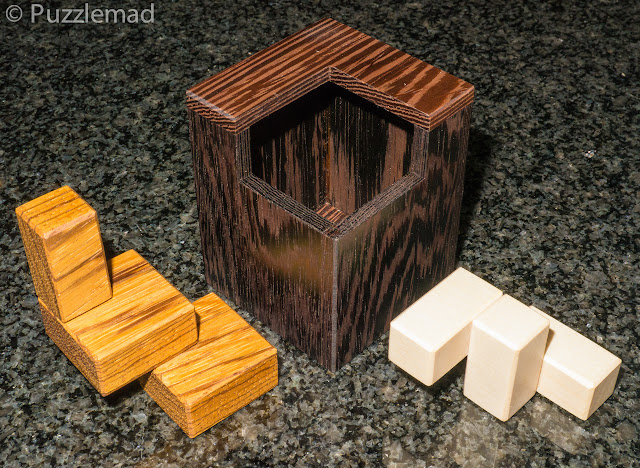
Waltz by Osanori Yamamoto
Another fabulous design by Osanori Yamamoto, stunningly visualised in Wenge, Maple and Zebrano. This one is almost as if Osanori-san has seen the wonderful 3 piece challenge by Alexander Magyarics and said to himself: "I can beat that"! It is another packing puzzle with a limited entrance and a requirement to block the entry once solved....but this time, just to make it even more interesting, there are only 2 pieces to be packed in the 3x3x3 cavity and filled the 2x2 entrance. Not only are there only 2 pieces but it quickly becomes apparent that one of them HAS to be the entry blocker. I was rather over-confident with this one and thought it would  be relatively easy. Oh no! it wasn't easy for me! I spent a day failing completely and did wonder whether I was going about it wrong - I looked at the name and thought about the cardinal feature of the Waltz and then decided to explore rotational moves. I was successful and managed to assemble the puzzle with the entry filled but something didn't feel right. This was especially true when I found that I couldn't take it apart! Aargh! In a bit of a panic, with a fair bit of dexterity and swearing, I was able to unravel what I had done and decided to try again the more conventional way. But this time I was determined to think© about the name as well but not be so stupid. The cardinal feature of a Waltz is rotation with minimal rise and fall. The 18 moves to achieve the assembly are a masterpiece. The gauntlet has been thrown down and is there anyone who can design something more simple with more beautiful moves than this? Over to you Alexander-san!

Gem

Gem by Osanori Yamamoto
This gorgeous gem of a puzzle by Osanori Yamamoto  is simply stunning made here from Purpleheart. I have previously bought and solved this in April where it was an extra puzzle that I chose to "make up the postage" from Japan! Osanori's version was a gorgeous creation and Pelikan have lived up to the same very high standards. When I bought the original, Osanori-san told me how pleased he was because it was his favourite puzzle.


The original was sent out as an assembly puzzle but this one arrived already assembled. Either way, it is a fun puzzle to explore. If you are good at assembly then it might be a good idea to get someone to dismantle it for you before you play. It consists of 3 rings of wood that are interlocked and  inserted into slots in the cube with one at 90º to the other 2. When disassembling it the sequence it is fun that you cannot see the shape or how the rings are interacting inside the cube. The sliding of the pieces over each other shows off the extreme precision that this has been made with. Having taken it apart, leave the pieces scrambled for a while and then try it as an assembly puzzle

The solution took me only about half an hour but again a lovely aha! moment made better by the silky smoothness of the pieces and how they glide over each other. I could see why this was one of Osanori-san's favourite puzzles. It is delightful. Another piece of Japanese puzzling heaven.

Den 3
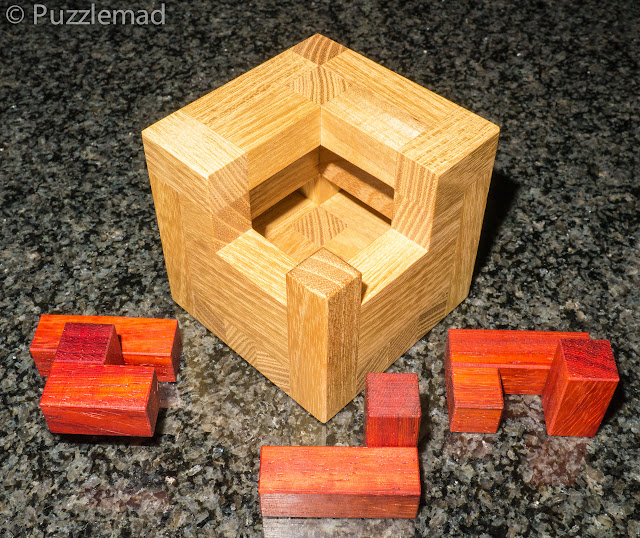
Den 3 by Osanori Yamamoto

In this packing puzzle designed by Osanori Yamamoto the aim, as usual is to assemble the pieces (3 of them this time, made from Padauk) into the nice chunky Acacia box. I must point out the incredible detail that Jakub and team have put into the box - Acacia is a relatively plain wood in terms of colour but with having very nice grain and shading. To make this one even more spectacular the top and bottom faces have been assembled with a diagonal line of differently placed cubes of wood - this makes this wonderful puzzle even more precious for a man addicted to gorgeous wood! The cavity of the box is the usual 3x3x3 cube but, with this one, the areas that must be occluded by the pieces are quite extensive over quite a lot of the puzzle which should limit the number of possibilities to go through. I used Burrtools to count the possible assemblies after I solved it and there are 124 ways to assemble a cube from the 3 pieces of this puzzle but when restricting the positions to allow the occlusion of the holes, this number shrinks down to a more reasonable 22. This number is still too high for me to go through and try them all (I find that I can't remember what I have tried after just 3 or 4 attempts) and necessitates using the restricted entry to significantly decrease the cubes to be tried. 

The solution of this took me an embarrassingly long time to find. I think I played with this on and off for 4 or 5 evenings before I found a cube that met all my criteria and then really struggled to place the pieces inside the box. I ended up solving it outside the box starting from cube shape and attempting all the moves that should be possible and gradually dismantled the cube. It should not be that difficult with just 3 pieces but I kept getting stuck 10 or 12 moves in. The disassembly of this puzzle has an incredible level 26 (19.4.3) - if you do manage to solve this then you can be very chuffed at your puzzling prowess. 

Tigridia
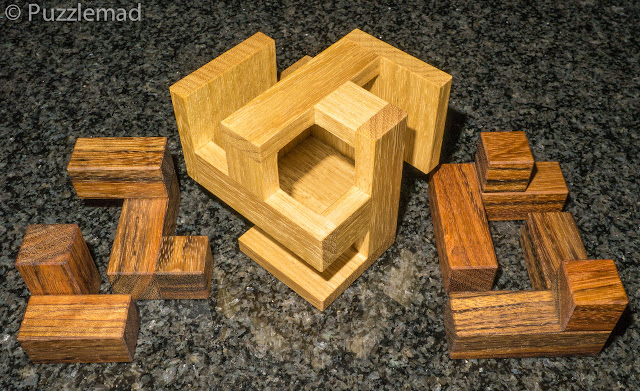
Tigridia by Alexander Magyarics
The final puzzle I played with in this new batch was Tigridia by the amazing Alexander Magyarics (last, mostly because my initial play revealed it to be a very difficult challenge). Beautifully made from Limba & Ovangkol, it consists of 4 pieces to be placed as a 3x3x3 cube inside one of the most complex boxes I have seen in one of these puzzles. The entryways are very limited but there are 3 of them to be used. There are lots and lots of holes in the box which need to be covered by the final filling. Your usual approach outside the box quickly reveals that there are a LOT of possible cubic assemblies (Burrtools later told me that there were 64) and obviously each one that you find will need to be tested in every possible orientation. I very quickly got quite confused and lost track of what I had been trying. Most of my potential assemblies, when I found one that also fit the brief to cover the holes, quickly revealed themselves to be impossible to move inside the box and could be discounted. After a couple of days trying and a deadline to hit, I went to Burrtools to at least give me the correct cubic assembly and then I could work out the method to place it inside the box. Even this proved to be a problem! I had the correct cube made but I really could not work out how it could be inserted inside the box, After a very frustrating and then satisfying hour, I found the critical move and it was something rather special that is only possible with a box with this many holes in it. The Aha! moment is wonderful when you find it but that might well take you a VERY long time.

I am rather humbled by the fact that Ivan Danik (the Puzzle Guy on YouTube) managed to solve this one and did not find it terribly difficult! I found this one amazingly hard. I agree with him that the frame is stunning!


Pick what you love guys and get them all tomorrow (6th November at 10am central European time) at the Pelikan store