Showing posts with label Stewart Coffin. Show all posts

Sunday, 12 July 2026

Pelikan Waits For No Man!

Having returned from the IPP, sneaked my new puzzles in (in their rucksack) and secreted them around my study, I started to work my way through them. I thought I was doing pretty well and felt I might just manage to get a few blog posts in before anything else arrived (I might have a couple on the way). Just when I thought I was safe, Jakub contacted me to say that he was ready with the next batch of Pelikan wonder. My first thought was: "Hooray! More gorgeous beauty and fabulous, difficult challenges" This thought was rapidly followed by another: "She's going to kill me!" Luckily, this time, the box arrived, and it was smaller than the previous ones. She who must be feared thought there were fewer puzzles in there, but don't tell her...they have just been packed tighter. Gulp.

Matruschka

Matruschka by Benjamin Heidt
3 tiny pieces make a stand
There have been quite a few creations on this blog from Benjamin. He designs interlocking puzzles and burrs that are just the right difficulty level for most puzzlers, with some very interesting design features and a lovely sequence to explore. Many burrs are much too complex for most due to multiple long blind dead ends, or alternatively have too simple a sequence and no challenge. Benjamin always gets it right, and Matruschka is a beautiful example. This chunky puzzle is made from Wenge, Cherry and Acacia with a diminutive stand made from Merbau. Looking at it, I was slightly confused as there only appears to be Wenge and Cherry visible, but after a couple of moves, the reason for the name and the extra wood type becomes apparent. A matryoshka doll is the name for the Russian nested dolls, but here Benjamin and the Pelikan team have taken the idea and altered it a little bit to make a nested burr.

The initial exploration reveals quite a few possible moves, and I was worried about having lots of long blind ends to explore, memorise and discount on my way to the correct solution. You can be reassured that, as usual, Benjamin has got it just right. There are quite a few possible ways to start, but the sequences are short before they stop, and you are forced to look elsewhere. The tolerances of the burr manufacture are superb, with everything sliding beautifully. The correct sequence is very well hidden, but once found, you are quickly on your way to the disassembly, and more and more pieces can be removed after you look for the unlocking sequence. The burr within a burr is revealed nicely:

Acacia burr nested within the final 3 large burr sticks
Once the inner burr is released, it can also be disassembled into 6 very beautiful sticks and then the whole lot displayed. 
 
That's a LOT of burr sticks!
The reassembly would actually have been possible for me without the use of burrtools, as I had sequentially removed pieces and placed them in their correct order and orientation on a table. I think most puzzlers should also manage the reassembly if they are careful to do this. Unfortunately, a cat decided to run across my carefully arranged table and scatter the sticks widely. A few unsafe for blogging words were uttered, and Burrtools was going to be my next step.

Once you have done the reassembly that you found then it is time to do it all over again! The 3-piece stand that is interestingly burr shaped can actually be reassembled inside the 6 piece burr so we end up with a burr in a burr in a burr! This is simply amazing!!!

This is a wonderful challenge for all burr aficionados, just the right difficulty level! With an extra twist at the end.

Surround Wil

Surround Wil by Frederic Boucher
There seems to be no end to the puzzle design skills of Frederic Boucher - there are several of his designs in this upcoming Pelikan release. This delightful packing puzzle is fun and should be perfect for all puzzlers of all levels. The puzzle is made from Acacia and a very vibrant Purpleheart. It is quite reminiscent of some of the packing puzzles by Yuu Asaka. There are 4 longer pieces with curved ends, and half-circles cut out, plus 5 disks, all to be fitted into a tray that is too small to take the long pieces side-by-side. If you look at my photo, the top-most large piece is tilted as it doesn't fit in.

This inability to fit the pieces side by side is a big clue that you need to get inventive with how the big pieces can be organised. I found a lovely way to get them all in the tray, but then the half-circle cutouts had been filled, with no space left for the disks. Time to think© and get creative. There is a lovely Aha! moment in this one, and it is very satisfying to pack them all in. This will be coming to work with me to challenge my colleagues - it's perfect for casual puzzling..

T Time!

T Time! by Frederic Boucher
This wonderfully clever packing puzzle by Frederic had me fooled for most of the week. It looks like a simple tray packing puzzle, but there is MUCH more to it. There is a 5x5 space inside the tray and 5 T-shaped pieces to be fitted inside alongside a 2x2 smiley disc. That doesn't look too difficult until you realise that the tray is covered by an acrylic cover with a T-shaped hole in it, in one corner. This explains the nicely curved corners on the pieces - they need to be inserted and manipulated using the holes in the bottom of the tray, plus some use of gravity, until they are in position. There will obviously need to be some rotational moves as they cannot possibly be arranged in the same orientation as the hole in the lid. It doesn't take long to find at least one (if not a few) possible arrangements of the pieces in that 5x5 space, but then the fiddly task of actually getting them into place begins, and, OMG, it's difficult! I spent several days trying everything I could to pack them all in. Nothing would work, and I had to stop for a bit and think© again. 

Finally, after several days of work, I had a special thought (unusual for me!) and realised that there was something very unusual about the design. My jaw dropped when I finally succeeded - Frederic is a genius!

Convolution Cube

Convolution Cube by Stewart Coffin
Convolution ball

Over the 15 years of this website, I have reviewed several versions of the Convolution puzzle by the amazing Stewart Coffin. This incredible interlocking design is not solvable by Burrtools due to the requirement for a rotational move with one of the pieces (does that make it a TIC?). I have a version from Brian Menold and a fabulous spherical version from Pelikan.

I personally would say that a Convolution (as well as its associated cousins, Involute and Involution) should be part of every serious puzzler's collection. All 3 are essential. If you don't have this, then you owe it to yourself to buy a copy. The Pelikan team have done a wonderful job creating this out of multiple different beautifully vibrant woods and the fit is just perfect!

Only 7 pieces but great fun!


The next bunch of puzzles will be reviewed next week - they include more from Dr Volker Latussek, another from Benjamin Heidt and then yet another unusual puzzle from Frederic Boucher. Wish me luck solving them!

Sunday, 30 March 2025

Revitalised By An MPP!

Bicolor 1365 by Koichi Miura
Purchased from Mine
I've been in a bit of a puzzle slump recently. Too busy and too tired to really play with much. It's only been the constant pressure of the blog that has kept me working on solving stuff and often I find myself leaving it until I have just a day to go before publishing to start playing. I really need to cut down the amount I work. I'm getting too old for it - I discovered yesterday, to my horror, that I am older than Frank, Big Steve and Allard! Damn! I'm old! 😱

That's quite something!

I received a bunch of puzzles from Mine at the beginning of the year and have put them in my file of puzzles to be played with and just left them there. Part of the reason for not playing was the strange warping that happened to the lid of one of the puzzles which occurred between the time they were manufactured and the time they were sent/received. Whenever I looked at it, I just got a disappointed feeling. Mine had apologised to everyone and it is an unfortunate side effect of the use of two different woods side by side. 

Every time I looked at the pile I felt guilty and picked one or two from the Mine delivery up and played a little before failing and putting them back... Until last night and this morning when I had a sudden rush of something to the head!

Yesterday was the 55th MPP (at least that's what LCVX seems to mean even if it is completely invalid Roman Numerals). I managed to work my way through 1 or 2 burrs in the shape of locks and even some in the shape of a tetrahedron and also worked my way through 4 or 5 of the Karakuri Xmas presents which was fun. I really got quite badly stuck on the set of Demonticons and needed quite a lot of assistance. I really must buy them soon. One fun thing to watch was Big Steve and Amy working on the Bicolor 1365 from Mine. It's a brilliant design by Koichi Miura which looks to be deceptively difficult based on the two of them working on it for ages and bickering at each other like an old married couple! The whole group of us got a LOT of entertainment watching them fail for a VERY long time. Needless to say, this motivated me to get my copy out when I got home and whilst watching TV that evening with the present Mrs S, I experimented and saw just how difficult it was.

Instructions
When the lid is placed, the colours will not match
I am not allowed to show the pieces but it is interesting because it consists of a box with a 3x3x2 voxel cavity with a fixed cubic on the base of the box and another fixed on the lid. The pieces completely fill the cavity and consist of 3 full voxel pieces and 4 more made with ½ voxels. It arrives in a solved state but in the "warmup state". I tipped the pieces out and examined them - the split pieces all fit together nicely to make whole ones and obviously I walked right into Koichi-san's trap! I spent the whole evening managing to create quite a few of the 1365 possible assemblies.

Every single time, I managed to fail to create the one single correct assembly that would allow the lid to be placed the correct way around. Finally, it was bed time and I put it down with relief. Sunday morning bright and groggy, I went back to work on it. Doing the same thing over and over again like Steve and Amy eventually got frustrating and I had a little think©. That hurt quite a bit and after recovering from the shock, I had a little fiddle with the split pieces to see how else they could be assembled and how they might then interact with the whole pieces. At some point after a couple of hours there was a really big Aha! moment and I tried something new. It wasn't quite right but I could tell I was nearly there. All I needed to do was fiddle a little bit and yessssss!

Take my word for it - the pieces are inside!
It's still a shame about the warping but the puzzle is great!
Having actually solved something thanks to the MPP, I figured that I should keep going whilst I was on a roll:

Bram's Hinged Cube
3D printed by Allard
The whole world is aware of Bram Cohen for a number of reasons. We all know of him as a brilliant puzzler and designer. Very recently he showed off a new design and allowed the puzzle to be made freely available by releasing the stl files for printing. When I arrived in Birmingham, there were a bunch of these available for grabs and I couldn't resist a lovely lilac copy (maybe Mrs S might like it? Whack! Ouch! That will be a no then.)

As you can see, each cube has a hinge on it attaching it to an adjacent cube and 3 of them are attached to 2 cubes. 2 of the cubes have a "blocker" on them which will interfere with adjacent hinges. The aim is to manipulate the hinges to assemble a 2x2x2 cube in such a way that the blockers don't clash. The rotation of the chains of cubies cause them to interfere with each other and there should be no force involved. This looked so good that I picked up another couple of copies to give away to colleagues at work. 

Two more copies to give away.
Notice that there're quite a few flat shapes to be made.
Playing with this is fascinating and reminiscent of the old Rubik's snake. It gets blocked very quickly and the temptation is to force pieces to move past each other. Resist that temptation as you don't want to pop a hinge. It is a fun thing to play with - several times I created a 2x2x2 cube with just one cube out of place and, after a good hour, I got an almost there solution but we all know that "almost" is not solved.

Blocked from achieving the solution
Finally after a couple of hours I had an Aha! moment and could see the correct cube assembly but getting the pieces into place was a big challenge. It required me to undo almost the whole thing to move pieces out of the way before trying again in a different order:

Bram is a genius!
Thanks to Allard for making me a copy.
Undoing it is also a bit of a challenge - I could not for the life of me work out how to return to the starting flat shape. To my shame it took me a good 20 minutes! And now I can't repeat the solve which means I didn't understand it at all - time to keep 

I even managed to solve an easier puzzle that Allard gave away:

Stella Octangular Puzzle
I couldn't resist this - straight away I realised that this was a version of the Triangular star puzzle. In fact, as far as I can tell it is identical and creates a very pleasing shape when assembled

Very pleasing - Just pull opposite vertices to disassemble
I am now busy working on a copy of Stewart Coffin's Diamonds puzzle (STC #269) which looks fairly simple but so far the full assembly has eluded me:

Diamonds (STC #269) printed by Allard
As you can see, attending an MPP has revitalised my puzzling - it's not an entirely solitary pastime this. Playing with friends and watching others struggle is very good for the motivation.

Don't tell Mrs S but I might have acquired a new lock whilst there. Andrew Coles is about to release a new lock to the world. The Clutch Lock is beautifully made and so far, I have done one thing and discovered why it has that name. It might be years before I make the next discovery!

Clutch Lock by AC puzzles

Looking forward to the next MPP in May - it may be the next time I solve anything! 😱


Sunday, 28 January 2024

An Original Pelikan

Shows where Jakub and Jaroslav Got Their Skills

Four Corners by Stewart Coffin
I have had a rather hard week at work this week and have been working on some tough new puzzles. This has meant that I have solved nothing! Yes, Nothing! I am rubbish at puzzles - you heard it first here. I wish I was a genius like Steve and Derek or a puzzle solving machine like Louis but unfortunately I seem to be much better at accumulating puzzles than solving them.

BM6


The Brass monkey number 6 arrived nearly 2 weeks ago and I have singularly failed to find even the first move. Remember that if you want one then it goes on sale NEXT Sunday. I am sure that you will have a lot of fun with it and solve it in a reasonable amount of time whilst I spend months and months trying to find the first move.


Oleg's Wardrobe


I also received the Oleg's Wardrobe from Dedwood Crafts. It is absolutely stunning and rather huge. It is NOT a box! Even if it has a cavity in it - Dee has said that it is a wardrobe and there's nothing that says I can't have wardrobes in my collection! Mrs S is muttering about storage again but has admitted that it is very very beautiful. Again, I have played for a bit and followed the easy first steps which lead you nowhere and then stopped dead. Yet again, I have accumulated something and haven't managed to solve it. Aargh! I am trying not to cry thinking about the previous 3 from Dee which also remain stubbornly closed.

Erm! I seem to have failed at these as well - I really need to find my Mojo.

Orbit
Uplift
Burner
All three by Dee Dixon remain unsolved - only one has revealed any steps at all to me!

Al Bus by Jordi Gallen         

Then after that, Having seen the Al Bus (designed and created by Jordi Gallen) raved about by several people at Peter Hajek's EPP and also enthused about by Derek, I decided that I should try and get a copy. It is available to purchase now from PuzzleMaster but when I looked at it and made my decision, a copy was put up for auction to go to charity commemorating the late Eric Fuller. I bid and I won and several rather gorgeous pieces of plastic arrived. I haven't had time to do much more than fiddle so far. It is rather lovely!

Having gotten nowhere with several rather complex puzzles all I can do is show off a rather lovely Stewart Coffin puzzle that I managed to acquire from Bernhard. This copy of the Four Corners (STC#6) was made by Josef Pelikan using 3 woods and is a lovely variant of the diagonal star puzzle. It slides apart beautifully to show 6 identically shaped pieces with the classic base and slightly altered ends:

Instantly recognisable piece types
At this point I noticed that there are 4 different woods appearing at the ends of the pieces (3 Padauk, 3 Wenge 3 Mahogany and then 3 Oak. When the puzzle had arrived, as you can see at the top of the post, all the colours at the ends were mismatched. I hadn't read anything about the puzzle and wondered to myself whether the aim is to reassemble ensuring that each of the 4 poles is the same colour/wood. I also wondered whether there were any alternative assemblies. I quickly discovered that despite the simplicity of the pieces, there seems to be no other way to assemble the puzzle. If you try to put it together with pieces the wrong way then it is blocked.

Sliding together blocked
After fiddling for a little while, I discovered that this one is a little awkward to assemble the halves. I found it quite confusing - I could assemble the top half with the single pole but struggled to manage the differently shaped bottom half. I got there in the end and now have the puzzle arranged with a different wood at each pole:

Much better!
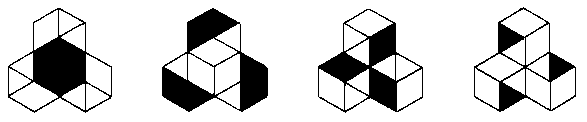
Looking at the online version of "The Puzzling World of Polyhedral Dissections" kindly hosted by John Rausch, there are other challenges involving different arrangements of the colours and symmetry. The four different ways in which the Four Corners Puzzle can be assembled in color symmetry are represented in in black and white below. The one on the left, in which each "corner" is a solid color, is the easiest and most obvious and is how the puzzle got its name. Each has a pair of solutions.

fig104

Finally, to extract one more bit of recreation from this puzzle, discover the 24 ways of assembling it such that the patterns of all four colors are identical but not symmetrical. You may skip the 3,808 ways that do not have either property. Hint: in general, these color symmetry problems are not the type that one solves by trial and error. One must try to discover the principles involved and the simple rules that transform one solution into another. You may not even need the physical pieces.

I have managed a couple of these and then got side-tracked by other toys! Now it's time to get back to these blasted sequential discovery puzzles and hopefully solve something for next week - wish me luck!


Sunday, 10 December 2023

Interlocking Heaven and Hell

Do you recognise those shapes?
Peanut puzzle by Stewart Coffin
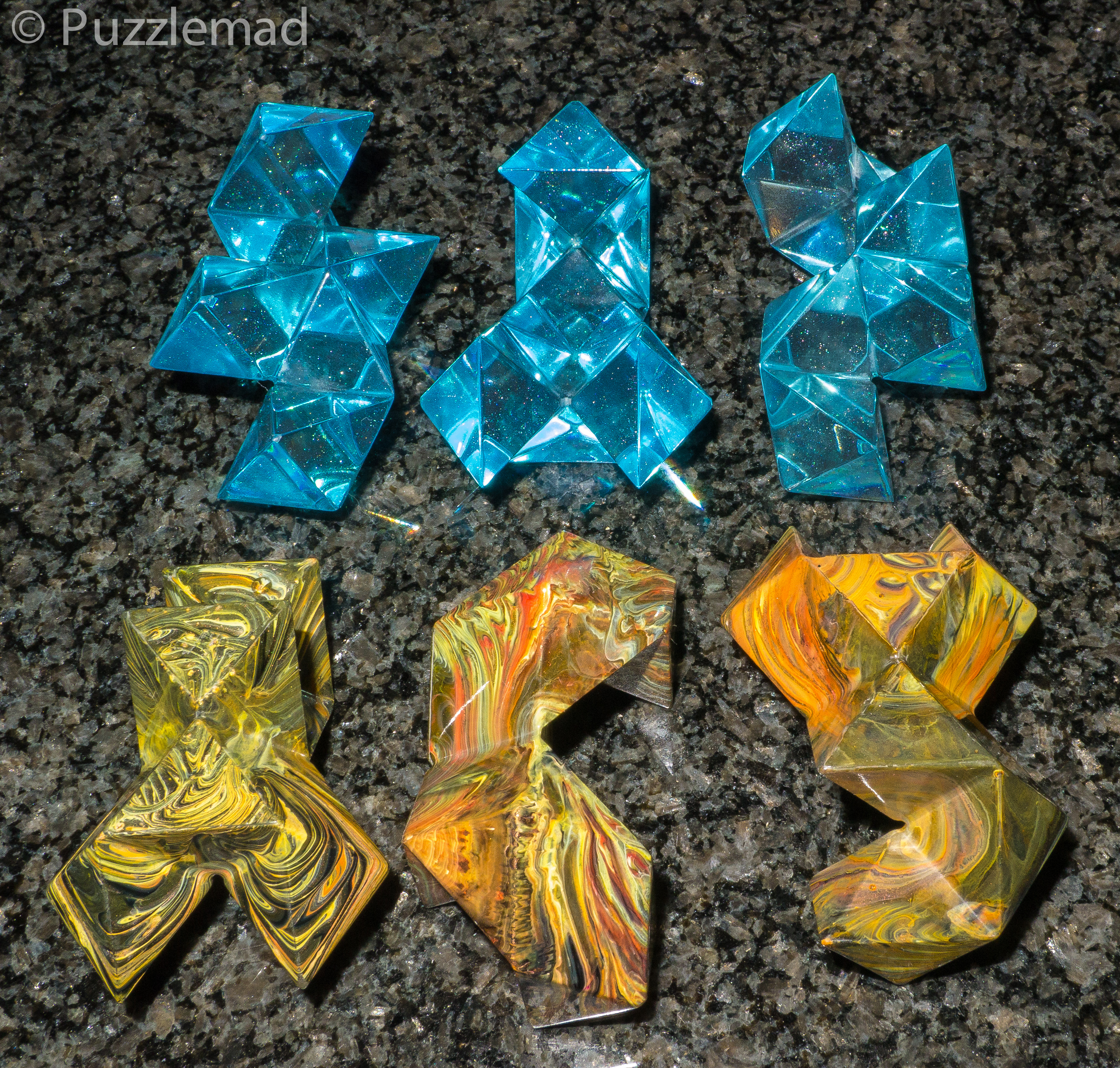
I saw this on Facebook a few months ago and, despite the fact that it is not a wooden version (which I have lusted after for years and never managed to acquire) I fell immediately in love with it. Lewis has gotten into casting beautiful puzzles using acrylics and had managed to model the pieces of the Peanut puzzle (#67) well enough to make moulds and and then create his pieces using one lovely clear transparent blue acrylic and another using a mixture of yellows and reds and black acrylics made into a gorgeous swirly pattern. I do already have a copy of this puzzle 3D printed by big Steve which I got a few years ago and which I completely failed to solve having dismantled it from the ring shape it arrived in. This was my motivation to try again. It looked heavenly but would I be in hell?

One of the features of this version that particularly excited me was that Lewis had recreated a booklet of construction problems to go with the puzzle. I had had no idea that there was any other challenge other than to use the 6 pieces to make the ring but apparently there are at least 31 achievable challenges. I say achievable with no real hope of this being achievable by me as I am absolutely hopeless at assembly puzzles. Stewart's original instruction sheet said:
From Stewart's original instruction sheet:
"The Peanut Puzzle is based on a two-piece dissection of the rhombic dodecahedron. The half pieces are joined different ways to make this set of six Peanut Puzzle pieces. There are twelve ways that the half-pieces might have been joined in pairs to make usable pieces having no axis of symmetry. This special set of six was found by Mike Beeler, using a computer, to be the only one of 924 possible sets that will construct all the symmetrical shapes below.
If any closed loop is considered a Peanut Puzzle construction of sorts, then many others are possible, some having symmetries and some not. See how many you can discover; then sketch them and invent names for them."
Also from Puzzle Craft 1992:
"The object of this puzzle is to join the pieces together in a closed loop to construct all sorts of different geometrical figures, such as those shown below, using three, four, five, or all six pieces. Or you can invent your own. The pieces are fun to just play with. In order to fit together all different ways, the pieces must be very accurately made, so this is not a project for the beginner."
The quality of the casting of the pieces and their sheer beauty is breathtaking and it even makes me forget about gorgeous wood for once. The booklet shares the same attention to detail. Beautifully printed and spiral bound with instructions on what shape to try for and how many pieces to use. For example puzzle one is as follows:

Excuse the poor photography
This just invites you to have a play. I struggle with assembly puzzles when the pieces are rectilinear and the pieces used here are anything but... they use a rhombic grid and the interlocking of the pieces is an interesting diagonal mating process. Each piece can unite with two others at each end. Therefore to make whatever shape is required you need to effectively make a ring form for them all. Embarrassingly, it took me about 45 minutes to solve the first and easiest challenge! Aargh!

Yay! Solved one!
It is hugely satisfying to do this and unbelievably difficult for a man of my scant brains. Challenge 2 was slightly harder:

How hard can it be?
Blush! Took me 2 hours!
OMG! This is humbling. The first two challenges should not have been so difficult as they are effectively planar challenges. Obviously the interaction is in 3D but the shapes to be created are all in the 2D plane and I was spending enormous amount of time trying to find the right interactions and with my Goldfish memory probably trying the same interlocking over and over again. Sigh - not terribly bright. The following day it was time to venture into 3D shapes with just the basic Tetrahedron:

Still "just" 4 pieces!
Took me a whole day!

I was seriously intimidated! I had a little try at the 4th challenge of a Diamond shape and after another whole day, had completely failed to manage an assembly even remotely close! It is great fun trying but after a while I had to put it down. Then I decided to be a complete sucker for punishment and attempt the hexagonal ring which is the shape most commonly associated with it. The picture to the left is from John Rauch's Puzzleworld site.

And of course, you guessed it! I have completely failed to assemble this shape. Is it just me? Or are these seriously seriously difficult puzzle challenges. I am fairly certain it is me!

I then wondered whether the puzzle could be modelled in Burrtools and maybe I could create a full set of the assemblies in BT format. Do I consider this a "cop out"? Only a little bit. It is all about having fun and I have said many many times on the site that the making of a BT file for a puzzle is a crucial part of the fun for me. I have no real experience of using the non-rectilinear grids with BT so this would be a good chance to try it out. And here is where I hit a brick wall for a while. When starting a new design the options are:
  • Brick
  • Triangular prism
  • Spheres
  • Rhombic tetrahedra
  • Tetrahedra-octahedra
I had no clue! I started with the obvious Rhombic tetrahedra grid and could not manage the creation of any useful shapes. I cannot recall which grid O settled on but I think it might have been the triangular grid which allowed me to model the 6 pieces (with huge difficulty). 

Two of the pieces successfully modelled in Burrtools
Time to model the challenges then - this is a whole lot harder! In fact so hard that I cannot do it. I think I will need to ask an expert for advice on how to go about it. The difficulty I am finding is that the shapes in the 2D representation of the grid change with each layer as you go up the z-axis.

If anyone is able to help with this then please let me know. It would be a fantastic resource for the puzzling world to have a BT file with all the challenges in it. Please use my contact page.

This is a fantastic puzzle design by the Master, Stewart Coffin and has been fabulously recreated by Lewis. They are quite time consuming to make but I am sure that he will be making more if you want to buy one from him. 


Sunday, 28 August 2022

Pelikan Summer Release Part 1 - How do they do it?

Coming soon from a Pelikan near you!
Last weekend, luckily whilst Mrs S was away from home at the outlaws, I took delivery of another big box from Jakub and Jaroslav. The delivery man knows us very well and he is so frightened of Mrs S that he had put the box on the front step and was hiding behind our garden hedge! Once he realised that he was not going to be lambasted for bring me more toys, he came out and we had a nice chat. Unfortunately we both forgot that Mrs S was able to listen in using our Ring camera. She was not terribly pleased! But I, on the other hand, was delighted. I had new toys to play with. I have not yet completed all the puzzles yet as it has been a big week for me at the hospital doing a single giant operation each day and having no time or energy when I got home to really work on anything. I have managed to play with four of them and plan to work on the others this week.

Triumph

It's quite hard to take a good photo of this
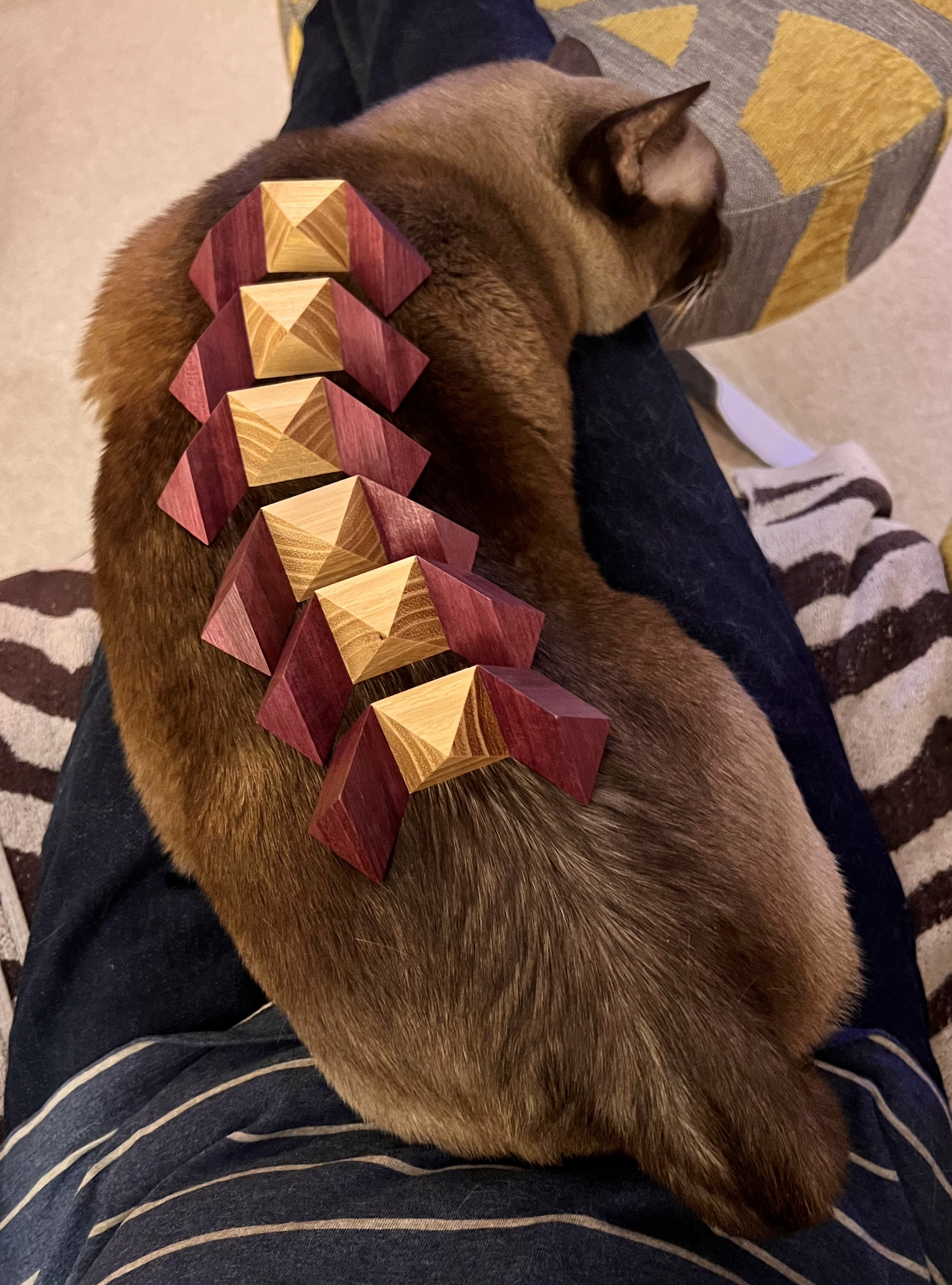
Triumph is a classic design form Stewart Coffin (design number 15). He made quite a few of these which are based on the classic Diagonal star puzzle with alterations in the extension pieces at each end. The star is made from Acacia and Purpleheart and looks stunning. Jakub has decided to send this out in the classic tower formation and this is relatively easy to work out what to push/pull to separate it into two pieces and then completely dismantle:

Six identical pieces
The precision with this is superb! There are no gaps anywhere and the sliding motion as you separate the halves is delicious. I used Burrtools many years ago to exhaustively examine all the possible assemblies and there are quite a lot of assemblies (approx 1200) but most are not attractive even though they fit together. I found just 3 or 4 particularly attractive ways to put the puzzle togther and you should have a nice time experimenting with this one. 

Be careful! The corners are so perfect that they are sharp and whilst you are unlikely to cut yourself, you may find handling it uncomfortable. The pieces fit so perfectly that it can be quite difficult to get everything aligned perfectly to allow the final assembly to slide together. It is very satisfying when it does. 

He came in useful at last!
I did not think that anyone could make this puzzle as perfectly as Scott Peterson who made me a copy many years ago and which sits dead centre in my display cabinets in pride of place. I actually think that this one from Pelikan is pretty much as perfect as his! You will need to keep these well temperature and humidity controlled to keep them moving well but it is worth the effort.

Triumph in tower form from Pelikan and Scott Peterson
I do hope that Pelikan choose to make the Triumph companion and the Fusion confusion as well because they really should be considered as a set.

Four Corners

It's also quite hard to take a good photo of this
Four corners is another of Stewart Coffin's Diagonal star based designs (this one made from Acacia and Wenge) and seems to be a less common one to be made judging from the complete lack of information or photos on the Puzzle-place wiki. Although John Rausch has some wonderful pictures on his site. As before this one comes apart into halves and then into 2 groups of 3 identical pieces that are just slightly different to the Triumph pieces:

Just a small difference from Triumph but a large difference in what is possible
Experimenting with this one I tried to establish whether there are any other assemblies and as far as I can fathom the rotational symmetry of the pieces means that only the 4 cornered assembly is possible. Again, it is a delightfully perfect fit as they are all slid together and apart.

This morning it occurred to me to try and mix the pieces up from the 2 puzzles and see whether they would fit together and then whether it would be nice. I will let you decide:


I think they look great!
It will be fun to experiment a little more when I have some time.

Zeus

Zeus by Osanori Yamamoto
This gorgeous creation has been made using Mahogany, Maple and Purpleheart giving a really lovely looking cross design. In the last batch of Pelikan puzzles there was a release from Osanori-san which also involved 4 twisted burr sticks fitted into a frame. This particular varian has a very shallow frame and very simple obstructions protruding into the cavity. The sticks are as simple as they can possibly be which means there is a lot of possible movement right from the outset. The first couple of attempts, I got a little lost and had to backtrack each time but eventually I found a rather promising sequence that almost released the first piece. Getting it actually to come out proved a little elusive until I had a quick look on both sides and realised what could move. After that I had my four sticks and frame and realised just how simple the shapes had been:

As simple as it gets!
Having taken my photos and rearranged the pieces from their removal orientations, I found the reassembly a fair challenge. If this was given to a puzzler having been already taken apart then it might prove really quite a challenge - it would certainly be completely beyond me but many of the better interlocking puzzlers would find this a great challenge. Well worth adding to your Osanori collection.

Broken Box

Broken Box by Lucie Pauwels
It was sent out assembled but I was rather stupid and dismantled it immediately!

I was rather curious when I took this from the packaging. The beautiful Wenge cube inside the Cherry wood box looked odd - there were magnets and I wasn't certain what they were for. So I dropped the cube out the centre and it fell apart into 9 horrifyingly awkward components and a box that was "broken". I wasn't certain what the point was apart from maybe put the pieces back in and maybe rearrange the box halves into an alternative shape around the cube. I initially decided "just" to put it back together again as I had received it. I wrote "just" because this was a horrifically tough task for an assembly puzzle dunce and it took me a couple of hours! I then thought I might try to make the flattened tray version and so far have completely failed! How can creating such a simple shape be so damned difficult? I put it aside to play with the other puzzles for a bit.

Jakub later sent me the instructions and showed that there were quite a few more challenges:

Two tray designs but one with a "twist"

Chair type designs but with a pretty limited access in one

I have no idea how I am going to solve this one!
These puzzles can be solved in 2 ways - you either make the shape first and then add the box frames to it or assemble the box and try to put the pieces inside afterwards. Burrtools tells me that there are hundreds of assemblies for some of the shapes but I have absolutely no skill in finding them! Lord knows how long this will take me! This will be tremendous value for money to any puzzler who purchases it as well as a really fantastic series of challenges. I did manage just one of the assemblies so far:

I think this was more luck that anything!

The other puzzles in the release are Maahes designed by my friend Terry Smart and previously made by Stephan Baumegger - it had been in my top ten of 2016. I have no recollection of the solution and will need to try again with the Pelikan version. Dino 2 is another of Alfons Eyckmans' wonderful burr zoo creations which will have a cute little dinosaur inside the usual 14 piece burr. Tau by the incredible Volker Latussek looks amazing and very reminiscent of one of my all time favourites from Laszlo Kmolnar, the No holes barred puzzle I reviewed in early 2016. Volker has told me that he is particularly proud of this design  which means that it will be incredible! Unfortunately there is a small mistake in the copy I have been sent and Jakub is having to make them again before they can be released. I hope to review these puzzles next weekend once I have had time to play.