Sunday, 11 July 2021

I Have Worked As Fast As I Can!

Coming soon from the New Pelikan Workshop
I showed off on my New Additions page that I had just received another huge batch of puzzles from Jakub and Jaroslav that they were hoping to release soon. I know that you all want to know about them as soons as possible and they want to sell them soon as well. I know that they like for me to write a bit of a spiel about them for their site and hence I start work as quickly as I can. Luckily I had a week of annual leave this week and did get a bit more time to play than I usually would BUT Mrs S is still a woman to fear if I don't do all the chores and duties that she has decided I must do and hence I did not have quite as much time as I needed. Plus...I am only human and my very feeble brain can only solve so many puzzles in a short period of time without feeling like it is going to explode. There are 9 in this release and I have managed to solve 5 of them so far. I will work on the remainder as quickly as I can.

I have no idea when these will be put up for sale so keep an eye out on the Pelikan puzzles site for updates or (if you are North America based) then keep an eye on the Pelikan section of PuzzleMaster for them appearing there (this normally happens a few weeks after the initial release).

I will start with the 2 puzzles from my friend Alexander Magyarics - right up front I have to shout out that HE IS ON FIRE!!! The puzzles that Alex has been designing recently have been not ownly beautiful in their design but absolutely astonishingly fun designs to play with and solve. He has got just the right difficulty level and play experience recently and these are the very best he has produced.

Colliding Galaxies 2

 Colliding Galaxies 2 by Alexander Magyarics 
Let me say from the beginning that for me this was the pick of the bunch - it may not be for everyone but I seriously struggled with this and the Aha! moment when I managed it was something truly special. Yet again this is another 3x3x3 cubic packing puzzle with a fancy box and a complex restricted entry which must be completely closed once solved. The title comes from the rather nice 3 armed hole on opposite poles of the box - the one pictured above is made from Cherry and Wenge and of course, like all of Jakub's work it is superbly made. The 4 pieces are quite restricted in the way they can be inserted into the box but so much that there is only one choice. Alex is not going to make it too easy by restricting too heavily.

Solving this was an unusual experience for me - I did my usual of trying to solve it outside the box and got only so far before having to change my approach - this may because I am stupid I guess. I found a few ways to construct a cube and felt this part was quite fun. Finding which orientations would fill the entry gaps was rewarding too and I had narrowed my assemblies down to only one or two. My next step is to seat the box on my lap (or the sleeping cat on my lap) and alongside it put the assembled shape I thought might be correct and then work through the possible disassembly. The problem for me was that these shapes and the holes in the box were too complex for me to keep visualised and held in place during the process. I tried this each evening for several days and just could not do it. Eventually I abandoned that approach and did something I have almost never managed before - I actually tried to assemble it within the box without having worked out what order or sequence to use first. What a challenge! Which pieces to put in first etc? Eventually I managed to get 3 of the pieces assembled inside but the 4th was a problem. I could do this with several combinations of 3 different pieces, Aaaargh! I spent 3 evenings desperately trying to get this together and always found that the crucial move that I needed was blocked until I noticed something special. A few slides later and:

At last! Fabulous!
I had not tried a particular set of positions before (I don't know why but I just had a mental block and couldn't see it) and suddenly I found the setup position I needed and AHA! It went together like a dream - this is a STUNNING challenge. You may find it easy but for me, I just could not seem to visualise the sequence. It forced me to work in a different way to my usual.

Play-boy 2

 Play-boy 2 by Alexander Magyarics 
It arrived like this
Yet again, we have another puzzle based on a non-rectilinear grid. Only Pelikan seem to have the courage to do these sorts of puzzles - probably because they must have a way to create the necessary jigs cheaply and easily. This puzzle has been made from Pink Oak and Padauk. Taking the pieces out of the box as it had been packed for transport, I could see just how accurately these had been made - the pieces had sharp corners and I had to be careful not to stab myself. I am sure that you can see it straight away but for me it took a few days for me to realise that this one is also "just" a 3x3x3 cube to be fitted into a box with a complex entry hole. The special feature is that this box and the pieces have been sheared along the x-axis to make a shape that is also quite difficult to visualise in your head (of course, YOUR head is probably more capable than mine).

I had taken this to work because I knew that I had a vascular case down in our angiography suite which was going to be a very easy anaesthetic and a VERY long procedure. I needed something to keep me out of mischief (I get up to all sorts of pranks if I am not kept properly occupied) - this puzzle was going to save the staff from being annoyed by an anaesthetist with the mind of a 12 year old and a low boredom threshold!

I worked on this in my usual fashion - assemble the correct shape outside the box and then work out whether and then how it can be placed inside. I am not good with a non-rectilinear grid and just finding the shape took me a little while. There are some big clues as to what is needed in looking at the shapes. The restricted entry is very helpful in limiting the possible assemblies and I was pretty sure that I had the correct one settled on fairly early. Time to work through the disassembly first outside the box and the skewed shape made it hard for me. After about ½ an hour I had it worked out - solved in about an hour? Not so fast! Actually doing the assembly proved an extra fun challenge - gravity has to be utilised just right and a good bit of dexterity - it was almost like a non-rotational version of the Rollercoaster puzzle which I reviewed here. The nursing staff and my ODP had watched me working on it with fascination and were almost as delighted as I was when I stood up and showed them this:

That was FUN!
Yet again Alex and Pelikan have produced something wonderful and requiring a different thought process to usual.

No Pelikan release seems to be complete without something from Osanori Yamamoto - the next two were his challenges.

All Tetra Pod

All Tetra Pod by Osanori Yamamoto
This puzzle has been beautifully made from wenge and Padauk. This was the first one I tried from the current batch - I thought I might manage to do it fairly quickly because the pieces are relatively simple being just the complete set of tetrominoes and also because I distinctly remembered having solved a very similar challenge from my good friend from South Africa, Johan Heyns. He had produced the Tetro puzzle from Ishino's site complete with a frame and a stand - I had written about it here and had enjoyed it a lot.

Tetro pieces - see the similarity?
Assembled in the stand
And there was my first mistake - the similarity was only superficial - Johan's puzzle was relatively easy because there are 63 possible assemblies into that corner shape and whilst finding one of them was not trivial, it was not too many hours of work. The new design from Osanori-san has a much more restricted entry (in fact, it is a corner shaped box with only a slot for entry). I think I had made about 6 different corner shapes which would not go inside the frame before I realised quite how much more of a challenge this was. I needed to think in terms of the restrictions as well and that really added to the challenge! Over an afternoon I think I lost most of the rest of my hair from this puzzle - it is a massive challenge and it transpires there is only a single assembly out of the 63 which is assemblable inside the box. It requires a lot of thought and a LOT of trial and error - fabulous!

That took me a very long time!
Palace

Palace by Osanori Yamamoto
Palace has been made from Pink Oak and Wenge. I know...it's yet another packing puzzle! Yet another of those 3x3x3 cubes that need to be inserted in a box so that they fill all the entry holes! Over the last few years I have bought dozens and dozens of these puzzles and I never ever get fed up with them! They are all very similar in idea yet all very different in challenge. I absolutely adore them because they require several different trains of thought and then some fun manipulation of pieces and even some dexterity too. Osanori (and Alexander) are the absolute masters of this subtype of the packing puzzle group (I consider it a mixture of packing and interlocking along with some dexterity).

Palace looks pretty simple because there are only 3 relatively small pieces and they don't look terribly complex but there is the challenge - such compact pieces still need to fill some very big gaps in the box. It is quite easy to make a few shapes outside the box which will fill the gaps so maybe the challenge will be small? Unfortunately the entry is really not very restricted at all and therefore it requires a lot of trial of different orientations and assemblies before the appropriate thoughts begin to percolate my dense noggin. Like most of Osanori-san's designs, the pieces need to dance around each other quite a bit - in this case there is one particular move that I really struggled to find at first. The Aha! is tremendous when it hits you and everything finally slots into place.

Palace solved - magnificent!
I would be interested how all of you store these puzzles? Do you leave them in the solved state? Do you put them on display in pieces or just assemble into an incorrect shape for the shelf?

Web 3

Web 3 by Dan Fast
Finally today, a new design from a man we have not heard much from in a long time...Dan Fast (he used to be called the CrazyBadCuber but has given up that moniker now) has designed a few puzzles over the years (both Twisty and interlocking/burr) which I have had the opportunity to review and enjoy a few times on the blog. Dan got into Burrtools a few years ago and has recently been playing with it again. He sent me a few BT files a month or so back to ask my opinion and I was fairly positive about them. Jakub also got to see them and was enthusiastic enough to make a quick prototype (really really quick!) and made the decision to produce one of the easier of the designs. Web 3 is the result. This has been gorgeously made from Garapa and Ovangkol (stunning grain on it). Dan has designed a whole bunch of these up to 8x8 but I think jakub wanted something more approachable for all puzzlers.

The aim here is to slot the pieces into the frame to create a lattice that sits flush with the base. My first attempt at this had it solved in about 5 minutes and I was left with a feeling that I was missing something. I took it apart and gave it to a coworker and they really struggled - I must have got lucky. They eventually put it together and were very pleased with themselves so I tried again. My second attempt was less straight-forward. It requires a little trial and error but mostly, after the first few attempts, a definite plan and logical approach. It is still not hugely difficult (I think that a 4x4 version might be really really tough - too tough for me) and they final assembly gives a nice satisfied feeling. This is definitely suitable for beginners and experienced puzzlers alike. Dan has commissioned Alfons Eyckmans to make a full set for him up to 8x8 - now that will be a wonderful puzzle set for his collection!

Fun challenge and looks great on display


I am continuing to work on the rest of the puzzles and will hopefully have reviews up for you all soon. 


Sunday, 4 July 2021

Aaron Extends Some Classic Puzzles

And Gives a Huge Challenge (which I even solve for once)

Axes and Hammer
At the beginning of the year my friend, Aaron Wang, showed off his latest creation on Facebook (it had quietly been shown off in the IPP design competition in 2020 for the IPP which had not happened due to this blasted pandemic). It was a very exciting announcement because he had clearly gotten very big ideas - not only was he making new disentanglement puzzles but he had branched out from simple hand made wire puzzles (which you will have seen a lot on this blog) into making beautiful versions out of stainless steel. Of course, I am addicted to his puzzles (I think I have bought almost everything he has produced) but how could I resist when he moves into a new medium? An order was placed and then it all went rather badly wrong! The Pandemic has really hammered the international postal service from China to the rest of the world.

Several of us in the UK had ordered these at the same time in March 2021 and  the tracking reached the airport and stopped... they stayed at the airport for weeks and weeks. Of course, I trust Aaron and he was just as exasperated as I was but we decided to just keep on waiting and after 3 months (just when Aaron was contemplating absorbing the cost and sending another package out with a different courier) the packages suddenly started to travel around the world. Phew! Once they had left China they arrived here pretty quickly and I was delighted to receive my fabulous puzzle - in fact there were 2 in there (he had made me a gift of another great design).

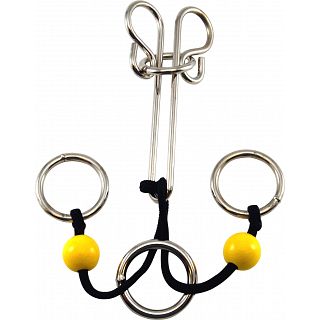
The star of the show (pictured at the top) is the Axes and Hammer puzzle. As soon as I saw it I recognised the type of design - I have featured this at least twice before much earlier in my adventure. The very basic versions are the Scorpion (available frome Puzzlemaster here) or the Smuggler's revenge which seems to be no longer available.

Scorpion
Smuggler's Revenge
These are functionally identical with a classic solving method but are not quite the same as Axes and Hammer in that the string/chain loop only feeds through once. For this more complex version then you should look at Scorpion's Sting from Puzzlemaster or the Wedge from the sadly no longer with us, Livewire Puzzles - you will notice that these have a double loop through the puzzle:

Scorpion's Sting
The Wedge
It won't fit
The solution for all these puzzles involve moving the ring to various positions and then feeding one end of the string/chain through the puzzle before continuing to manipulate the ring further. It is actually not a particularly difficult one (Scorpion is level only 8 (Demanding) out of Puzzlemaster's scale of 5 to 10 whilst Scorpion's sting is level 10 - I would put it down at level 9 at most). The key feature is the ability to move the ends through the puzzle. I quickly set to playing with Aaron's version and quickly discovered that Houston has a problem! As you can see in the picture to the left, the axe heads will not go through. It can only pass through at the very end and this is impossible with the ring in the way as pictured which is an essential position for the solution of the more basic versions. Oh yesssss! This is why I buy puzzles from Aaron - he does make his own designs but he also takes other designs and makes them MUCH more fun.

I worked on this for a couple of days and really had to Think© and make some more interesting discoveries before I had it solved. The tolerances on this are absolutely perfect...if you don't get the plan and the positioning just right then this will not solve. Aaron could have made this one easier by only having a single loop like this:

The equivalent of the Scorpion rather than the Scorpion's Sting
Too easy for Aaron 
The weight of the Axe heads also adds to the challenge as they pull down and make the accurate positioning more awkward - I would suggest that it is almost vital that you have the help of a cat to solve this - if you are not working at a table then you need something to lean on:

He is essential - couldn't have done it without him
Wonderful challenge - a great variant on a classic
The next puzzle was a delightful surprise which took me down the puzzler's path of frustration - elation - frustration and tears! Aaron was very kind and included a gift to me of a new puzzle called the The Bodies:

Three bodies
I instantly recognised this puzzle on two levels! This had been made by cannibalising the All Cuffed Up puzzle (from the same range as the Smuggler's revenge). It is a version of the Classic ball and chain puzzle which I have written about at length before (especially here). It is interesting for me that the All cuffed up version was the one that Aaron used. The Ball and Chain puzzle has a very specific sequence of moves with the puzzle held in exact orientation to solve or else produce an ever more complex loop or knot. EXCEPT the All cuffed up had a fatal flaw - the "ball part" which was a triangle on the end of the chain was able to fit through the hole in the end of the circle and this would allow the ring to slip off easily, avoiding the main solution method. Aaron had taken the flawed puzzle and removed the reason for the flaw by chaining three of the circles together ensuring that nothing could fit through where it shouldn't. This meant that the Three bodies was a Ball and chain on steroids - the same idea but much MORE!

Aaron has done similar dreadful things to these puzzles before and kept me occupied for days, weeks and months before:

Classic Ball and Chain puzzle

2 layer variant
3 layer variant 
Yet again it was time to Think© and again utilise the help of a cat to hold the pieces in place. There is no chance of a cheat here and I definitely needed to be careful - many of Aaron's more complex constructions have a quick release mechanism to help after creating a horrendous knot. The Three bodies had no quick release and if I made a mess then that was the end of the puzzle. Luckily my trusty Burmese boy made short work of the puzzle and after a couple of evenings of play the ring was removed:

Now put it back!
The reverse process was not a huge challenge because I had properly mastered the sequence having had to do it several times.

As usual, this success lulls me into a false sense of security and I then move on to puzzles which are well above my skill level. Aaron has made a whole bunch of Ball and chain variants over the last year  or so and I have dutifully bought them all and singularly failed with almost all of them (apart from the 2 and 3 level variants above). I was flushed with success and confidence and quickly moved back through my collection to puzzles that have been lying in my work bag for nearly a year:

Maze B&C
Wholly B&C
I really thought that I might have managed to develop some real skillz with these classic puzzles and all I can say is "thank heaven for the quick release mechanisms"! I managed to get quite close with one - but as you all know - close is not solved so no cigar for me:

So near and yet still not there!
I never managed much better than that with this puzzle despite hours and hours of trying. Interestingly, if I start with the solved puzzle and work in reverse then I can usually reassemble to the unsolved state but at no point can I go the other way!

The Wholly B&C looks simpler but has proved to be a complete nightmare for me - I cannot assemble or disassemble it and in either direction end up with a complete mess. I repeat...thank heavens for the quick release:

Not even close! An horrific knot
Aaron has created other B&C based puzzles and yep, you guessed it, I can't solve them either! I will keep trying but suspect it might take me years. Great value for money of course. You should all keep an eye out for even more puzzles being released later this year - he has been teasing us on Facebook for a few weeks now.

Thank you for reading my drivel guys! I seem to have somehow passed the 2 million pageview mark! Amazing

My goodness you are suckers for punishment!


Sunday, 27 June 2021

ACT II: Breitenbach’s Great 17 Variant

William Breitenbach’s Great 17 variant, as interpreted by me, channeling Calvin O. Brown.
How does he do it? Despite having massive upheaval in his life, my friend and co-conspirator Mike Desilets manages to produce not just a bit of fluff (usually how I would describe my drivel) but a major puzzling exposition. A deep analysis of a subject that completely confounds my powers of understanding and at the end leaves me with a much deeper knowledge of a subject that everyone is aware of but very few get to properly understand. I have had a tough week at work and have only just managed to solve a couple of puzzles yesterday. This guest post gives me a bit of a breather in my publishing schedule - thank you my friend.

Over to Mike...

Aloha kākou puzzlers,

Following fast on the heels of the previous Foreign Office post, and at the sufferance of my editor and patron, I present today YET MORE peg solitaire (Ed - hooray! I need to learn more). I only hope that George B., John B., and Kevin find this interesting. If anyone else does, that’s a bonus.

As you recall, we left off looking at an unproduced variation on William Breitenbach’s Great 13 puzzle design. We saw that, with only slight modification, the Great 13 can be infinitely expanded, and in either ‘direction’ to boot. Having discovered this, Mr Breitenbach took the time, effort, and expense to acquire a design patent for what I have designated the Great 17 solitaire puzzle.

But that is not the end of this story. As observed in the last post, you cannot realistically expand the Great 13 puzzle much over 17 places for practical reasons of size. It is also far from certain that progressively increasing the number of places in a solitaire puzzle enhances the puzzling experience. Quite the opposite, at least in my experience. But it is possible to modify a solitaire design in another way, and that is to tinker with the rules for allowable jumps. As you shall soon learn, this is precisely what Mr Breitenbach did.

Patent illustration for Great 17 variant.
Breitenbach’s exploration of the hidden potentialities of the Great 17 resulted in a very interesting variant, for which he applied and was granted a U.S. Patent on April 25, 1899 (downloadable from here). We will call this Great 17 variant 17v. For temporal context, Kevin, this patent was awarded one month after the Great 17 design patent was issued, and a full three months BEFORE the patent of the now-classic Great 13. It is also worth noting that the 17v patent was issued as a utility patent, whereas the Great 13 and 17 patents were design patents (you can tell this from the patent numbers, which are different sequences). Utility patents are specifically awarded for the mechanics of an invention, how it functions, whereas design patents are intended to protect the form or appearance of an invention. I don’t know exactly what to make of Breitenbach’s patent choice, but I have the nagging feeling it is meaningful.

Considering the distinctive parallelogram shape of 17v, it seems clear that more than a little thought went into the design. Stretching and squashing the puzzle, although not directly affecting play, was clearly intentional. Maybe this produces a little visual confusion. If nothing else, it certainly distinguishes the puzzle from G13 and G17. This may actually have been critical to getting the patent application past the patent inspectors/researchers. Possibly the utility patent choice also came down to this as well. Two design patents for VERY similar designs (not to mention G13) may have been a hard sell. I don’t know if the utility side of the U.S. Patent shop researched design patents when checking for originality.

Can you spot the difference between 17v and the original Great 17?

Appearance considerations aside, let's take a look at what Mr B came up with. It’s pretty straightforward actually. Taking the basic Great 17 structure, four of the diagonal movement options are removed. You can also conceptualize this as the complete removal of the center rectangle, which it is. We are left, then, with two concentric rectangles connected to the center position by eight radial lines. As George Bell rightly observes (and he of all people would), the result is a clock solitaire-like structure. If you don’t know what I mean by clock solitaire, first of all, shame on you, and second, please go to George’s solitaire website immediately and educate yourself. George’s article on clock solitaire is provided here, to save you a few clicks. I also highly recommend you purchase the only commercially available instantiation of clock solitaire from the very good folks over at Creative Crafthouse. (Ed - I have it and it is a fabulous version)

Made for George and now available to buy with quite a few challenges in the booklet
Once you have done all this, you will understand why 17v is clock-like. The fatal flaw, however, is that 17v is rectangular, not round, on the outside. Hence, you cannot communicate all the pieces continuously around the dial, only the corner pieces. From a clock’s perspective, this is intolerable. But it is possible to “clockify” 17v (see below). Rounding the outer race gives us a proper clock shape with 8 outer positions and 8 inner (as opposed to 12 outer and 6 inner for standard clock solitaire). Play around with these, if you will, and note any interesting properties in the comments section.

Some Breiten-clocks.
Setko-style Breitenbach 17v.
As you know by now, when I find an obscure historical puzzle, I am compelled to make a version. Predictably, I modeled it on the standard Setko 5.5 x 5.5 inch board in American black walnut. Note the Eye of Sauron, which is a little menacing and probably not the best choice (Ed - the whole thing is stunning!). I also could not think of a good way to inscribe ‘guidelines’ to show the allowable moves. Thus it’s somewhat abstract and probably not suitable for general consumption; but hardly a problem for the seasoned solitairian, of course. I did make the effort to retain the precise proportions and angles of the patent illustration, so on that count at least, it is a faithful instance. It may well be the only instance, in existence.

Pretty grain and perfect pegs.


George Bell and John Beasley have given this little puzzle some thought, and also some computational treatment for good measure. From George’s work, we now know a few things about the 17 variant (Thanks George! Let me know if I don’t get this right). In addition to the standard center compliment problem, other compliments are also solvable. It is important to first observe, however, that the puzzle has only five unique positions (1, 2, 4, 5, 9 can represent them). Of these, compliments for positions 1, 2, 5, and 9 are solvable. Position 4, somewhat inexplicably, cannot be solved for compliment. If you remove the position 4 peg, you can only end at positions 1 or 17. Beyond compliment problems, there is a broad range of ending position solutions for starting positions 2 and 5. From either of these, you may end at 7, 8, 10, 11, 13, or 16.

Place numbering schema for George Bell’s analysis
The larger point, Kevin, is that there is always more to a solitaire puzzle than the conventional center compliment (as we already saw with the Great 13 in Act I). One of the most enjoyable and original challenges, for me at least, comes from the good Doctor John Beasley. John proposes removing the center peg and ending with only the four corners in place. The corners can (and must) move, some of them at least, but they must end back at the corners. This is a very clever challenge the discovering the unique dynamics involved is hugely satisfying. It is comparable to learning an entirely new board. (Ed - for some reason, when I thought about that challenge my whole body went cold and I shuddered! It sounds impossible!)


I’m sure there are many solutions to the central vacancy/four corner problem, so it won’t be a great spoiler to present one of them here. I show this one because I really like it, and I really like it because it demonstrates the beauty possible in a solitaire solution. That’s important, because when you find a beautiful solution, you tend to remember it. And if you remember in a manner that doesn’t involve rote memorisation, one could even say you ‘understand’ the solution (Ed - hahaha! Me? Understand one of these? NEVER!). Consistent with the highest PuzzleMad standard, you have solved the puzzle.

It takes a little work to follow the solution movements in the illustration above. Sorry, that just the nature of trying to show the solution in a reasonably compressed manner. You can actually just look at the final movement sequence and its beautiful symmetry, that’s all you need to understand its attraction. And thanks to the mysterious properties of the Breitenbach Singularity, the final two movements can even be made simultaneously! (Ed - I noticed that and find it somewhat unbelievable. Quite beautiful!)


Since you all seem to enjoy cryptic solitaire movement diagrams as much as I do, I’ll treat you to a couple more. These are intended to beat to death the point made above and also way back in Act I, to wit, solutions to peg solitaire puzzles are ideally more than arbitrary movement sequences. For Breitenbach’s Great 17 variant, I happen to have found a couple interesting solutions. Check out the image below. This is a pleasing clock-work solution. The beauty of a solution like this one is that once you discover the basic concept, you will always and forever know how to solve the puzzle. An arbitrary, unstructured solution, by contrast, will generally need to be memorized, which I suppose counts for something. But under the Puzzlemad solving hierarchy, it is unquestionably a lesser form. A memorized solution, like a random string of numbers, is unlikely to stick in your long-term memory. A concept-based solution, like the password you use on all your accounts (with minor variations), generally will.


My favourite and most memorable center compliment solution is not clock-style, however, with all due respect to George and John. There is actually a solution so simple in concept that I guarantee, once learned, it will stick. It is relentless and rather gruesome actually. It is based on the fact that pegs on a radial line, any radial line, can be formed into a type of buzz-saw. It takes just two moves to set up (if using the vertical and horizontal lines in the diagram, the moves are actually mandatory). After this, simply transport all the outer pegs to the center position, one-by-one, and dispose of using the reciprocating peg. Be sure that the final pair is adjacent to your set pegs, and then perform a clever little clean-up operation. This works with the original Great 17 as well, of course, but I didn’t seem to see it on that board. The diagonals beg your attention on the Great 17, but without them the radial structure dominates and I think facilitated discovery of the cross-cutting solution.

I’m sure there are many other interesting concept-based solutions for you to find. I wanted to share these two mainly to illustrate and drive home the point that peg solitaire can and should be far more than a series of trial and error attempts ending in an arbitrary solution. The sophisticated puzzler should aim higher, and solitaire boards will reward those who do. I suspect most casual puzzlers don’t know this about solitaire. I didn’t until I finally started to THINK©.

This wraps up the trio of Breitenbach solitaire puzzles, one of which is well known and has echoed forth to the present day. The other two were apparently never produced for one reason or another. Circling all the way back to my original declaration, I think the Great 13 was the right choice to produce, and indeed its seems to have hit the sweet spot for both the turn-of-the-century and the modern puzzle consumer. Once the Great 13 was on the market, there was likely no need for a slightly larger and very similar looking Great 17, nor indeed its bastard variant, 17v. For the 21st Century metagrobologist, however, they sure are fun to toy around with. (Ed - I'm not so sure - my brain hurts now. It is probably better with a physical puzzle in your hands.)

I suppose that is QUITE enough peg solitaire for one day. After suffering through this article, you are probably all desperate to get back to Kevin’s beautiful puzzle porn. Me too. But please stay tuned for Act III, which will be delivered to PuzzleMad HQ whenever I get around to it. No headache-inducing diagrams next time, I promise. Now, as always, a closing word from the most tolerant and beneficent editor you will ever have the pleasure to write for...


Beneficent? Wow! I have never been described as that even by the present Mrs S! Thank you so much Mike! What an exposition! I am truly amazed at your skill and knowledge. You certainly made me Think and even made me go back to George's peg solitaire board and play - yes, I failed to solve almost all the challenges yet again. I love the idea of these and love that they can be properly analysed but I wish I had the ability to look at a board and see an approach/solution.

Mike is right that next week will be back to the usual semi-incoherent rubbish that I usually post on the internet! I have been trying to acquire and solve some new interesting stuff for you.website

Sunday, 20 June 2021

Making 2D Patterns With 3D Objects

Or George Gets it Right Again!

Blockistry

Look at this...yet another easily available puzzle for you to read about. By now, most of you know that I am really rubbish at pattern forming puzzles and seldom buy them so why on earth would I add this to my collection? I saw the Blockistry puzzle described by Roxanne Miller on Facebook and she described how her husband, George was enthralled by it. Over the years I have come to realise that George and I share very similar tastes in puzzles and a similar approach to puzzling as well. Like me doesn't like exhaustive searches for solutions and has a huge enjoyment working out how to get 3D puzzles modelled in Burrtools. So if he gets deeply embedded in a puzzle that would not normally be his thing (and certainly not mine) then I sit up and pay attention. Then Michel van Ipenburg sent out his monthly newsletter describing his recent puzzling acquisitions and also seemed to like this puzzle. I went to their site and was slightly surprised at the price ($49.95) for 4 blocks of wood and a booklet - with a gulp, I purchased and trusted George.

This is a far cry from the usual craftsman made work that I buy and write about. The site describes the pieces as hand made from the native tree of Finland (Birch) giving an "authentic feel of the North". Ignore the advertising hype - this is just a plain block of a white wood (it may be Birch but it doesn't really matter) and it is nicely cut with smooth surfaces, two of which have been coated with a black layer. What this is NOT, is "finely crafted"! That doesn't actually matter - the fabulous Symmetrick puzzle that I bought from another Finnish craftsman and puzzle store owner was also made from a plain pale wood and became one of my favourite puzzles of all time. But of course, Tomas does not make any claims about it being special wood.

It arrives very nicely packaged in a square cardboard box in which the blocks are nicely arranged along with a booklet of 50 challenges and a felt cloth which is the "playing board". It is actually a very nice package (certainly very portable) and quite enticing to play with. 

The 4 identical blocks are an odd rhomboidal shape with only the top surface coated in the black film. The stated aim is to make the shapes in the booklet which get progressively tougher - so what is so special? why would this interest such a seasoned puzzler like George or someone less experienced like me? Here is where the twist comes to play - the aim is to make the shape when visible solely from above i.e. to create a 2D shape using 3D objects. To make this even more challenging all 4 blocks must be used and the shape must be self supporting. This last factor really does turn up the challenge a notch. I am not sure how to describe the shapes so here is a photo that shows them of:

4 identical "blocks"
The first few in the booklet are not too tough and are really just there to give an idea about how to think about looking at the finished shape and the colour scheme from above:

These aren't terribly tough

Number 4 looks like this when solved:

Easy peasy yes? Indeed, that one was but before long the need to think as a projection onto a 2D plane began to get quite challenging...and very enjoyable. It is not something that can be done easily on your lap - you need a flat surface and certainly having a cat in the way really does make it impossible.

A later challenge like the one below requires the blocks to be piled up and yet still be stable and self supporting and the successful shape is only obvious when viewed from directly above.


Nice easy shape
Solved it - piled up pieces
One thing that the pictures above do show off is that these are not a finely crafted puzzle. They are good enough but the edges are not sharp, the coating does not go right to the edge and it makes it look ever so slightly poorer quality. BUT once you get past this, the puzzling challenges are really quite pleasant.

Viewed from in front - it doesn't look like the diagram
I have almost finished all 50 of the challenges in the book (it took me a good few hours to work them out) and will soon be heading to their Facebook group where they have been posting extra challenges each week - this puzzle will have some decent longevity, I think.

If you do get stuck on one of the challenges or want to check your solution is correct (I did because my solution did not seem to be particularly stable) then their website has a solutions page (password protected) that has cute little animated videos showing how to assemble each puzzle. Beautifully done.

Should you buy this puzzle? Despite the craftsmanship claims not quite being met, this is actually a pretty good puzzle with a really decent set of challenges. The price of $49.95 (they will quote in a currency local to you) is supposed to be a reduced price from the usual $79.95. I do not think I could ever justify the higher price but the reduced one is acceptable. If you enjoy pattern making puzzles and like the idea of using 3D shapes to make 2D patterns then you will enjoy this. Like George, I was quite enthralled.


Sunday, 13 June 2021

All at Sea and Hitting the Bottle

Ship in a bottle
It would seem that every Sunday when I write my blog post I sit down with tears in my eyes and almost unable to see. Not for any emotional reason but this is the time that I have to do one of my employer mandated twice weekly lateral flow tests. 15 minutes before I start to type, I have had a good swipe at the back of my throat (pharynx for those of you keen to learn some anatomy) enough to make me significantly gag (Mrs S uses the affectionate term "boak") and then stuffed the thing far enough into my nose to feel like I am doing a brain biopsy. At the end of this with tears streaming down my face, I sit down to think about puzzles. Yep, I'm a truly depraved individual - who could think about puzzles after that?

Recently I might have received a little package from Tom Lensch and one of the puzzles that Arrived was a puzzle from last year. Ship in a bottle was designed by Goh Pit Khiam quite a few years ago and was entered into the IPP design competition in 2003 (that time made by Walter Hoppe). Tom rereleased it in 2018 and I sort of ran out of money at that time and turned it down. Of course Allard bought a copy, described it as a brilliant puzzle and immediately made me regret my decision. On top of that, at several subsequent MPP's it had been brought out and people playing with it seemed to enjoy it and further make me regret that decision - another reason for tears! Somehow I never actually got to play with it there as I am very easily distracted by other shiny things and squirrels.

Simple instructions - turn the ship around
Well, the last year has definitely encouraged me to hit the bottle - this bloody pandemic seems to have increased everyone's alcohol intake considerably. My own personal gin collection has increased enormously. When Tom let me know what he had available recently, he said he had some new copies of Ship in a bottle available and so I jumped on board and sent some PayPal. The package crossed the pond really quickly and before I had had time to warn Mrs S that yet more stuff might be arriving the postman had knocked on the door. She then knocked on me when I got home from work. It seemed like a good idea to hit the bottle as an analgesic!

Beautifully made from Walnut and acrylic with nice brass capped screws the bottle looked lovely. Tom had sent out the ship blocks (Maple I think) outside the bottle to protect it from being broken by the pieces in transit. The "cork" in the bottle is also made from Walnut and is held in place with a magnet. Pulling that cork reveals the only way to insert the pieces into the bottle. There are gaps all the way around the outside so that fingers (or as Tom suggests a pencil capped by an eraser) can be used to manoeuvre the pieces into whatever position you wish and then slide them around each other. I started on the first position and quickly achieved this:

Ok I'm hooked - definitely floating on a stable sea
Photo taken, I take the pieces out and reverse the orientation of the bottle. Now let's reassemble that ship...oh, now I see why everyone liked this puzzle. The presence of 3 vertically oriented pieces which appear to need to be inserted last (which is impossible) suddenly presents a challenge. Allard is right again (damn him!) I need to think© outside the boxbottle and this hurts (maybe I have sampled too much brain with my lateral flow swabs?)

Like most of you, I have solved the 15 puzzle many times before and initially thought that this would help but nope, not really much help at all. There is quite a lot more to this than just sliding tiles around, the presence of 2x1 tiles in both orientations really limits your options. 

In the end I solved it in about 45 minutes (probably much longer than most puzzlers) but I was distracted by TV and a cat trying to knock the 1x1 pieces off my lap. The assembly of the ship requires a fairly long sequence of moves and provides a very nice Aha! moment. After that it's time to reset to the beginning and of course, I had completely forgotten the correct sequence and had to work it out again. Really lovely!

Oh yessss! Definitely as much fun as everyone promised
Having reassembled the ship in the start position, I tried again and still couldn't do it without a struggle - this is an absolutely delightful challenge. It's not too difficult for an experienced puzzler but still fun and will be a wonderful challenge for a beginner or a child. I think I will be taking it to work to torture my colleagues with - at least they stand a chance solving this one (I have one particular orthopaedic surgeon who starts to cry whenever I threaten him with Tomas Linden's Symmetrick puzzle - if you don't have a copy then go and buy one right now!)

Having hit the bottle and completely consumed the contents (Hic burp!) I then decided to play with my balls:

Of course they are not my balls!
I just own them
My recent bunch of puzzles from Mine included a copy of Dog and Balls that he had managed to unearth. I couldn't resist adding it to my pile especially as all men like to play with their balls. The aim is to swap the green and red balls over without lifting anything off the tray. This is not as challenging as the Ship in the bottle despite needing many many more moves. Also quite fun.

I'm not very good at sliding piece puzzles but these were very enjoyable - if you find one for sale then definitely worth adding to your collection. Now it might just be time for some more gin. Cheers everyone.